Study protocol for the Australasian Cerebral Palsy Musculoskeletal Health Network (AusCP MSK) prospective cohort study: early detection of musculoskeletal complications in young children with moderate to severe cerebral palsy (GMFCS III–V)
Craig F Munns, Laura A Bentley, Roslyn N Boyd, Denise Brookes, Maddison J Taylor, Peter Pivonka, Natasha Nassar, Stewart G Trost, J Paige Little, Kylie Tucker, Joshua Burns, Leanne Sakzewski, Nadia Badawi, Robert S Ware, Tracy Comans, Kate L Willoughby, Simon Paget, Stina Oftedal

TL;DR
This study aims to detect early musculoskeletal issues in children with cerebral palsy to improve long-term health outcomes.
Contribution
The study introduces a comprehensive, population-based surveillance approach to identify early biomarkers of musculoskeletal complications in children with moderate to severe cerebral palsy.
Findings
The study will use multiple cohorts to explore hip displacement, scoliosis, and skeletal fragility in children with cerebral palsy.
Multilevel mixed-effect models will be used to analyze relationships between early biomarkers and musculoskeletal complications.
Bone quality will be examined through transiliac bone biopsies in children undergoing hip surgery.
Abstract
Cerebral palsy (CP) is the most common physical disability of childhood, affecting movement and posture, resulting from a neurological insult during pregnancy or the neonatal period. While the brain lesion is static, the musculoskeletal sequelae in CP are often progressive and lifelong, associated with pain and can impact the lives of children with CP, their families and the healthcare system. The Australasian Cerebral Palsy Musculoskeletal Health Network (AusCP MSK) study will conduct comprehensive, population-based surveillance of children with moderate to severe functional mobility limitations (Gross Motor Function Classification System (GMFCS) levels III–V) to explore the early biomarkers of, and interactions between, musculoskeletal complications related to CP, including hip displacement, scoliosis and skeletal fragility. The AusCP MSK study involves three cohorts of children.…
Genes, proteins, chemicals, diseases, species, mutations and cell lines named across the full text — each resolved to its canonical identifier and authoritative record.
Click any figure to enlarge with its caption.
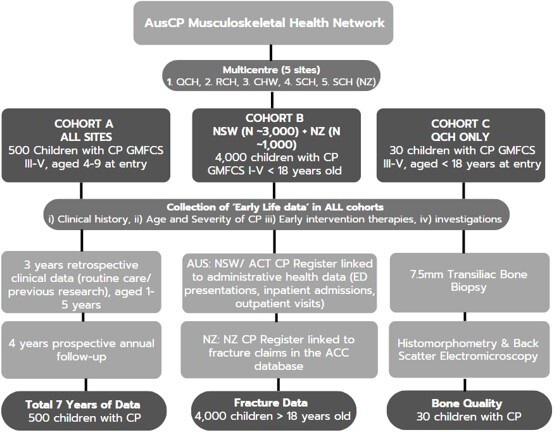 Figure 1
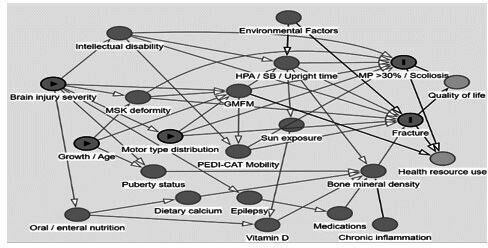 Figure 2
Peer Reviews
No public reviews on file for this paper yet. If you reviewed it on a platform where reviews are public (OpenReview, ICLR, NeurIPS, ICML), you can paste yours below so the community can read it here.
Videos
No videos yet. Explain this paper in a talk, walkthrough, or lecture? Add one.
Taxonomy
TopicsCerebral Palsy and Movement Disorders · Hip disorders and treatments · Infant Development and Preterm Care