Preventing suicide with Safe Alternatives for Teens and Youths (SAFETY): a randomised feasibility trial
Moa Karemyr, Martin Bellander, Moa Pontén, Anna Ohlis, Oskar Flygare, Ylva Walldén, Ralf Kuja-Halkola, Gergö Hadlaczky, David Mataix-Cols, Joan Rosenbaum Asarnow, Clara Hellner, Jennifer L Hughes, Johan Bjureberg

TL;DR
This study tested a family-based therapy called SAFETY for youth with suicidal behavior and found it to be feasible and promising in reducing self-harm and improving mental health.
Contribution
The study introduces and evaluates SAFETY, a novel family-based cognitive behavioral treatment for youth suicidal behavior.
Findings
SAFETY showed high compliance and low attrition in treating youth with suicidal behavior.
Participants in SAFETY had significantly reduced non-suicidal self-injury compared to supportive therapy.
SAFETY was associated with moderate-to-large improvements in anxiety, depression, and emotion dysregulation.
Abstract
Suicide attempts are common in youth and have potentially lethal outcomes. Effective treatments targeting suicide attempts are scarce. To assess the feasibility and preliminary efficacy of a family-based cognitive behavioural treatment relative to an active control for youth with suicidal behaviour. 30 youths (93% female; mean (SD) age=14.6 (1.5) years) residing in Sweden with recent suicidal behaviour (last 3 months) and at least one available parent were randomised to 12 weeks of the family-based cognitive behavioural treatment Safe Alternatives for Teens and Youths (SAFETY) or supportive therapy, an active control treatment. Primary endpoint was 3-month post-treatment. Feasibility outcomes included treatment and assessment compliance, adverse events, treatment credibility and treatment satisfaction. Secondary outcomes included suicide attempt, non-suicidal self-injury, anxiety,…
Genes, proteins, chemicals, diseases, species, mutations and cell lines named across the full text — each resolved to its canonical identifier and authoritative record.
Click any figure to enlarge with its caption.
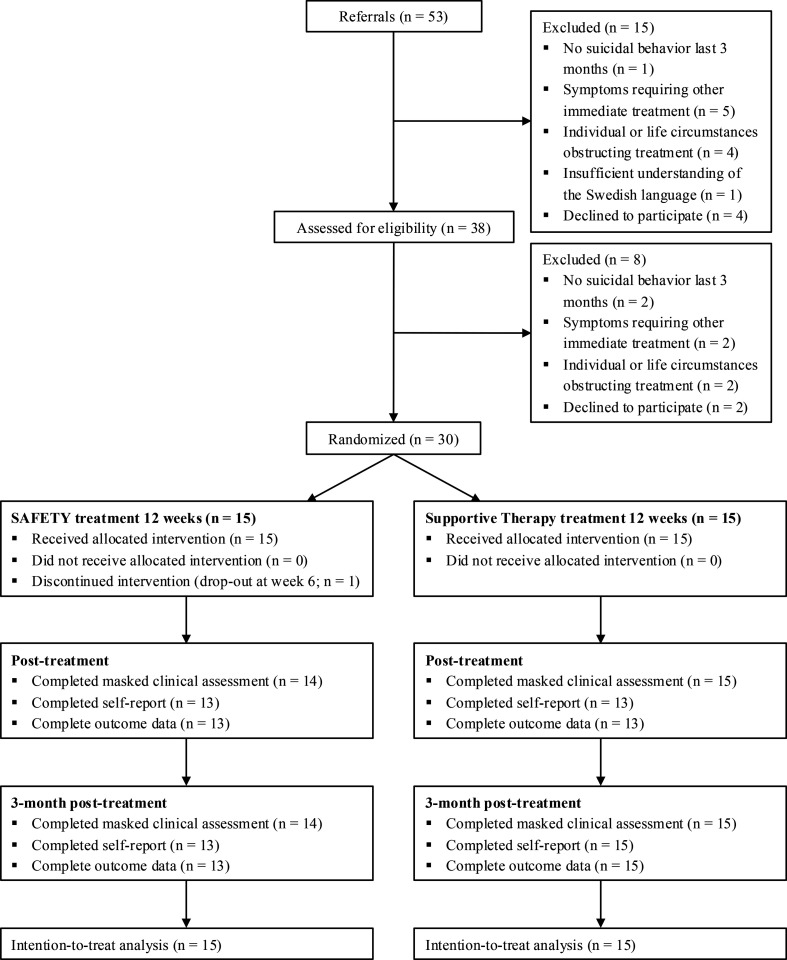 Figure 1
Peer Reviews
No public reviews on file for this paper yet. If you reviewed it on a platform where reviews are public (OpenReview, ICLR, NeurIPS, ICML), you can paste yours below so the community can read it here.
Videos
No videos yet. Explain this paper in a talk, walkthrough, or lecture? Add one.
Taxonomy
TopicsSuicide and Self-Harm Studies · Child and Adolescent Psychosocial and Emotional Development · Resilience and Mental Health