The paradoxical GH response at OGTT does not predict Pasireotide efficacy but matters for glucose metabolism
G. Occhi, G. Voltan, S. Chiloiro, A. Bianchi, P. Maffei, F. Dassie, G. Mantovani, G. Del Sindaco, D. Ferone, F. Gatto, M. Losa, S. Cannavò, C. Scaroni, F. Ceccato

TL;DR
This study finds that a paradoxical GH response during an oral glucose test does not predict how well pasireotide treats acromegaly but is linked to worse glucose metabolism.
Contribution
The study clarifies that GH-Par does not predict pasireotide efficacy but is associated with glucose metabolism changes.
Findings
Pasireotide effectively reduced IGF-1 levels in most patients regardless of GH-Par status.
GH-Par patients had a higher risk of glucose metabolism alterations after pasireotide treatment.
Pre-existing glucose metabolism issues were more common in GH-Par patients.
Abstract
A paradoxical increase in GH after oral glucose load (GH-Par) characterizes about one-third of acromegaly patients and is associated with a better response to first-generation somatostatin receptor ligands (fg-SRLs). Pasireotide is typically considered as a second-/third-line treatment. Here, we investigated the predictive role of GH-Par in pasireotide response and adverse event development. we collected a multicenter Italian retrospective cohort of 59 patients treated with pasireotide for at least 3 months, all having GH profile from OGTT. IGF-1 normalization or at least 30% reduction at the last follow-up visit defined a responder patient. Considering the entire cohort, median IGF-1 levels before pasireotide (available in 57 patients) were 1.38 times the upper limit of normal (ULN) in patients with large (median size 18 mm) and invasive (82%) adenomas after failure of fg-SRL…
Genes, proteins, chemicals, diseases, species, mutations and cell lines named across the full text — each resolved to its canonical identifier and authoritative record.
Click any figure to enlarge with its caption.
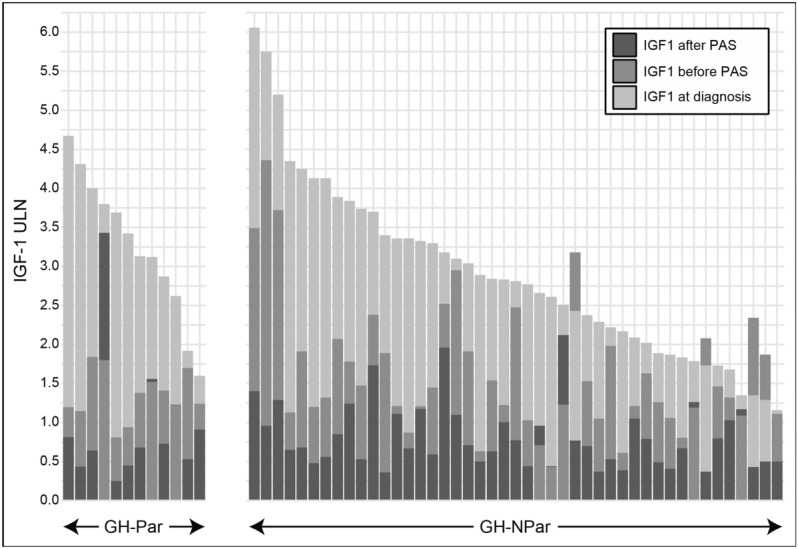 Figure 1
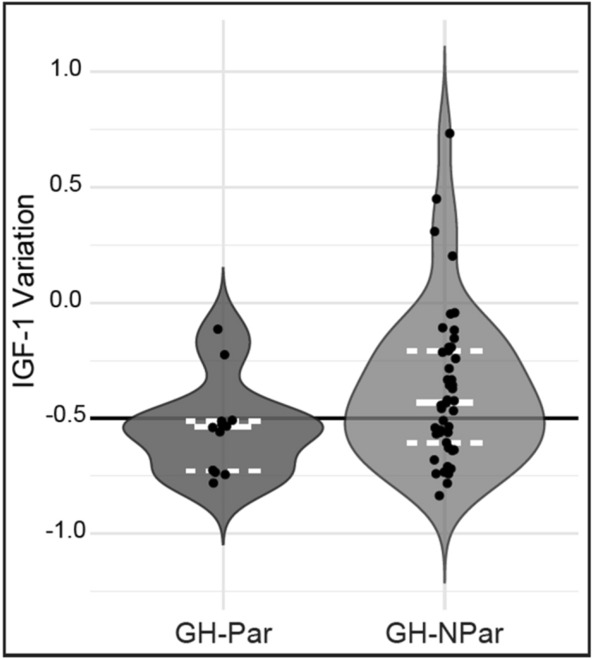 Figure 2
Peer Reviews
No public reviews on file for this paper yet. If you reviewed it on a platform where reviews are public (OpenReview, ICLR, NeurIPS, ICML), you can paste yours below so the community can read it here.
Videos
No videos yet. Explain this paper in a talk, walkthrough, or lecture? Add one.
Taxonomy
TopicsPituitary Gland Disorders and Treatments · Growth Hormone and Insulin-like Growth Factors · Neuroendocrine Tumor Research Advances