A rare image of zinc-responsive acral hyperkeratosis
Abhishek Patil, Sourabh Deshmukh

Abstract
Genes, proteins, chemicals, diseases, species, mutations and cell lines named across the full text — each resolved to its canonical identifier and authoritative record.
Click any figure to enlarge with its caption.
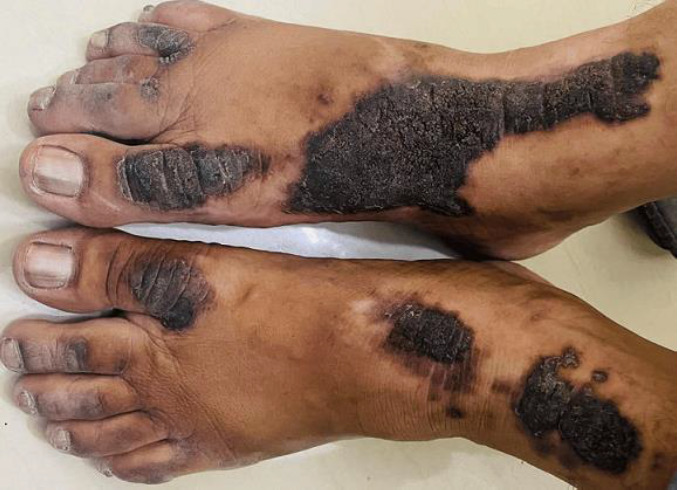 Figure 1
Peer Reviews
No public reviews on file for this paper yet. If you reviewed it on a platform where reviews are public (OpenReview, ICLR, NeurIPS, ICML), you can paste yours below so the community can read it here.
Videos
No videos yet. Explain this paper in a talk, walkthrough, or lecture? Add one.
Taxonomy
TopicsGenetic and rare skin diseases. · RNA regulation and disease · Trace Elements in Health
Image in medicine
Acral hyperkeratosis that responds to zinc usually manifests as symmetrically distributed, long-lasting, well-defined hyperpigmented plaques over the acral areas of the body. It is a condition that causes thickening of the skin on the hands and feet. Zinc deficiency can be a cause of acral hyperkeratosis. A 50-year-old man came in with a six-month-old, slightly itchy, scaly, raised lesion over both feet which were darkly coloured and somewhat irritating. A cutaneous examination of the dorsum of the feet revealed bilaterally symmetrical, well-demarcated hyperpigmented plaques. The patient was treated using oral zinc with 200mg of zinc sulfate twice daily and 10% urea-containing emollient for local application. He got significant relief from raised lesions and hyperpigmented plaques.
feet with raised lesions and hyperpigmented plaques