Hypertrichosis Cubiti Presenting in a Female Child: A Case Report
Matthew K Mlachak, Michelle A Jahnke

TL;DR
A six-year-old girl with a sacral cleft developed unusual hair growth around her elbows, which was managed with common hair removal methods.
Contribution
This paper presents a rare case of hypertrichosis cubiti in a pediatric patient with a sacral cleft.
Findings
Hypertrichosis cubiti was observed in a six-year-old female with a sacral cleft.
Terminal hair growth around the elbows was managed using depilatory creams and shaving.
The patient showed no other health abnormalities apart from the sacral cleft.
Abstract
Hypertrichosis cubiti is a rare form of unusual hair growth in the arms around the elbow area. Here, we report a case of hypertrichosis cubiti in a six-year-old female child with a sacral cleft, otherwise of normal health. Specifically, terminal hair growth was observed in this case. The excessive hair growth often poses aesthetic concerns for patients and can be treated to avoid emotional distress regarding physical appearance. Management of the condition typically involves common hair removal techniques, and over-the-counter depilatory creams and shaving were used to treat this case.
Genes, proteins, chemicals, diseases, species, mutations and cell lines named across the full text — each resolved to its canonical identifier and authoritative record.
Click any figure to enlarge with its caption.
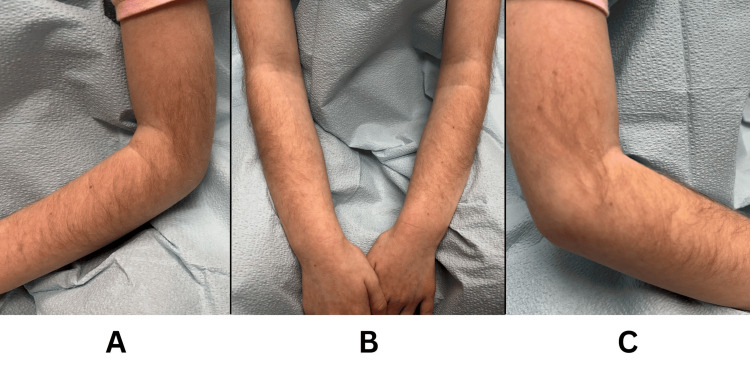 Figure 1
Peer Reviews
No public reviews on file for this paper yet. If you reviewed it on a platform where reviews are public (OpenReview, ICLR, NeurIPS, ICML), you can paste yours below so the community can read it here.
Videos
No videos yet. Explain this paper in a talk, walkthrough, or lecture? Add one.
Taxonomy
TopicsHair Growth and Disorders · Dermatologic Treatments and Research · Oral Health Pathology and Treatment
Introduction
Hypertrichosis cubiti, commonly known as “hairy elbow syndrome”, is a highly underreported condition in biomedical literature. It can be identified through the appearance of excessive hair growth on the lateral aspects of the lower third of the upper arm and the upper third of the forearm. The first reported case was identified in 1970 by Beighton in a young female whose maximum hair growth was noted at the age of five, with the condition becoming less visible as she aged [1]. Hypertrichosis cubiti has previously been identified to accompany genetic conditions such as Wiedemann-Steiner syndrome [2], although the condition has been seen to manifest independently [3]. Here, we present the infrequent condition, hypertrichosis cubiti, in a six-year-old female child.
Case presentation
A six-year-old female child presented with long terminal hair growth on the extensor surfaces of the regions starting at her forearms and through the upper arms, with the highest concentration of hair growth around the elbow (Figures 1A, 1C). The growth was bilateral and symmetric (Figure 1B). Upon examination, no other abnormal hair growth was observed in the upper extremities of the female. The hair growth was first noticed by the mother at the age of three, with growth progressing over time. The mother reported the patient pulling out the hair at a younger age, with the hair growing back rapidly. No family history of hypertrichosis was reported. Interestingly, a sacral cleft was discovered, but no other physical or mental abnormalities were observed in the female. Furthermore, the patient did not appear to be of short stature and was identified in a normal percentile of growth. The main concern of the patient was the removal of the hair due to its abnormal quantity. Additionally, the patient and mother voiced their preference for the use of temporary removal options. Thus, the recommended treatment for the patient was the use of shaving and over-the-counter chemical hair removal creams containing potassium thioglycolate and calcium hydroxide when hair growth is noticed. For safety purposes, the mother was instructed to apply the cream on the patient due to her young age. No complications or skin sensitivities have been reported thus far with treatment.
Hypertrichosis cubiti on the extensor surfaces of the regions between the forearms and upper arms(A) left arm, (B) bilateral, (C) right arm
Discussion
Hypertrichosis cubiti is an underreported dermatological condition that is identified by terminal or vellus hair growth on the extensor surface of the bottom portion of the upper arm and the upper portion of the forearm. The condition may present with other symptoms such as short stature and facial abnormalities, often due to underlying conditions such as Wiedemann-Steiner syndrome, or by itself [2-6]. In most reported cases, hair growth peaks within childhood, then progressively thins towards the end of adolescence. In the case presented, a similar hair growth progression was reported at the time of examination, although no hair growth regression has been observed thus far, most likely due to the young age of the patient.
The excessive hair growth characterized by hypertrichosis cubiti itself does not pose a threat to the overall health of a patient. In fact, its presence alone can be classified as a cosmetic issue of interest, granted it does not present as a part of an underlying condition [6]. Treatment options for the condition mainly consist of hair removal procedures such as shaving, trimming, waxing, laser removal, and, in some cases, electrolysis [7]. If depilatory creams are selected as a treatment, application instructions provided with the product should be followed closely, and application should be supervised by an adult. It is important to note that hair color and texture may pose a limit on the treatment method used.
In the current case, the patient with hypertrichosis cubiti also presented with a sacral cleft. Interestingly, in Wiedemann-Steiner syndrome, in which hypertrichosis cubiti is a common symptom, between one-quarter and one-third of patients also report a sacral cleft [8]. Since the patient in the current report did not present with any other common symptoms of Wiedemann-Steiner syndrome and no family history of the condition was reported, genetic testing for the condition was not explored. Nevertheless, Pavone and others reported a case of hypertrichosis cubiti in a patient without Wiedemann-Steiner syndrome in which vertebral abnormalities were discovered [9]. Thus, an association between bone anomalies and hypertrichosis cubiti should be explored in patients without underlying genetic conditions. Without any immediate health concerns, the patient in this report will continue temporary hair removal treatments for hair growth management, with the hope that hair growth will regress towards the end of adolescence.
Conclusions
A six-year-old female child presented with hypertrichosis cubiti in a bilateral, symmetric form. No excessive hair growth was noted anywhere else on the patient. The female presented with a sacral cleft, but no other abnormalities were reported, and normal stature was observed. The main concern of the patient was the appearance of excessive hair growth, and temporary hair removal treatment options such as shaving and chemical hair removal were recommended.
The reference list from the paper itself. Each links out to its DOI / PubMed record.
- 1Familial hypertrichosis cubiti: hairy elbows syndrome J Med Genet Beighton P 15816071970551960310.1136/jmg.7.2.158PMC 1468803 · doi ↗ · pubmed ↗
- 2Wiedemann-Steiner syndrome with 2 novel KMT 2A mutations J Child Neurol Min Ko J Cho JS Yoo Y 2372423220172777732710.1177/0883073816674095 · doi ↗ · pubmed ↗
- 3Hypertrichosis cubiti: another case of a well-recognized but under-reported entity Pediatr Dermatol Martínez de Lagrán Z González-Pérez R Asunción Arregui-Murua M Soloeta-Arechavala R 3103112720102060915910.1111/j.1525-1470.2010.01148.x · doi ↗ · pubmed ↗
- 4Hypertrichosis of the elbows [Article in French]Ann Dermatol Venereol Plantin P Le Roux P Larzul C Le Noac'h E Guillet G 7017031201993 https://www.ncbi.nlm.nih.gov/pubmed/81611028161102 · pubmed ↗
- 5Hairy elbows [Letter to the Editor]Arch Dermatol Warner TF 191161980
- 6Hairy elbows Cutis Rudolph RI 69361985 https://www.ncbi.nlm.nih.gov/pubmed/40176574017657 · pubmed ↗
- 7Causes and management of hypertrichosis Am J Clin Dermatol Trüeb RM 617627320021244480410.2165/00128071-200203090-00004 · doi ↗ · pubmed ↗
- 8Wiedemann-Steiner syndrome: a rare differential diagnosis of neurodevelopmental delay and dysmorphic features J Pediatr Genet Carman KB Kaplan E Aslan CN Kocagil S Cilinigr O Yarar C 1621641120223576995510.1055/s-0040-1716709 PMC 9236732 · doi ↗ · pubmed ↗