HIV-1 reverse transcriptase subtyping revealed CRF35-AD as a current subtype in the northeast of Iran
Zahra Mazaheri, Masoud Youssefi

TL;DR
This study identifies CRF35-AD as the most common HIV-1 subtype in northeast Iran and finds treatment discontinuation and duration correlate with increased drug resistance mutations.
Contribution
The study reports CRF35-AD as a current prevalent HIV-1 subtype in northeast Iran and links treatment patterns to mutation increases.
Findings
CRF35-AD was the most prevalent HIV-1 subtype (88.6%) in the studied population.
Treatment discontinuation and duration were significantly correlated with increased mutations (r=0.621 and r=0.452, respectively).
Abstract
Previously, the sequence of the HIV-1 reverse transcriptase gene was analyzed to identify mutations associated with drug resistance. We statistically analyzed the relationship between a set of additional data and increasing mutations. Existing sequences were also phylogenetically analyzed. Of all patients tested for phylogenetic tree analysis, one individual had the F subtype, two had the CRF01-AE strain, and two had the A subtype. Phylogenetic tree analysis revealed that HIV-1 CRF35-AD was the most prevalent subtype (88.6%) among the cases studied. The number of treatment discontinuations (r=0.621, df=20, p=0.002) and the duration of treatment (r=0.452, df=20, p=0.035) were significantly correlated with an increase in mutations.
Genes, proteins, chemicals, diseases, species, mutations and cell lines named across the full text — each resolved to its canonical identifier and authoritative record.
Click any figure to enlarge with its caption.
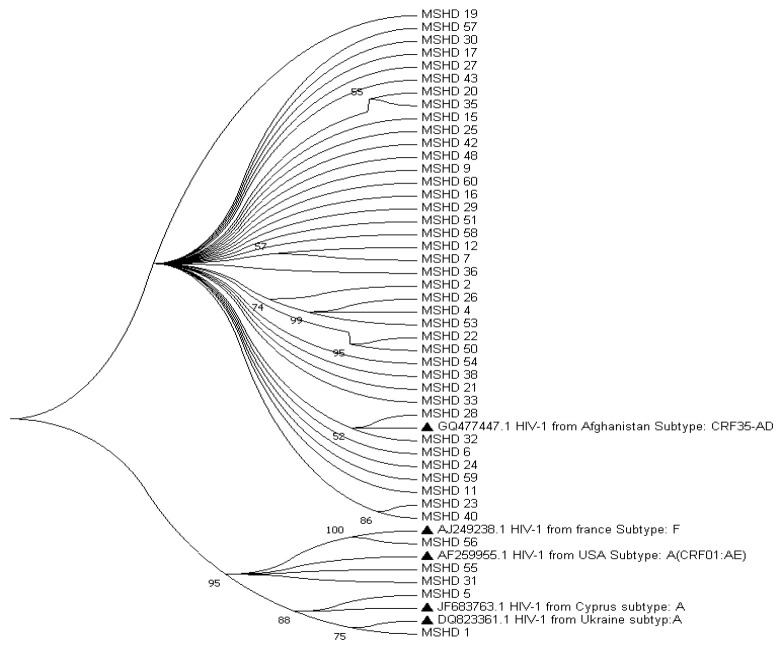 Figure 1
Peer Reviews
No public reviews on file for this paper yet. If you reviewed it on a platform where reviews are public (OpenReview, ICLR, NeurIPS, ICML), you can paste yours below so the community can read it here.
Videos
No videos yet. Explain this paper in a talk, walkthrough, or lecture? Add one.
Taxonomy
TopicsHIV, Drug Use, Sexual Risk · Hepatitis C virus research