Creating a Usable and Effective Digital Intervention to Support Men to Test for HIV and Link to Care in A Resource-Constrained Setting: Iterative Design Based on A Person-Based Approach and Human Computer Interaction Methods
Anya Zeitlin, Thulile Mathenjwa, Thembelihle Zuma, Sally Wyke, Philippa Matthews, Nuala McGrath, Janet Seeley, Maryam Shahmanesh, Ann Blandford

TL;DR
This paper describes the development of a digital health app to encourage HIV testing and care among men in rural South Africa, using a combination of user-centered design and iterative testing methods.
Contribution
The paper introduces a combined approach of the person-based approach and human-computer interaction methods for designing effective digital health interventions in resource-limited settings.
Findings
The person-based approach helped define content and key messages but was insufficient for ensuring usability.
Iterative testing with local participants improved the app's usability and clarity for users with low digital literacy.
Combining PBA with HCI methods led to a more inclusive and effective digital intervention for hard-to-reach populations.
Abstract
It is challenging to design usable and effective digital health interventions (DHIs). The person-based approach (PBA) has been proposed to incorporate users’ perspectives for the design of DHIs. However, it does not explicitly describe the iterative stages of design and evaluation that are essential in moving from early planning to deployment. For this, we draw on methods from human computer interaction (HCI) that have been developed for various situations. This study aimed to reflect on the adaptation and synthesis of PBA and HCI approaches to developing DHIs. We present a case study applying both approaches to develop Empowering People through Informed Choices for HIV (EPIC-HIV1), a DHI designed for men living in rural KwaZulu-Natal, South Africa, intended to support them in making an informed choice about whether to take an HIV test and, if necessary, engage in care. We conducted a…
Genes, proteins, chemicals, diseases, species, mutations and cell lines named across the full text — each resolved to its canonical identifier and authoritative record.
Click any figure to enlarge with its caption.
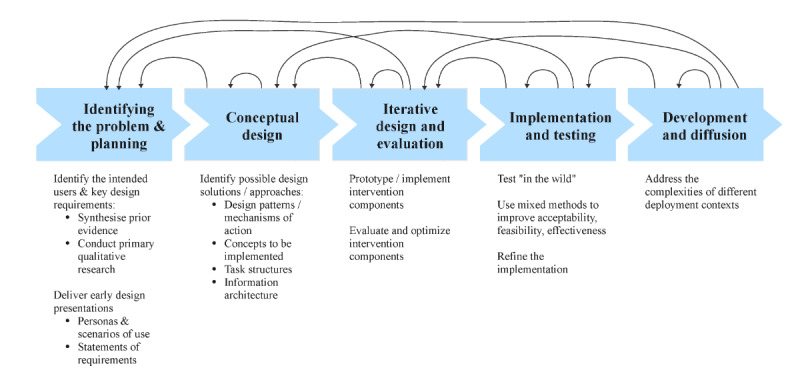 Figure 1
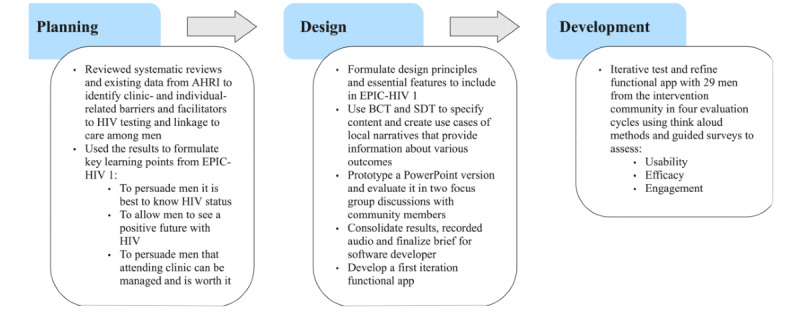 Figure 2
 Figure 3
 Figure 4
 Figure 5
 Figure 6
Peer Reviews
No public reviews on file for this paper yet. If you reviewed it on a platform where reviews are public (OpenReview, ICLR, NeurIPS, ICML), you can paste yours below so the community can read it here.
Videos
No videos yet. Explain this paper in a talk, walkthrough, or lecture? Add one.
Taxonomy
TopicsICT in Developing Communities · Mobile Health and mHealth Applications · Innovative Human-Technology Interaction