Impact of Pre-lockdown Hyper-energy on Mood and Rhythm Dysregulation in Older Adults During the COVID-19 Pandemic
Diego Primavera, Goce Kalcev, Fabrizio Bert, Elisa Cantone, Alessandra Perra, Massimo Tusconi, Samantha Pinna, Germano Orrù, Alessandra Scano, Enzo Tramontano, Ivan Barbov, Marcello Nonnis, Antonio Egidio Nardi, Giulia Cossu, Federica Sancassiani, Mauro Giovanni Carta

TL;DR
Older adults with hyper-energy before lockdown showed worse mood and rhythm regulation during the pandemic compared to those without hyper-energy.
Contribution
The study identifies a link between pre-lockdown hyper-energy and increased vulnerability to mood and rhythm dysregulation during lockdown in older adults.
Findings
Individuals with pre-lockdown hyper-energy showed significantly higher increases in rhythm dysregulation and depressive symptoms during lockdown.
A strong inverse correlation was found between perceived energy and depressive symptoms, especially during lockdown.
Those who no longer had hyper-energy at T1 still showed greater increases in BSRS and PHQ-9 scores compared to those without hyper-energy.
Abstract
The aim of this work is to verify whether a cohort of elderly people with hyper-energy tended to increase depressive symptoms and misaligned social and personal rhythms during the lockdown compared to a cohort of older adults without hyper-energy one year before the lockdown. The two cohorts were evaluated in April 2019 (T0) and in April 2020 (T1). Hyper-energy, cognitive performance, depressive symptoms, and social and personal rhythms were evaluated at T0 and T1. In the measure of the Brief Social Rhythm Scale (BSRS) score, the differences between groups in the two observation times reach statistical significance. The sub-group with previous hyper-energy at T0 but no longer having hyper-energy at T1 increases the score by more than 5 points (a higher score indicates greater rhythm dysregulation, thus having a worse regulation of rhythms at T1), while in those individuals who didn’t…
Genes, proteins, chemicals, diseases, species, mutations and cell lines named across the full text — each resolved to its canonical identifier and authoritative record.
Click any figure to enlarge with its caption.
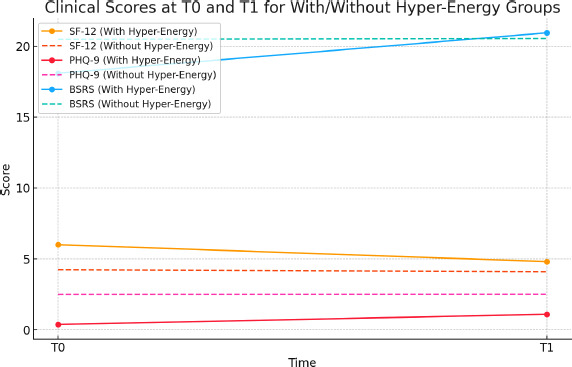 Figure 1
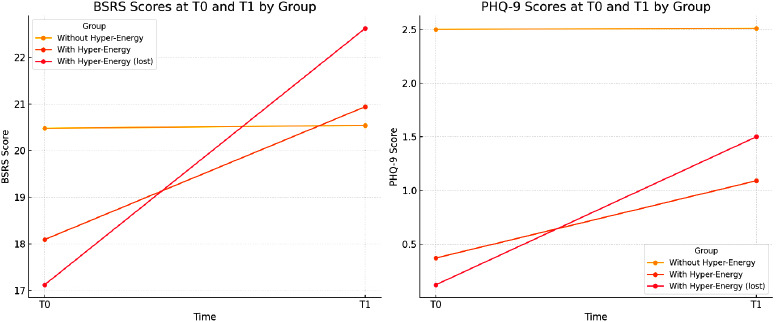 Figure 2
Peer Reviews
No public reviews on file for this paper yet. If you reviewed it on a platform where reviews are public (OpenReview, ICLR, NeurIPS, ICML), you can paste yours below so the community can read it here.
Videos
No videos yet. Explain this paper in a talk, walkthrough, or lecture? Add one.
Taxonomy
TopicsHeart Rate Variability and Autonomic Control · COVID-19 and Mental Health · Circadian rhythm and melatonin