“Don’t You Love Me?” Abusers’ use of shame-to-guilt to coercively control 2SLGBTQQIA+ individuals and rural women experiencing intimate partner violence
Stefan Kurbatfinski, Nicole Letourneau, Jason Novick, Susanne Marshall, Keira Griggs, Dawn McBride, Kendra Nixon

TL;DR
The study explores how abusers use shame and guilt to control 2SLGBTQQIA+ individuals and rural women in abusive relationships, highlighting unique tactics tied to their identities.
Contribution
This study is the first to explore shame-to-guilt tactics in intimate partner violence specifically among 2SLGBTQQIA+ and rural women populations.
Findings
Abusers use identity-based shaming related to gender and sexual orientation differently for 2SLGBTQQ+ and rural women.
Threats of suicide and manipulation through parenting and health conditions are common tactics.
Recommendations are provided to help survivors rebuild their identities after experiencing shame-to-guilt abuse.
Abstract
Abusers’ use of manipulative behaviors to trigger feelings of shame-to-guilt (a process through which abusers shame their partners to incur feelings of guilt) among their 2SLGBTQQIA+ and rural women intimate partners is a type of emotional abuse used to coercively control their partners. This study investigated the different tactics that abusers use to shame-to-guilt their partners who identify as 2SLGBTQQIA+ and/or reside in rural areas. A qualitative design was used to conduct this study. We used data from two larger studies to undertake thematic analysis using semi-structured interviews with Albertan 2SLGBTQQ+ (n = 18; no participants identified as intersex or asexual) and rural women (n = 11) who experienced shame-to-guilt behaviors along with service providers who worked with these groups (n = 24). Seven themes were identified based on participants’ experiences, including…
Genes, proteins, chemicals, diseases, species, mutations and cell lines named across the full text — each resolved to its canonical identifier and authoritative record.
Click any figure to enlarge with its caption.
 Figure 1
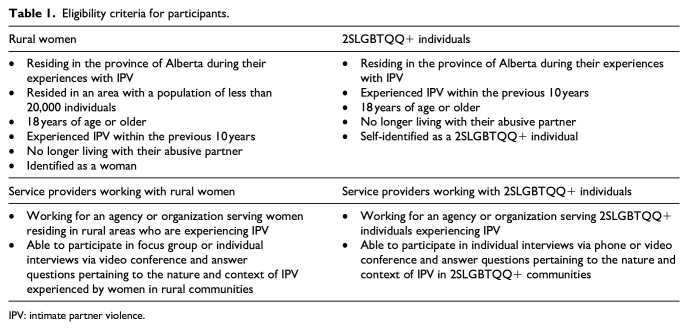 Figure 2
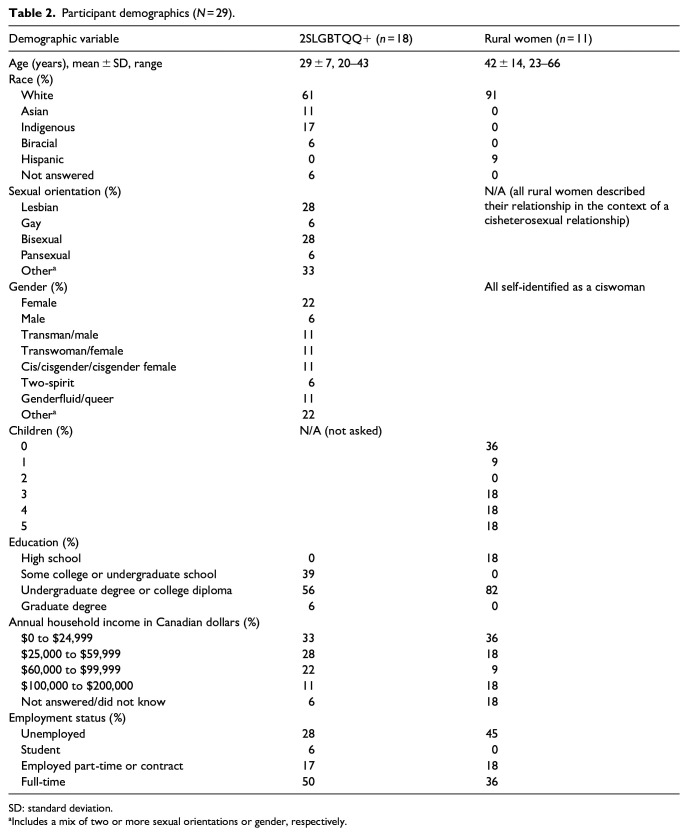 Figure 3
Peer Reviews
No public reviews on file for this paper yet. If you reviewed it on a platform where reviews are public (OpenReview, ICLR, NeurIPS, ICML), you can paste yours below so the community can read it here.
Videos
No videos yet. Explain this paper in a talk, walkthrough, or lecture? Add one.
Taxonomy
TopicsIntimate Partner and Family Violence · Marriage and Sexual Relationships · Homicide, Infanticide, and Child Abuse