Cardiovascular magnetic resonance imaging markers of ageing: a multi-centre, cross-sectional cohort study
Hosamadin S Assadi, Xiaodan Zhao, Gareth Matthews, Rui Li, Jordi Broncano Cabrero, Bahman Kasmai, Samer Alabed, Javier Royuela Del Val, Hilmar Spohr, Yashoda Gurung-Koney, Nay Aung, Sunil Nair, Andrew J Swift, Vassilios S Vassiliou, Liang Zhong, Abdallah Al-Mohammad

TL;DR
This study uses automated cardiac MRI to track age-related heart changes and predict functional heart age in healthy and unhealthy aging.
Contribution
A fully automated CMR model to predict functional heart age, validated across healthy and diseased populations.
Findings
CMR-derived functional heart age matched chronological age in healthy individuals.
Functional heart age was significantly higher than chronological age in patients with hypertension, diabetes, and atrial fibrillation.
The model showed higher functional heart age in obesity classes II and III.
Abstract
Cardiac ageing involves a series of anatomical and physiological changes contributing to a decline in overall performance. Cardiac magnetic resonance (CMR) provides comprehensive structural and functional assessment for detecting age-related cardiovascular remodelling. We aimed to develop a fully automated CMR model to predict functional heart age. This international, multi-centre, retrospective observational study enrolled 191 healthy individuals with normal body mass index (BMI), free of metabolic, cardiovascular, and respiratory disease as the derivation cohort. Left atrial (LA) end-systolic volume and LA ejection fraction were selected for the final model. The model was validated on 366 patients with BMI >25 kg/m2 and one or more comorbidities [hypertension, diabetes mellitus (DM), atrial fibrillation (AF), and obesity]. In healthy individuals [median age: 34 years, 105 (55%)…
Genes, proteins, chemicals, diseases, species, mutations and cell lines named across the full text — each resolved to its canonical identifier and authoritative record.
Click any figure to enlarge with its caption.
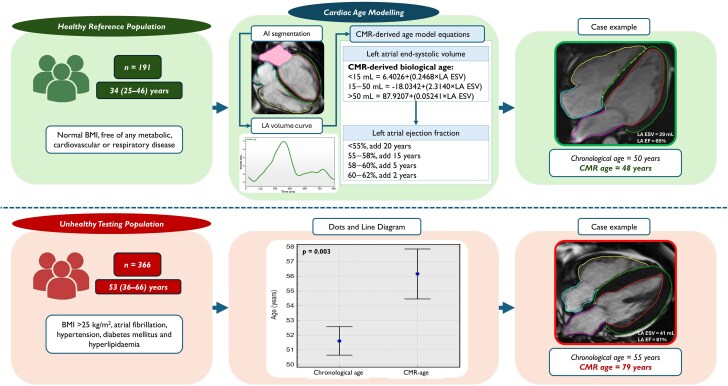 Figure 1
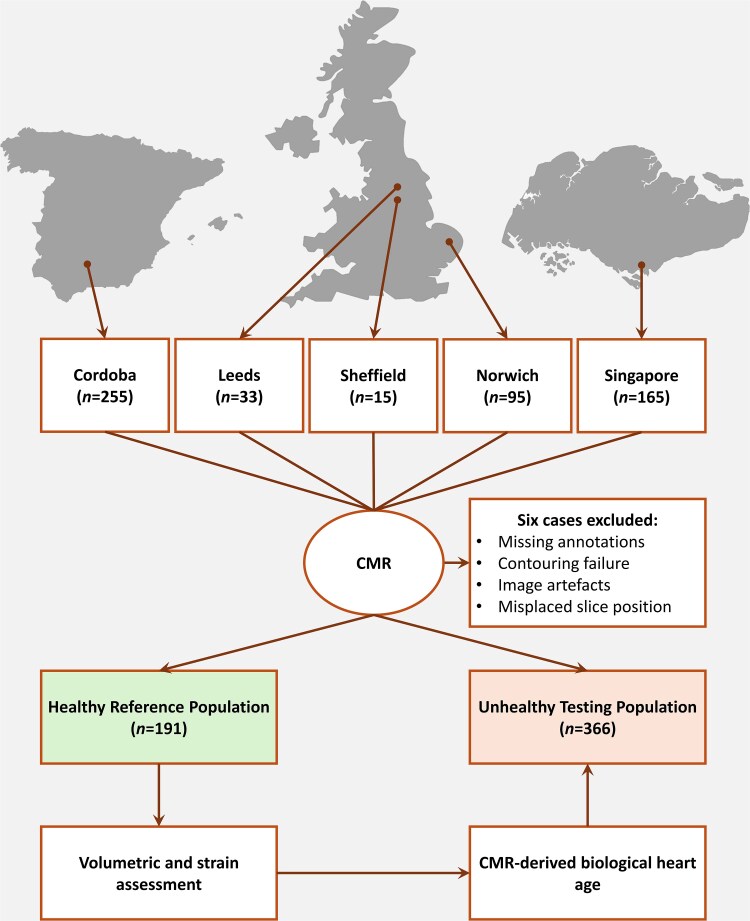 Figure 2
 Figure 3
 Figure 4
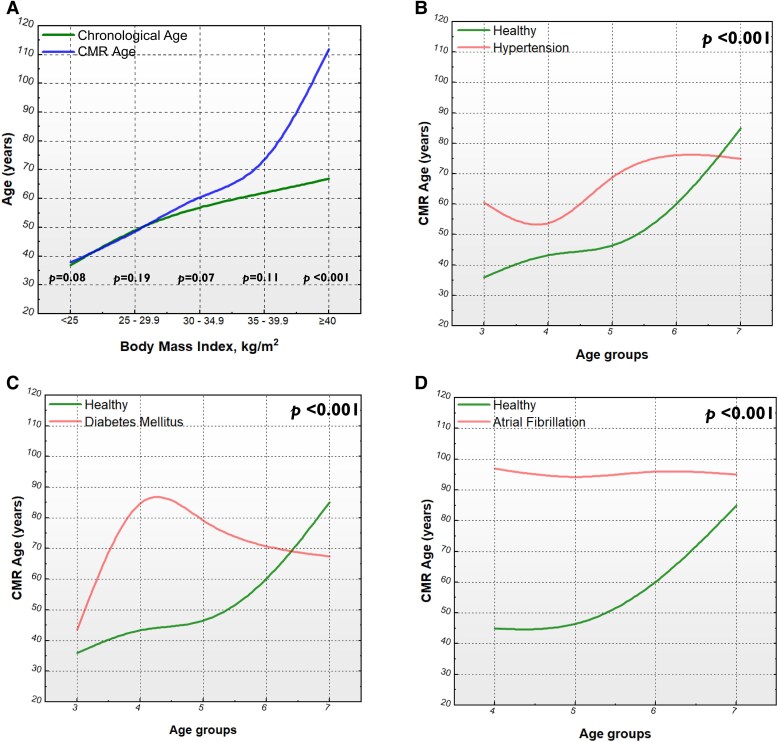 Figure 5
 Figure 6
Peer Reviews
No public reviews on file for this paper yet. If you reviewed it on a platform where reviews are public (OpenReview, ICLR, NeurIPS, ICML), you can paste yours below so the community can read it here.
Videos
No videos yet. Explain this paper in a talk, walkthrough, or lecture? Add one.
Taxonomy
TopicsCardiac Imaging and Diagnostics · Cardiovascular Function and Risk Factors · Cardiovascular Disease and Adiposity