Mosquito-Based Detection of Endogenous Jaagsiekte Sheep Retrovirus in Senegal: Expanding the Scope of Xenosurveillance
Marie Henriette Dior Ndione, El Hadji Ndiaye, Madeleine Dieng, Babacar Diouf, Safietou Sankhé, Diawo Diallo, Mouhamed Kane, Ndeye Marie Sene, Maimouna Mbanne, Faty Amadou Sy, Seynabou Mbaye Ba Souna Diop, Serge Freddy Moukaha Doukanda, Amadou Alpha Sall, Ousmane Faye, Ndongo Dia

TL;DR
Mosquitoes in Senegal were found to carry genetic traces of a sheep retrovirus, showing they can detect host and pathogen material in ecosystems.
Contribution
First detection of endogenous Jaagsiekte Sheep Retrovirus (enJSRV) in mosquitoes using xenosurveillance.
Findings
JSRV-related sequences were detected in a blood-fed mosquito pool from Barkedji, Senegal.
Phylogenetic analysis showed the sequence was similar to endogenous JSRV in sheep genomes.
Mosquitoes can capture host-derived retroviral material and pathogenic viruses through bloodmeals.
Abstract
Mosquitoes are well-known vectors for arthropod-borne viruses, yet their role as passive carriers of non-arthropod-borne viruses remains underexplored. Xenosurveillance, a method that utilizes blood-feeding arthropods to sample host and pathogen genetic material, has emerged as a valuable tool in viral ecology. In this study, we report the first identification of Jaagsiekte Sheep Retrovirus (JSRV)-related sequences in blood-fed mosquitoes collected in Senegal. JSRV, a betaretrovirus responsible for ovine pulmonary adenocarcinoma, is typically found in sheep, but its genetic trace in mosquitoes offers a novel perspective on host–vector contact and surveillance. Our study aimed to investigate whether mosquitoes can serve as sentinels for detecting both pathogens and host-derived markers in complex ecosystems. Mosquitoes were collected between 2016 and 2019 from three ecologically…
Genes, proteins, chemicals, diseases, species, mutations and cell lines named across the full text — each resolved to its canonical identifier and authoritative record.
Click any figure to enlarge with its caption.
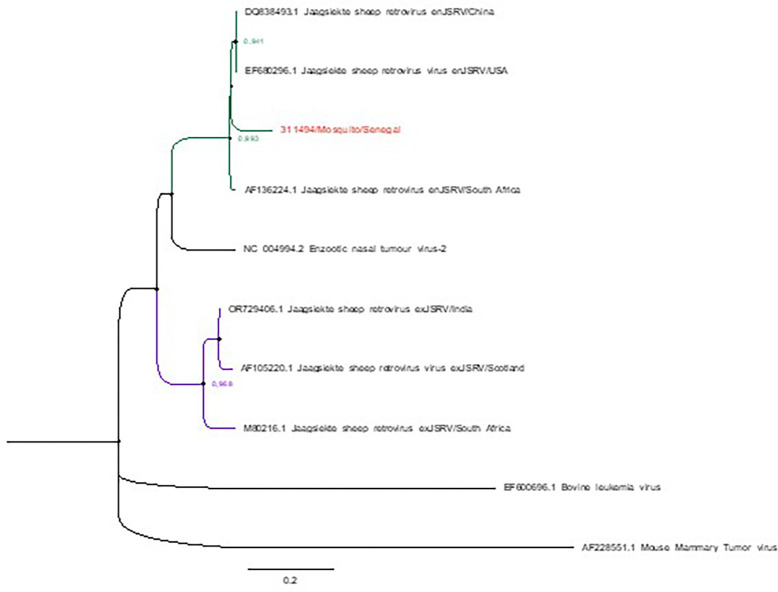 Figure 1
Peer Reviews
No public reviews on file for this paper yet. If you reviewed it on a platform where reviews are public (OpenReview, ICLR, NeurIPS, ICML), you can paste yours below so the community can read it here.
Videos
No videos yet. Explain this paper in a talk, walkthrough, or lecture? Add one.
Taxonomy
TopicsInsect symbiosis and bacterial influences · Insect-Plant Interactions and Control · Forest Insect Ecology and Management