Provincial distribution and factors associated with high completed fertility among married and cohabiting women aged 40–49 years in Sierra Leone: a cross-sectional study
Augustus Osborne, Alhaji Mustapha Abu, Hassan S Rogers, Florence Gyembuzie Wongnaah, Bright Opoku Ahinkorah

TL;DR
This study finds that over 60% of married or cohabiting women in Sierra Leone have high fertility, with factors like partner education, wealth, and contraceptive use playing a role.
Contribution
The study identifies geographic and socioeconomic factors associated with high fertility in Sierra Leone using national survey data.
Findings
The national prevalence of high completed fertility among married and cohabiting women in Sierra Leone was 61.7%.
Women in the Northern province had lower odds of high fertility compared to those in the Eastern province.
Contraceptive use and higher partner education were associated with lower odds of high fertility.
Abstract
High completed fertility among married and cohabiting women has significant implications, such as burden on resources, exacerbating healthcare issues and educational and gender disparities. This study examined the provincial distribution and factors associated with high completed fertility among married and cohabiting women aged 40–49 y in Sierra Leone. Data for the study were sourced from the 2019 Sierra Leone Demographic and Health Survey. Our study comprised 2253 married and cohabiting women aged 40–49 y in Sierra Leone. Geographic variations in high fertility were presented using a spatial map. A mixed-effect multilevel binary logistic regression analysis was performed to identify the factors associated with high completed fertility. The findings were presented as adjusted ORs (aOR) with 95% confidence intervals (CIs). The national prevalence of high completed fertility among…
Genes, proteins, chemicals, diseases, species, mutations and cell lines named across the full text — each resolved to its canonical identifier and authoritative record.
Click any figure to enlarge with its caption.
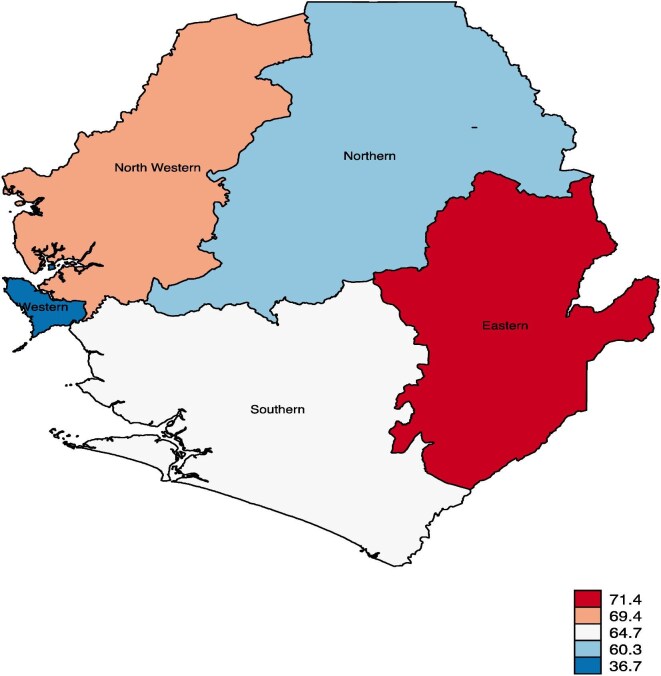 Figure 1
Peer Reviews
No public reviews on file for this paper yet. If you reviewed it on a platform where reviews are public (OpenReview, ICLR, NeurIPS, ICML), you can paste yours below so the community can read it here.
Videos
No videos yet. Explain this paper in a talk, walkthrough, or lecture? Add one.
Taxonomy
TopicsGlobal Maternal and Child Health · Demographic Trends and Gender Preferences · Family Dynamics and Relationships