Rapid Transmission and Divergence of Vancomycin-Resistant Enterococcus faecium Sequence Type 80, China
Liqiang Li, Xingwei Wang, Yanyu Xiao, Bing Fan, Jiehong Wei, Jie Zhou, Zetian Lai, Yanpeng Zhang, Hongmei Mo, Li Zhang, Dixian Luo, Dayong Gu, Shucai Yang, Yidi Wang, Jiuxin Qu

TL;DR
This study examines how vancomycin-resistant Enterococcus faecium evolved and spread during an outbreak in China.
Contribution
The study reveals how genomic divergence and recombination drive the evolution of VREF during an outbreak.
Findings
Two VREF subpopulations diverged through insertion sequence–mediated recombination.
One subpopulation gained more antimicrobial resistance and carbohydrate metabolism genes.
Persistent transmission highlights the importance of genomic surveillance to control spread.
Abstract
We investigated genomic evolution of vancomycin-resistant Enterococcus faecium (VREF) during an outbreak in Shenzhen, China. Whole-genome sequencing revealed 2 sequence type 80 VREF subpopulations diverging through insertion sequence–mediated recombination. One subpopulation acquired more antimicrobial resistance and carbohydrate metabolism genes. Persistent VREF transmission underscores the need for genomic surveillance to curb spread.
Genes, proteins, chemicals, diseases, species, mutations and cell lines named across the full text — each resolved to its canonical identifier and authoritative record.
Click any figure to enlarge with its caption.
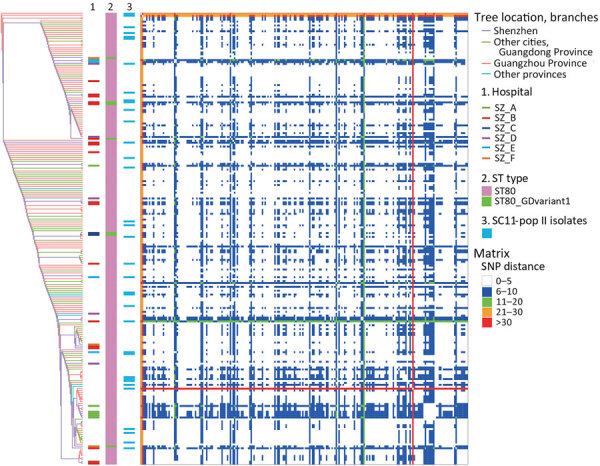 Figure 1
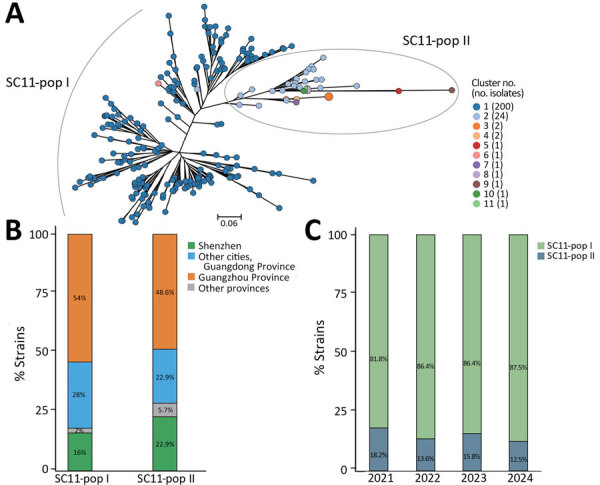 Figure 2
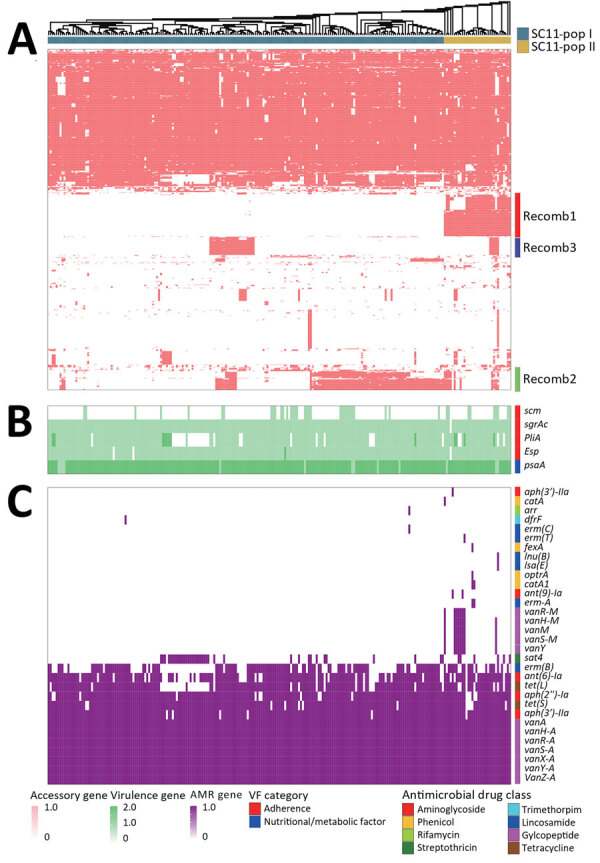 Figure 3
Peer Reviews
No public reviews on file for this paper yet. If you reviewed it on a platform where reviews are public (OpenReview, ICLR, NeurIPS, ICML), you can paste yours below so the community can read it here.
Videos
No videos yet. Explain this paper in a talk, walkthrough, or lecture? Add one.
Taxonomy
TopicsAntimicrobial Resistance in Staphylococcus · Bacterial Identification and Susceptibility Testing · Infective Endocarditis Diagnosis and Management