Triple-Rod Construct Approach for Severe Rigid Scoliosis: A Comprehensive Case Series
Thirumurugan Kurusamy, Mohamed Faizal B Abdul Manan, Dzulkarnain Amir, Fazir Mohamad

TL;DR
This study shows that the triple-rod surgical technique effectively corrects severe rigid scoliosis with minimal complications in a group of eight patients.
Contribution
The paper introduces the triple-rod technique as a novel surgical approach for correcting severe rigid scoliosis with improved stability and reduced complications.
Findings
The triple-rod technique achieved significant correction of coronal and sagittal spinal deformities in patients with severe rigid scoliosis.
No intra- or post-operative complications such as neurological deficits or hardware issues were observed in the eight patients treated.
The main thoracic curve showed the greatest improvement following the triple-rod surgical correction.
Abstract
Introduction and aim: Scoliosis is a complex three-dimensional deformity of the spine that leads to lateral curvature, rotation, and imbalance. The severity of scoliosis varies, ranging from mild cases requiring observation to severe, rigid deformities that may necessitate surgical intervention. The surgical management of severe rigid scoliosis carries with it several devastating complications, such as neurological injury, bleeding, implant failure, or loss of correction. The triple-rod technique is an advanced spinal instrumentation method for correcting severe and rigid scoliosis, involving the sequential placement of three rods to enhance deformity correction, reduce mechanical stress on the primary rods, and improve the stability of the construct. These are eight patients among many who presented with varying etiologies of severe rigid scoliosis, but were all treated with a…
Genes, proteins, chemicals, diseases, species, mutations and cell lines named across the full text — each resolved to its canonical identifier and authoritative record.
Click any figure to enlarge with its caption.
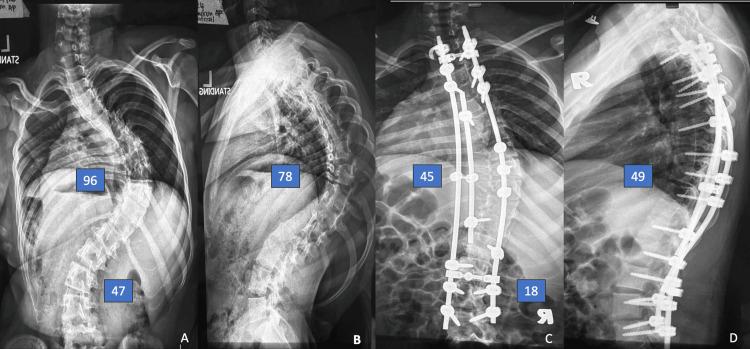 Figure 1
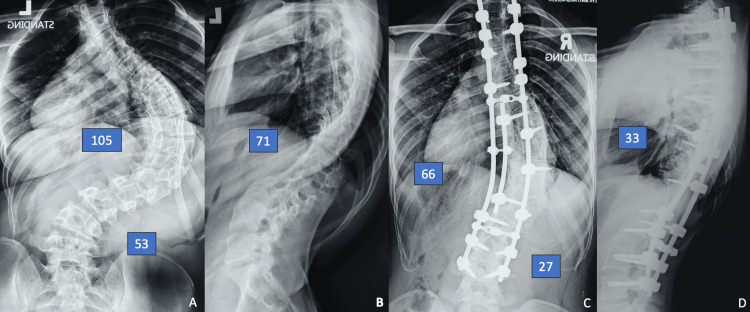 Figure 2
Peer Reviews
No public reviews on file for this paper yet. If you reviewed it on a platform where reviews are public (OpenReview, ICLR, NeurIPS, ICML), you can paste yours below so the community can read it here.
Videos
No videos yet. Explain this paper in a talk, walkthrough, or lecture? Add one.
Taxonomy
TopicsScoliosis diagnosis and treatment · Spinal Fractures and Fixation Techniques · Spine and Intervertebral Disc Pathology