Addicted to love? Validity evidence for the Love Addiction Inventory — Brazilian version
Daniela Zibenberg, Jean Carlos Natividade

TL;DR
This study adapts and validates a Brazilian version of a tool to measure addiction to romantic relationships.
Contribution
The study provides validity evidence for the Brazilian version of the Love Addiction Inventory.
Findings
The Brazilian LAI version shows adequate reliability and internal structure validity.
Positive correlations were found between LAI and emotional dependence and addiction markers.
Negative correlations were observed between LAI and self-esteem.
Abstract
The Love Addiction Inventory (LAI) is an instrument developed to assess the six dimensions of addiction to a romantic partner: salience, tolerance, mood modification, relapse, withdrawal, and conflict. The present study sought to adapt and provide validity evidence for the Brazilian version of the LAI. An online questionnaire was completed by 1310 Brazilian adults who were in romantic relationships. The data shows adequate reliability indices, validity evidence regarding the instrument’s internal structure, and validity based on the relationships among the variables. Notably, positive correlations between the LAI and Emotional Dependence Questionnaire and other addiction markers and negative correlations between the LAI and self-esteem were identified. These findings provide a helpful instrument for symptom tracking and investigating interventions for the treatment of love addiction…
Genes, proteins, chemicals, diseases, species, mutations and cell lines named across the full text — each resolved to its canonical identifier and authoritative record.
Click any figure to enlarge with its caption.
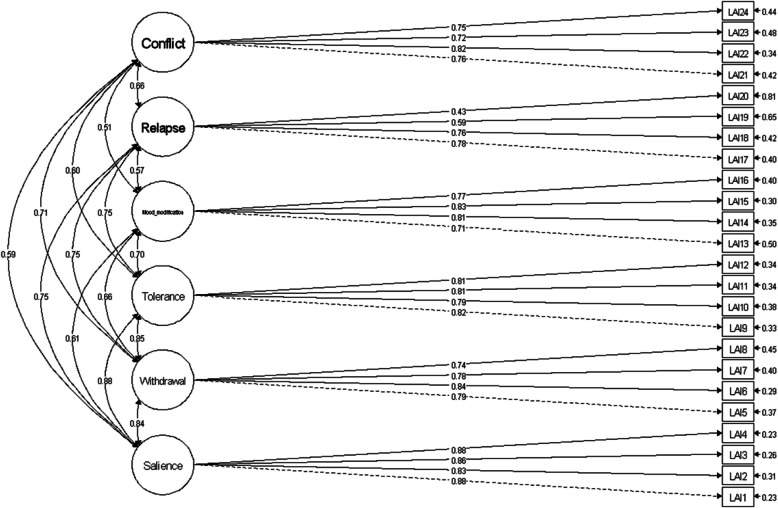 Figure 1
Peer Reviews
No public reviews on file for this paper yet. If you reviewed it on a platform where reviews are public (OpenReview, ICLR, NeurIPS, ICML), you can paste yours below so the community can read it here.
Videos
No videos yet. Explain this paper in a talk, walkthrough, or lecture? Add one.
Taxonomy
TopicsImpact of Technology on Adolescents · Sexuality, Behavior, and Technology · Attachment and Relationship Dynamics