Robust inverse probability weighted estimators for doubly truncated Cox regression with closed-form standard errors
Omar Vazquez, Sharon X. Xie

TL;DR
This paper introduces a new method for analyzing survival data affected by double truncation, offering robust estimators and closed-form standard errors.
Contribution
The paper proposes robust estimators with time-varying weights and introduces a nonparametric test for verifying truncation assumptions.
Findings
The proposed estimators are robust to extreme event times and allow sensitivity analysis for non-positivity.
A nonparametric test and graphical diagnostic are developed to assess the quasi-independent truncation assumption.
Closed-form standard errors are derived for both the proposed estimators and the NPMLE.
Abstract
Survival data is doubly truncated when only participants who experience an event during a random interval are included in the sample. Existing methods typically correct for double truncation bias in Cox regression through inverse probability weighting via the nonparametric maximum likelihood estimate (NPMLE) of the selection probabilities. This approach relies on two key assumptions, quasi-independent truncation and positivity of the sampling probabilities, yet there are no methods available to thoroughly assess these assumptions in the regression context. Furthermore, these estimators can be particularly sensitive to extreme event times. Finally, current double truncation methods rely on bootstrapping for variance estimation. Aside from the unnecessary computational burden, there are often identifiability issues with the NPMLE during bootstrap resampling. To address these limitations…
Genes, proteins, chemicals, diseases, species, mutations and cell lines named across the full text — each resolved to its canonical identifier and authoritative record.
Click any figure to enlarge with its caption.
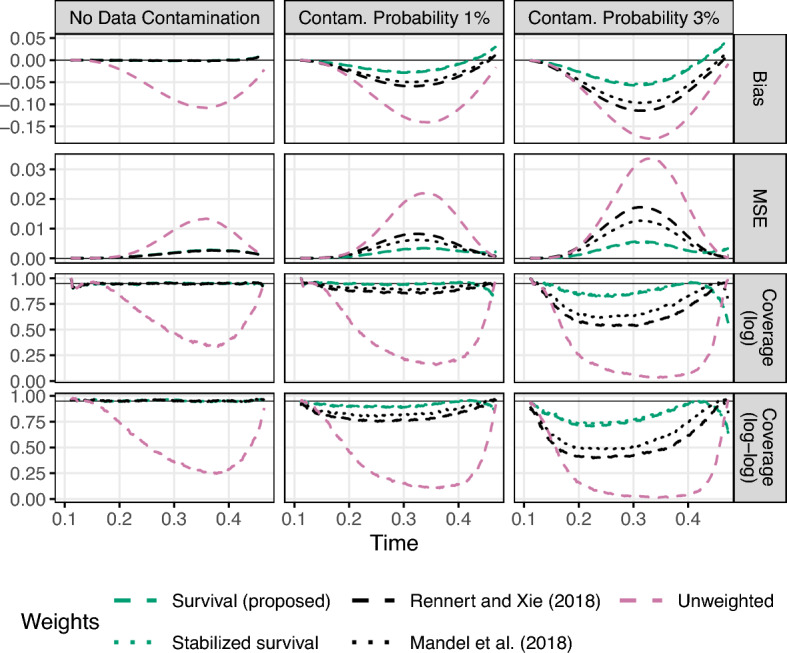 Figure 1
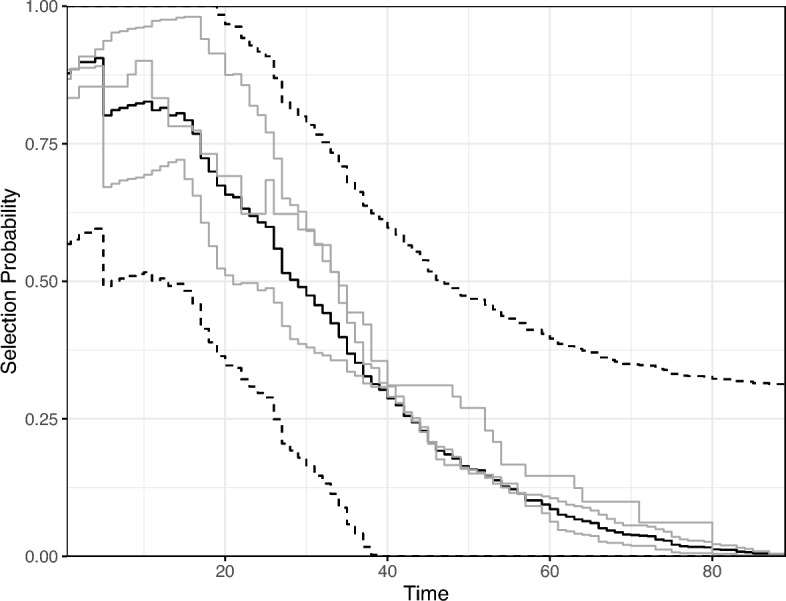 Figure 2
Peer Reviews
No public reviews on file for this paper yet. If you reviewed it on a platform where reviews are public (OpenReview, ICLR, NeurIPS, ICML), you can paste yours below so the community can read it here.
Videos
No videos yet. Explain this paper in a talk, walkthrough, or lecture? Add one.
Taxonomy
TopicsStatistical Methods and Inference · Statistical Methods and Bayesian Inference · Advanced Causal Inference Techniques