Pollination efficiency of hummingbirds and flowerpiercers at the flowers of Lobelia laxiflora (Campanulaceae): morphological fit matters
Stefan Abrahamczyk, Ruben Dürr, Emanuel Brenes, María A. Maglianesi

TL;DR
This study shows that the hummingbird Colibri cyanotus is an efficient pollinator of Lobelia laxiflora due to a perfect match between its bill length and the flower's corolla tube, while another bird, Diglossa plumbea, fails to pollinate.
Contribution
The study provides empirical evidence of morphological trait matching and bird behavior influencing pollination efficiency in a rare plant-hummingbird one-to-one interaction.
Findings
Colibri cyanotus efficiently pollinates Lobelia laxiflora due to morphological fit and behavior.
Diglossa plumbea does not act as a pollinator despite visiting flowers.
Lobelia laxiflora is completely self-incompatible.
Abstract
Research on pollination systems has largely focused on structures of mutualistic networks, whereas pollinator efficiency defining the quality of visits received much less attention. Different flower-visiting animals can vary in their pollination efficiency, e.g. due to their morphology, size or visitation frequency. Here, we analyse several reproductive traits, including flower morphology and reproductive system of Lobelia laxiflora and compare pollination efficiency of flower visitors based on seed set. We found experimentally that Lobelia laxiflora is completely self-incompatible and that the flowers are frequently visited by Colibri cyanotus, which did not show preferences for one flower sex. Diglossa plumbea was a more rare visitor and concentrated on female flowers Diglossa forced their bills deeply into the dorsally open corolla tube but did not pierce flowers. Corolla tube length…
Genes, proteins, chemicals, diseases, species, mutations and cell lines named across the full text — each resolved to its canonical identifier and authoritative record.
Click any figure to enlarge with its caption.
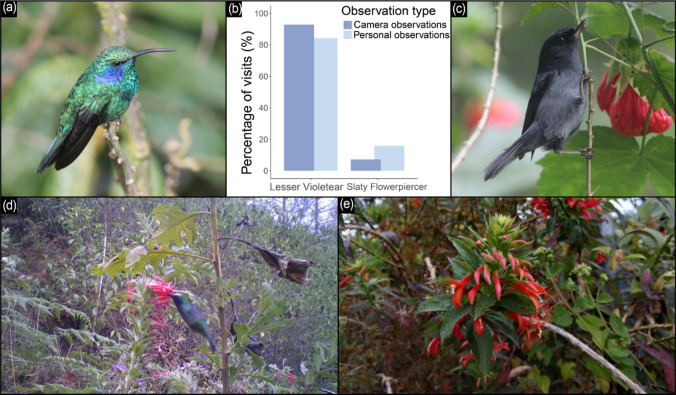 Figure 1
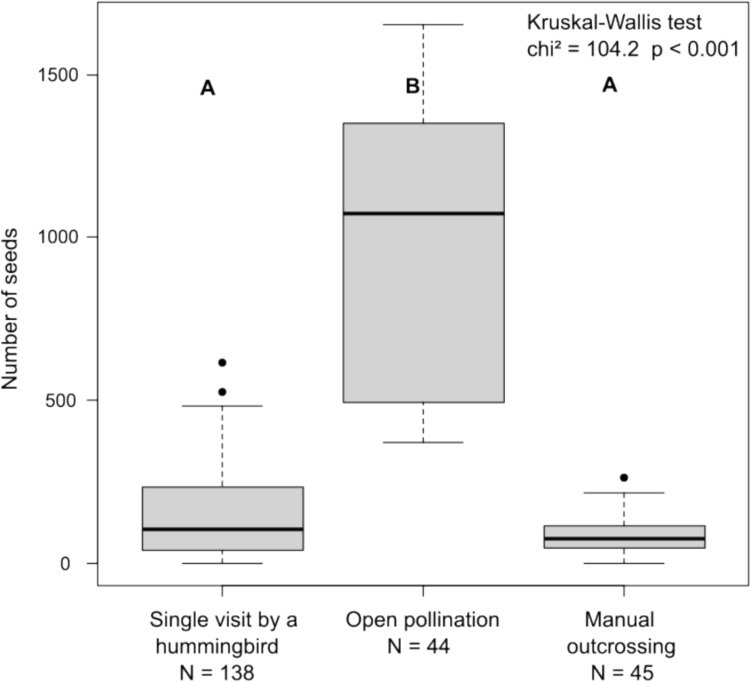 Figure 2
Peer Reviews
No public reviews on file for this paper yet. If you reviewed it on a platform where reviews are public (OpenReview, ICLR, NeurIPS, ICML), you can paste yours below so the community can read it here.
Videos
No videos yet. Explain this paper in a talk, walkthrough, or lecture? Add one.
Taxonomy
TopicsPlant and animal studies · Plant Parasitism and Resistance · Plant Diversity and Evolution