How psychological and descriptive narratives modulate the perception of facial emotional expressions: an event-related potentials (ERPs) study
Daniela Altavilla, Valentina Deriu, Alessandra Chiera, Stefania Crea, Ines Adornetti, Francesco Ferretti

TL;DR
This study explores how reading different types of stories affects brain responses to emotional facial expressions.
Contribution
It shows that narrative transport influences neural processing of emotions, particularly through internal simulation.
Findings
Reading modulated early brain responses to emotional faces regardless of narrative type.
Only psychological narratives showed a link between narrative transport and P100 amplitude.
Greater narrative transport correlates with enhanced internal emotional simulation.
Abstract
The aim of the present study was to investigate whether stories with high and low narrative transport exert different effects on neural activation in response to facial emotional expressions. Thirty-one participants were randomly assigned to two groups based on the type of story they read: psychological narrative with high narrative transport (6 women and 10 men; age M = 34.38 ± 8.77); descriptive narrative with low narrative transport (9 women and 6 men; age M = 24.07 ± 7.38). The electroencephalographic activity of the participants in response to emotional facial expressions (joy, anger, fear, sadness) was recorded before (T0) and after (T1) the reading task. The findings indicated that the reading task modulated the early brain response (P1, N170) to emotional facial expressions, irrespective of the narrative type. However, only in the psychological narrative group was the amplitude…
Genes, proteins, chemicals, diseases, species, mutations and cell lines named across the full text — each resolved to its canonical identifier and authoritative record.
Click any figure to enlarge with its caption.
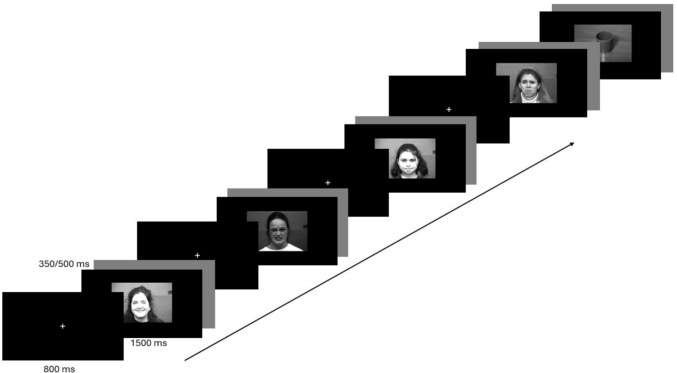 Figure 1
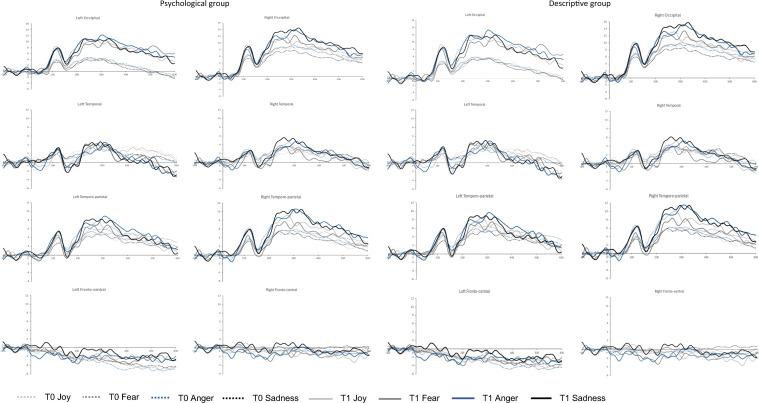 Figure 2
Peer Reviews
No public reviews on file for this paper yet. If you reviewed it on a platform where reviews are public (OpenReview, ICLR, NeurIPS, ICML), you can paste yours below so the community can read it here.
Videos
No videos yet. Explain this paper in a talk, walkthrough, or lecture? Add one.
Taxonomy
TopicsFace Recognition and Perception · Evolutionary Psychology and Human Behavior · Media Influence and Health