Glial cells diverge in fly brain evolution
Yaoyu Jiao, Trevor R. Sorrells

TL;DR
A study shows that glial cells undergo significant changes in fruit flies living in toxic environments, suggesting their key role in brain evolution.
Contribution
The study highlights glial cells as major drivers of brain evolution in ecologically specialized fruit flies.
Findings
Glial cells exhibit the most dramatic molecular and cellular changes in toxic-niche fruit flies.
This finding underscores the importance of glial cells in brain evolution.
The study reveals a previously underappreciated role for glial cells in ecological adaptation.
Abstract
How animal brains evolve to support ecological specialization is poorly understood. A recent PLOS Biology study reveals that glial cells show the most dramatic molecular and cellular changes in the brains of fruit flies adapted to a toxic niche, highlighting their underappreciated role in brain evolution. How animal brains evolve to support ecological specialization is poorly understood. This Primer explores a recent PLOS Biology study which reveals that glial cells show the most dramatic molecular and cellular changes in the brains of fruit flies adapted to a toxic niche, highlighting their underappreciated role in brain evolution.
Genes, proteins, chemicals, diseases, species, mutations and cell lines named across the full text — each resolved to its canonical identifier and authoritative record.
Click any figure to enlarge with its caption.
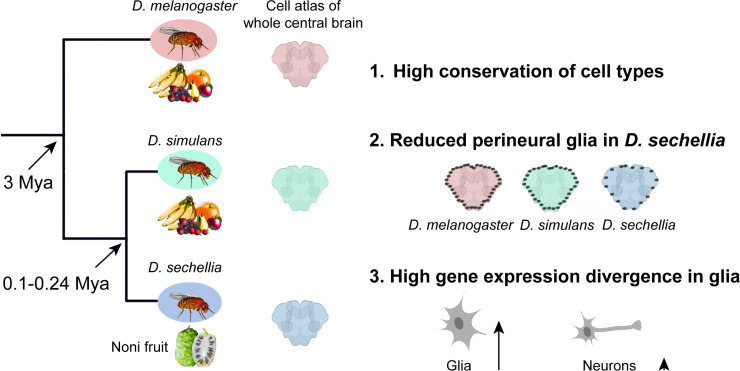 Figure 1
Peer Reviews
No public reviews on file for this paper yet. If you reviewed it on a platform where reviews are public (OpenReview, ICLR, NeurIPS, ICML), you can paste yours below so the community can read it here.
Videos
No videos yet. Explain this paper in a talk, walkthrough, or lecture? Add one.
Taxonomy
TopicsNeurobiology and Insect Physiology Research · Plant and animal studies · Insect and Arachnid Ecology and Behavior