XPRS: a tool for interpretable and explainable polygenic risk score
Na Yeon Kim, Seunggeun Lee

TL;DR
XPRS is a new tool that makes polygenic risk scores more interpretable by showing which genes and SNPs contribute most to an individual's genetic risk for diseases.
Contribution
XPRS introduces a novel visualization and interpretation framework for PRS using SHAP values to highlight key genetic contributors.
Findings
XPRS uses SHAP values to break down PRS into gene and SNP contributions.
The tool provides multilevel visualizations like Manhattan and LocusZoom plots for better interpretation.
XPRS is available as a web-based tool to improve clinical communication and understanding of genetic risk.
Abstract
The polygenic risk score (PRS) is an important method for assessing genetic susceptibility to diseases; however, its clinical utility is limited by a lack of interpretability tools. To address this problem, we introduce eXplainable PRS (XPRS), an interpretation and visualization tool that decomposes PRSs into genes/regions and single nucleotide polymorphism (SNP) contribution scores via Shapley additive explanations (SHAPs), which provide insights into specific genes and SNPs that significantly contribute to the PRS of an individual. This software features a multilevel visualization approach, including Manhattan plots, LocusZoom-like plots, and tables at the population and individual levels, to highlight important genes and SNPs. By implementing with a user-friendly web interface, XPRS allows for straightforward data input and interpretation. By bridging the gap between complex genetic…
Genes, proteins, chemicals, diseases, species, mutations and cell lines named across the full text — each resolved to its canonical identifier and authoritative record.
Click any figure to enlarge with its caption.
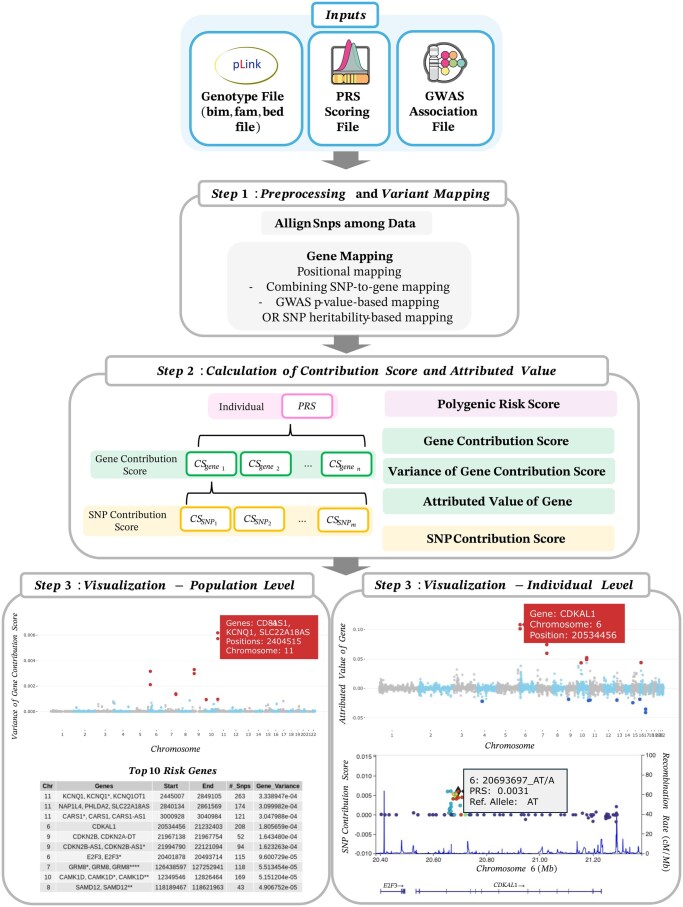 Figure 1
Peer Reviews
No public reviews on file for this paper yet. If you reviewed it on a platform where reviews are public (OpenReview, ICLR, NeurIPS, ICML), you can paste yours below so the community can read it here.
Videos
No videos yet. Explain this paper in a talk, walkthrough, or lecture? Add one.
Taxonomy
TopicsGenetic Associations and Epidemiology · BRCA gene mutations in cancer · Genomics and Rare Diseases