Gene polymorphisms of miR-323b and miR-1343 that regulate kininogen L are associated with schizophrenia susceptibility: A preliminary population‑based study
Xiaoyu Liu, Mengdi Jin, Mingjia Yang, Lijuan Yan, Weijiao Zhao, Lizhuo Liu, Hongmin Wang, Yongzhuo Ding, Yanyan Sun, Yanchi Zhang, Qiong Yu

TL;DR
This study found that certain gene variations in miR-323b and miR-1343 are linked to schizophrenia risk and specific symptoms like auditory hallucinations.
Contribution
The study identifies novel miRNA-related SNPs associated with schizophrenia susceptibility and symptom manifestation.
Findings
The hsa-miR-323b-rs56103835 mutation is significantly linked to schizophrenia under a dominant model.
The hsa-miR-1343-rs2986407 mutation increases the risk of auditory hallucinations in schizophrenia patients.
A three-factor model involving miR-SNPs showed potential but not significant interaction with schizophrenia.
Abstract
miRNA-related single-nucleotide polymorphism (miR-SNP) is a type of functional SNP that affects the regulatory functions of miRNA genes, miRNA binding sites, or components of miRNA biogenesis. This study aimed to explore the relationship between miRNA gene polymorphisms that regulate the kininogen L protein and schizophrenia (SCZ). Bioinformatics methods predicted miRNA gene polymorphism sites regulating the kininogen L protein. The polymorphisms of rs56103835, rs6513496, rs651349, and rs2986407 were detected using improved multiple ligase detection reaction multiple SNP typing technologies in 513 SCZ patients and 509 controls. The association of miR-SNP variations with SCZ susceptibility and symptoms was evaluated using SNPstat to determine the optimal inheritance model. Generalized multifactor dimensionality reduction analysis and logistic regression were used to calculate miR-SNP…
Genes, proteins, chemicals, diseases, species, mutations and cell lines named across the full text — each resolved to its canonical identifier and authoritative record.
Click any figure to enlarge with its caption.
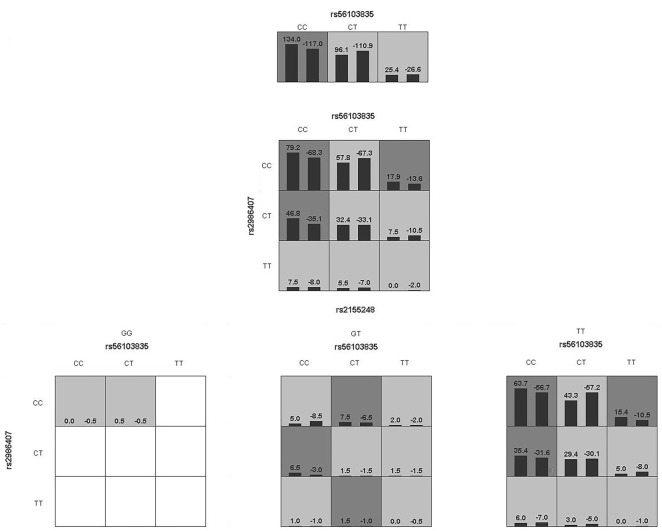 Figure 1
 Figure 2
Peer Reviews
No public reviews on file for this paper yet. If you reviewed it on a platform where reviews are public (OpenReview, ICLR, NeurIPS, ICML), you can paste yours below so the community can read it here.
Videos
No videos yet. Explain this paper in a talk, walkthrough, or lecture? Add one.
Taxonomy
TopicsGenetic Syndromes and Imprinting · Kruppel-like factors research · MicroRNA in disease regulation