Coevolutionary training of phages can be more successful in several small, relative to single large, habitats
Xiao Liu, Quan‐Guo Zhang

TL;DR
Small, isolated habitats help phages evolve better infectivity against bacteria compared to a single large habitat.
Contribution
Metapopulation training with small, isolated habitats increases phage diversity and infectivity when bacterial dispersal is blocked.
Findings
Several small habitats supported more diverse phages with greater infectivity ranges.
Blocking bacterial dispersal was crucial for the success of small habitat metapopulations.
Metapopulation training can help prepare effective phage cocktails quickly.
Abstract
Evolutionary training of phages can help to counter bacterial resistance evolution. Here, we address whether metapopulation processes can enhance the evolution of phage infectivity. Our experiment with a model bacterium‐phage system supported a prediction of long‐term fluctuating selection dynamics. Specifically, metapopulations of several small habitats showed greater total infectivity ranges by supporting more diverse phages, compared with single large populations. Crucially, the advantage of several small habitats was conditioned on blocking bacterial dispersal within metapopulations. We conclude that well‐designed metapopulation training programs can be useful for quick and easy preparation of cocktail phage materials.
Genes, proteins, chemicals, diseases, species, mutations and cell lines named across the full text — each resolved to its canonical identifier and authoritative record.
Click any figure to enlarge with its caption.
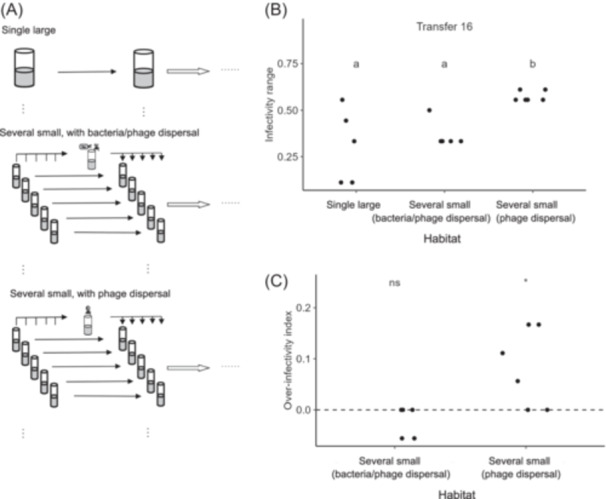 Figure 1
Peer Reviews
No public reviews on file for this paper yet. If you reviewed it on a platform where reviews are public (OpenReview, ICLR, NeurIPS, ICML), you can paste yours below so the community can read it here.
Videos
No videos yet. Explain this paper in a talk, walkthrough, or lecture? Add one.
Taxonomy
TopicsBacteriophages and microbial interactions · Evolution and Genetic Dynamics · Plant Virus Research Studies