The ABC’s of Enhancing Medical Residents Approach to Resolving Interprofessional Conflicts in Workplace
KRISHNA MOHAN SURAPANENI

TL;DR
This paper addresses how medical residents can better handle conflicts in multidisciplinary healthcare teams using a new framework called the ABCs.
Contribution
The paper introduces the ABCs framework to improve interprofessional conflict resolution among medical residents.
Findings
Medical residents often lack training in interprofessional collaboration.
The ABCs framework helps improve communication and teamwork in healthcare settings.
Implementing the ABCs can enhance patient care and team integration.
Abstract
Interprofessional conflicts (IC) in healthcare settings pose significant challenges for medical residents, who are often trained in discipline-specific environments. The transition to a multidisciplinary team approach, which is increasingly necessary in modern healthcare, can be difficult without proper training in communication, negotiation, and teamwork. This article explores the gaps in Graduate Medical Education regarding interprofessional collaboration and offers a framework—the ABCs (Acknowledgment of Expertise, Balancing Power Dynamics, Clear Communication)—to enhance medical residents' ability to resolve conflicts. Implementing these strategies not only improves the work environment for residents but also enhances patient care and promotes a more integrated healthcare system.
Genes, proteins, chemicals, diseases, species, mutations and cell lines named across the full text — each resolved to its canonical identifier and authoritative record.
Click any figure to enlarge with its caption.
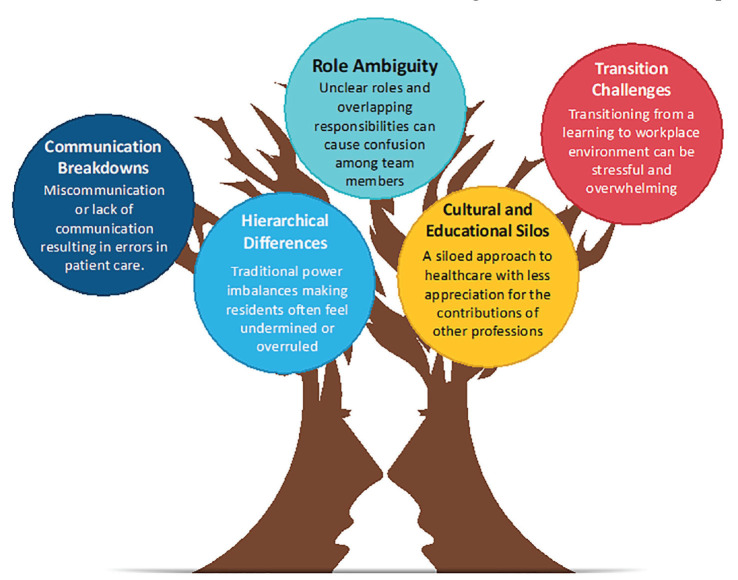 Figure 1
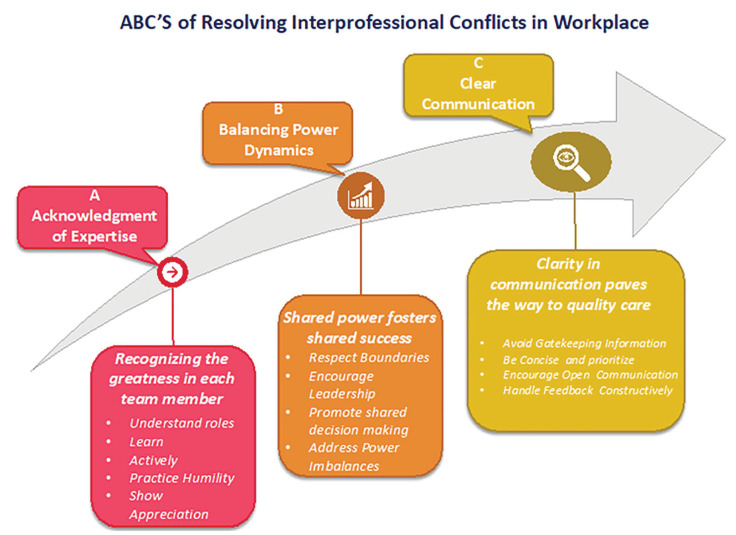 Figure 2
Peer Reviews
No public reviews on file for this paper yet. If you reviewed it on a platform where reviews are public (OpenReview, ICLR, NeurIPS, ICML), you can paste yours below so the community can read it here.
Videos
No videos yet. Explain this paper in a talk, walkthrough, or lecture? Add one.
Taxonomy
TopicsInterprofessional Education and Collaboration · Ethics in medical practice
Introduction
Interprofessional Conflicts (IC) in the workplace is a significant issue faced by medical residents, arising from interactions with other healthcare professionals, including nurses, pharmacists, and senior physicians ( 1 ). Medical residents trained predominantly within a single discipline are often well-versed in specific medical knowledge and skills pertinent to their field. However, modern healthcare increasingly requires professionals to operate within diverse teams where collaboration and communication across different specialties are crucial. In interprofessional settings, medical residents must interact effectively with nurses, pharmacists, therapists, and other healthcare professionals ( 2 ). This shift can be challenging for those accustomed to a more isolated or discipline-specific training environment. Without the skills to navigate these complex dynamics, residents may struggle with teamwork, communication, and conflict resolution, which are essential for effective patient care and safety ( 3 ).
Despite its importance, graduate medical education often lacks comprehensive training in interprofessional collaboration. This gap means that new physicians may not be adequately prepared to engage in the team-based, collaborative practice that modern healthcare settings demand ( 3 , 4 ). Traditional medical training programs tend to emphasize clinical and technical skills, with less focus on the soft skills like communication, negotiation, and teamwork that are vital in a multidisciplinary workforce. As a result, residents might feel less equipped to handle the demands of a collaborative healthcare environment, leading to increased stress and decreased efficiency ( 4 ). Figure 1 shows the key problems leading to interprofessional conflicts in the workplace.
Key problems leading to interprofessional conflicts in workplace
This gap in training is often exacerbated by the fast-paced, high-pressure environment typical of many healthcare settings, where the urgency of patient care demands can overshadow the need for thorough and deliberate strategies for conflict management ( 5 ). This imbalance not only affects residents’ job performance but also hinders their long-term professional development and growth. Addressing the educational gaps in interprofessional collaboration is vital for equipping medical residents with the skills necessary to manage interprofessional conflicts effectively in today's complex healthcare environments ( 6 , 7 ). This article aims to contribute to the ongoing discourse on enhancing interprofessional relationships in healthcare settings by providing the ABCs for resolving interprofessional conflicts, thereby improving both the work environment for medical residents and the care provided to patients (Figure 2). This approach not only benefits individual professionals but also supports the broader goal of a more integrated and efficient healthcare system.
ABC’s of Resolving Interprofessional Conflicts in Workplace
A- Acknowledgment of Expertise
Acknowledgment of expertise is a foundational step in resolving interprofessional conflicts. This goes beyond mere recognition of each professional's credentials; it involves a deep appreciation of the unique perspectives and contributions that diverse disciplines bring to patient care ( 8 ). This acknowledgment serves as a critical step towards fostering a collaborative environment, essential for effective healthcare delivery. Misunderstanding and undervaluation of each individual’s expertise is the root cause of conflicts in healthcare workplace ( 9 ). Take the initiative to understand the roles, responsibilities, and challenges faced by other healthcare professionals. Do not assume you fully understand the roles or contributions of other professionals based solely on their job titles or your past experiences ( 10 ). Also, be open to learning new information and constructing knowledge from others. Medicine is an ocean, and one person cannot learn everything ( 11 ). Preaching humility is the key. Recognize that despite individual medical training, there are areas of patient care where other professionals have greater expertise. Approach every interaction with the humility to learn and the willingness to integrate other team members' insights into the clinical decision-making ( 12 , 13 ). Also, regularly acknowledge and appreciate the contributions of all team members ( 14 , 15 ). Our collective strength lies in the recognition and integration of each other's unique expertise. By fostering a workplace that prioritizes understanding and values the diverse expertise of its team, medical residents can lead the way in creating a more integrated, effective, and compassionate healthcare system.
Incorporating the acknowledgment of expertise into resident training programs is crucial for building strong, collaborative healthcare teams. A simple way to start is by integrating more opportunities for residents to work closely with professionals from other disciplines—like nurses, pharmacists, or therapists— during real patient cases or simulations. This hands-on experience helps residents see the value each person brings to patient care. It also breaks down assumptions about roles, which are often based on job titles or past experiences and encourages a deeper appreciation for everyone's unique contributions. Another key approach is to include regular team debriefs where residents can openly talk about the role each team member played in a case and how their input impacted the outcome. This kind of reflection fosters a culture of respect and learning. Mentorship can also be a powerful tool—pairing residents with experienced professionals from different fields gives them a chance to learn about challenges and insights specific to those roles. By focusing on these elements—real-world collaboration, reflective practice, and mentorship— resident programs can create an environment where acknowledging and valuing expertise becomes a second nature. It helps build a more effective, cohesive healthcare team, where everyone’s strengths are recognized and leveraged for better patient outcomes.
B - Balancing Power Dynamics
Balancing Power Dynamics within interprofessional teams is a crucial element in resolving conflicts and fostering a collaborative work environment. Traditionally, physicians may hold more decision-making authority compared to other healthcare professionals like nurses, pharmacists, or therapists ( 16 , 17 ). However, modern healthcare increasingly recognizes that effective patient care relies on the integrated efforts of a diverse team, each member bringing specialized knowledge and skills ( 18 ). Navigate your role consciously. Respect the professional boundaries and scopes of practice of each team member ( 19 , 20 ). Avoid dictating or dismissing the work of others, which can foster resentment and resistance rather than collaboration ( 21 ). While it's natural to want to avoid conflict, not addressing power imbalances can lead to resentment and dysfunction within the team. It's important to confront these issues constructively ( 22 ). Also, encourage leadership roles within the team that rotate or are shared among different professions rather than only physicians having a dominant role ( 23 ). Practice shared decision-making. Resist the temptation to let a single professional group (traditionally medical professionals) dominate decision-making processes, even in high-pressure situations where quick decisions are necessary ( 24 , 25 ). Cultivate a team culture where respect is a fundamental principle that guides all interactions. Embracing these principles ensures that the healthcare environment becomes a place of mutual respect and collaboration, where every team member feels valued and empowered.
Incorporating the concept of balancing power dynamics into resident training programs can be achieved by fostering a culture of shared leadership and collaboration from the outset. Training programs can implement team-based care simulations where residents work alongside other healthcare professionals, such as nurses, pharmacists, and therapists, to encourage shared decision-making. These exercises would emphasize equal contributions from all team members, ensuring that no single profession dominates the process. Additionally, residency programs can include short-term courses or workshops on communication and conflict resolution that address power imbalances directly, teaching residents how to navigate these dynamics constructively. Encouraging rotating leadership roles during clinical rotations or case discussions also provides residents with a practical understanding of how to collaborate effectively while respecting each team member’s expertise. By integrating these practices into training, residents will develop the skills needed to create a more balanced, respectful, and collaborative healthcare environment.
C- Clear Communication
Clear communication in healthcare is critical because it directly impacts patient safety and care outcomes ( 26 ). In environments where complex information needs to be conveyed quickly and under pressure, the clarity of that information can mean the difference between effective and compromised care ( 27 ). For medical residents working within interprofessional teams, mastering the art of clear and promoting conversations is essential not only for resolving conflicts but also for facilitating day-to-day operations and transitions in patient care ( 28 ). Avoid gatekeeping information as a form of power. Sharing knowledge freely can help level the playing field and foster trust among team members ( 29 ). While it’s important to be thorough, too much information at once can overwhelm recipients and lead to confusion further complicating the conflicts. Strive to be concise and prioritize information based on the immediacy and relevance of the situation ( 30 , 31 ). Foster an environment where open communication is a norm ( 32 ). Ask questions to understand problems and perspectives of other team members better, and always express your thoughts and decisions with empathy, clarity, and respect ( 33 ). Avoid missing out on learning from feedback, whether giving or receiving it. Constructive feedback is a vital tool for improvement and understanding in a multidisciplinary team ( 34 , 35 ). Handle feedback with care, ensuring it is always given in a constructive, supportive, and respectful manner ( 36 ).
Conclusion
Incorporating clear communication into resident training programs can be achieved by integrating interactive workshops, simulations, and interdisciplinary team meetings that emphasize concise and effective information-sharing. Through role-playing scenarios, residents can practice conveying complex medical details in high-pressure situations while ensuring clarity and avoiding information overload. Participation in patient handovers and regular interdisciplinary meetings will further help residents refine their communication skills in real-world settings. Mentorship programs that pair residents with senior healthcare professionals can also reinforce the best practices for open, respectful, and empathetic communication. Regular feedback sessions will allow residents to reflect on their communication styles and make improvements, ultimately fostering a collaborative environment where clear communication enhances patient care and teamwork.
These ABC practices are not just procedural; they are integral to the shared commitment of all team members to improve patient care, highlighting that effective teamwork and patient outcomes are intrinsically linked in the pursuit of excellence in healthcare. The goal is not merely about reducing conflict; it's about enhancing the team’s capacity to deliver the best possible patient care. By actively engaging in these practices that acknowledge expertise, distribute power more equitably with respectful and constructive communication, healthcare teams can leverage the full range of their collective expertise, ultimately leading to more effective and patient-centered care.
Training these ABC practices—Acknowledgment of Expertise, Balancing Power Dynamics, and Clear Communication—within residency programs is essential for developing well-rounded, collaborative physicians. These training opportunities allow the residents to practice equitable leadership and communication, creating a more inclusive and effective care environment. Ultimately, instilling these practices during residency ensures that future healthcare teams will be better equipped to deliver patient-centered care through mutual respect and collaboration.
The reference list from the paper itself. Each links out to its DOI / PubMed record.
- 1Lee YH Ahn D Moon J Han K Perception of interprofessional conflicts and interprofessional education by doctors and nurses Korean J Med Educ 2014264257642580023210.3946/kjme.2014.26.4.257PMC 8813443 · doi ↗ · pubmed ↗
- 2Slim L Reuter-Yuill LM A Behavior-Analytic Perspective on Interprofessional Collaboration Behav Anal Pract 20211441238483486882510.1007/s 40617-021-00602-7PMC 8586292 · doi ↗ · pubmed ↗
- 3Belrhiti Z Van Belle S Criel B How medical dominance and interprofessional conflicts undermine patient-centred care in hospitals: historical analysis and multiple embedded case study in Morocco BMJ Glob Health 202167 e 00614010.1136/bmjgh-2021-006140 PMC 828091134261759 · doi ↗ · pubmed ↗
- 4Park YC Park KH Interprofessional education program for medical and nursing students: interprofessional versus uniprofessional Korean J Med Educ 20213311103373555210.3946/kjme.2021.182PMC 7973076 · doi ↗ · pubmed ↗
- 5Weber BW Mirza K Leveraging Interprofessional Education to Improve Physician/Laboratory Cooperation and Patient Outcomes Med Sci Educ 2022321239413504308110.1007/s 40670-021-01496-4PMC 8758242 · doi ↗ · pubmed ↗
- 6Ward W Zagoloff A Rieck C Robiner W Interprofessional Education: Opportunities and Challenges for Psychology J Clin Psychol Med Settings 2018253250662945350710.1007/s 10880-017-9538-3 · doi ↗ · pubmed ↗
- 7Sulaiman N Rishmawy Y Hussein A Saber-Ayad M Alzubaidi H Al Kawas Setal A mixed methods approach to determine the climate of interprofessional education among medical and health sciences students BMC Med Educ 20212112033383672710.1186/s 12909-021-02645-4PMC 8035734 · doi ↗ · pubmed ↗
- 8Baumgarten M Brødsgaard ANørholm V Foss NB Bunkenborg G Interprofessional Collaboration Between Nurses and Physicians in the Perioperative Period J Perianesth Nurs 2023385724313721275310.1016/j.jopan.2022.12.002 · doi ↗ · pubmed ↗