A Cross‐Sectional Examination of Movement Behaviours and Guideline Adherence Rates Among Preschool‐Aged Children With Disabilities
Maeghan E. James, Kathleen A. Martin Ginis, Rebecca L. Bassett‐Gunter, Krista L. Best, Kelly P. Arbour‐Nicitopoulos

TL;DR
This study examines how preschool-aged children with disabilities follow movement guidelines for physical activity, screen time, and sleep.
Contribution
It provides descriptive data on movement behaviors and guideline adherence rates in a small sample of preschool-aged children with disabilities.
Findings
Children met the sleep guideline most frequently (79.3%), while few met the physical activity and screen time guidelines.
Only 4.3% of children met all three movement behavior guidelines.
Average physical activity was 108 minutes per day, with only 40 minutes of moderate-to-vigorous activity.
Abstract
Meeting the 24‐h movement behaviour guidelines (hereafter ‘guidelines’) supports healthy growth and development. It is recommended that preschool‐aged children engage daily in 180 min of physical activity (PA), 60 min of which are moderate‐to‐vigorous PA (MVPA), along with less than 1 h of screen time and 10–13 h of sleep for optimal health. However, research on movement behaviours among children with disabilities in the early years is limited. This study aimed to describe movement behaviours and guideline adherence rates among preschool‐aged children with disabilities. A cross‐sectional subanalysis was conducted of caregivers of young children (aged 4 years) with a disability (N = 31; 65% boys, 55% with a developmental disability) who were part of a Canadian study on movement behaviours in children and youth with disabilities. Caregiver‐reported PA, screen time and sleep behaviours…
Genes, proteins, chemicals, diseases, species, mutations and cell lines named across the full text — each resolved to its canonical identifier and authoritative record.
Click any figure to enlarge with its caption.
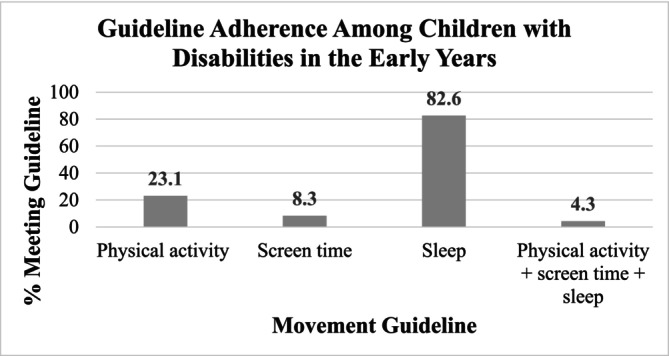 FIGURE 1
| Caregiver demographic profile |
|
|---|---|
| Relationship to child, mother | 27 (87.1) |
| Age (mean, SD) | 37.2 (4.4) |
| Province | |
| British Columbia | 14 (45.2) |
| Alberta | 1 (3.2) |
| Manitoba | 1 (3.2) |
| Ontario | 9 (29.0) |
| Quebec | 3 (9.7) |
| New Brunswick | 1 (3.2) |
| Nova Scotia | 1 (3.2) |
| Yukon Territory | 1 (3.2) |
| Employment status | |
| Full‐time | 11 (35.5) |
| Part‐time | 5 (16.1) |
| Self‐employed | 2 (6.5) |
| Unemployed, currently looking for work | 1 (3.2) |
| Unemployed, not currently looking for work | 8 (25.8) |
| Other (e.g., student and retired) | 12 (2.3) |
| Undisclosed | 4 (12.9) |
| Annual household income | |
| < $50 000 | 7 (22.6) |
| $50 000–$99 999 | 12 (38.7) |
| > $100 000 | 6 (19.4) |
| Undisclosed | 4 (12.9) |
| Highest level of education | |
| High school | 6 (19.4) |
| College or technical school | 6 (19.4) |
| University, undergraduate (e.g., Bachelors) | 11 (35.5) |
| University, graduate (e.g., Masters, PhD and MD) | 7 (22.6) |
| Undisclosed | 1 (3.2) |
| M | SD | Min | Max | |
|---|---|---|---|---|
| Average daily minutes of leisure time PA | 108.3 | 89.9 | 0.0 | 270.4 |
| Light intensity | 74.2 | 69.7 | 0.0 | 137.5 |
| Moderate intensity | 21.9 | 23.6 | 0.0 | 85.7 |
| Vigorous intensity | 13.6 | 16.0 | 0.0 | 51.4 |
| Moderate‐to‐vigorous intensity | 40.1 | 47.0 | 0.0 | 188.6 |
| Average daily minutes of screen time | 224.8 | 169.2 | 0.0 | 694.3 |
| Video games | 60.7 | 77.2 | 0.0 | 291.4 |
| TV | 82.5 | 71.4 | 0.0 | 291.4 |
| Computer | 39.8 | 51.9 | 0.0 | 154.3 |
| Phone | 47.4 | 52.8 | 0.0 | 197.1 |
| Average nightly hours of sleep | 10.6 | 1.0 | 8.3 | 12.1 |
- —Social Sciences and Humanities Research Council of Canada 10.13039/501100000155
- —Canadian Tire Jumpstart Charities
Peer Reviews
No public reviews on file for this paper yet. If you reviewed it on a platform where reviews are public (OpenReview, ICLR, NeurIPS, ICML), you can paste yours below so the community can read it here.
Videos
No videos yet. Explain this paper in a talk, walkthrough, or lecture? Add one.
Taxonomy
TopicsInfant Development and Preterm Care · Children's Physical and Motor Development · Obesity, Physical Activity, Diet
Summary
- This study highlights a significant gap in meeting physical activity recommendations among preschool‐aged children with disabilities.
- Results demonstrated that screen time among preschool‐aged children with disabilities far exceeds recommended limits, highlighting a need for strategies to reduce sedentary behaviour in this population.
- Sleep was the most successfully adhered‐to guideline, indicating that children with disabilities generally meet the recommended sleep duration.
- These findings emphasize the need for increased surveillance research on movement behaviours among preschool‐aged children with disabilities in the early years.
Introduction
1
Engaging in more physical activity (PA), less sedentary behaviour (including screen time) and uninterrupted sleep can support holistic health and development in young children (Kuzik et al. 2017). Establishing healthy patterns of PA, sedentary behaviour and sleep in the early years is especially important for setting the foundation for healthy behaviours later in life (Telama and Hirvensalo 2015). Recognizing this, movement behaviour guidelines have been established by individual countries and the World Health Organization for children in the early years. In Canada, these daily guidelines recommend that preschool‐aged (i.e., 3–4 years) children engage in at least 180 min of PA at any intensity throughout the day, with at least 60 min spent in energetic play (i.e., moderate‐to‐vigorous PA; MVPA); engage in no more than 60 min of screen time; and have at least 10–13 h of good quality sleep (Tremblay et al. 2017).
Globally, most young children are meeting the age‐specific guidelines for PA (62%–93%) and sleep (63%–89%), and fewer are meeting the age‐specific sedentary behaviour guideline (2%–38%) or all three movement behaviour guidelines (7%–19%) (Chaput et al. 2017; Cliff et al. 2017; Nyström et al. 2020; Tanaka et al. 2023). Within these studies, little focus has been directed towards reporting on movement behaviours in young children with disabilities, thus limiting understanding of movement behaviour within this child population. Children with disabilities are defined as those who have long‐term physical, mental, intellectual and/or sensory impairments that prevent full and equal participation in society (United Nations 2008). In 2021, it was estimated that 29 million children globally between the ages of 0 and 4 years old had moderate‐to‐severe disabilities (United Nations Children's Fund 2021).
Several disparities have been reported for children with disabilities in the early years, including barriers to participation in community and childcare environments (Benjamin et al. 2016; United Nations Children's Fund 2021), highlighting a need for research exploring movement behaviours specifically among children in this population. This short communication addresses this gap by presenting the findings from the first study in Canada and, to our knowledge, internationally, which examines the three movement behaviours among children with disabilities in the early years.
Methods
2
A subanalysis of the larger National Physical Activity Measurement (NPAM) study was conducted to examine guideline adherence in a sample of 31 young children (aged 4 years) with disabilities. NPAM was a cross‐sectional online study conducted between January 2018 and May 2023 (with a temporary pause on data collection from March 2020 to July 2022 due to the COVID‐19 pandemic) to examine the movement behaviours of children and youth with disabilities aged 3–17 years old in Canada (Arbour‐Nicitopoulos et al. 2023). As part of the NPAM study, caregivers completed an online survey that took approximately 25 min to complete. Caregiver survey data pertaining to family demographics (e.g., age and disability type) and child movement behaviours (overall PA, MVPA, screen time and sleep) were used in the subanalysis.
PA, screen time and sleep were measured using items from the International Physical Activity Questionnaire for Children and Adolescents (Hagströmer et al. 2005), Health Behaviour in School‐aged Children (HBSC) survey (Roberts et al. 2009) and the International Study on Childhood Obesity, Lifestyle, and the Environment (ISCOLE) Diet and Lifestyle Questionnaire (Katzmarzyk et al. 2019), respectively. Details on the items used and how movement behaviour durations were calculated can be found in Appendix A. Data analysis was conducted using SPSS version 24.0. Descriptive statistics (n, %) were used to summarize sample demographic and child movement behaviour characteristics, and guideline adherence.
Results
3
Thirty‐one caregivers (87% mothers, mean age = 37 years, SD = 4 years) of preschool‐aged children with disabilities (M age = 4 years, SD = 0) completed the survey. Table 1 presents a complete demographic description of these caregivers and their children. Table 2 presents the mean duration children were reported to spend in daily PA (including MVPA), screen time and sleep. On average, caregivers reported their child to be engaging in 108 min (SD = 90) of total PA per day, 40 (SD = 47) of which were spent in MVPA. Children were reported to engage in an average of 225 min (SD = 170) of daily screen time per day and 10.6 h (SD = 1 h) of sleep per night. Adherence rates for the three movement behaviour age‐specific guidelines are presented in Figure 1. Most children (83%) met the sleep guideline, with fewer meeting the guideline for PA (23%) or sedentary behaviour (8%). One child (4%) in the sample met the guideline for all three movement behaviours. For the PA guideline, 31% of children engaged in MVPA at least 60 min each day and 24% engaged in PA at any intensity for at least 180 min each day.
Children with disabilities' adherence rates to individual (i.e., 180 min of total PA and 60 min of MVPA; less than 2 h of screen time and 10–13 h of sleep) and combined movement behaviour guidelines in the early years.
Discussion
4
This study provides insights into the 24‐h movement behaviours of preschool‐aged children with disabilities in a sample of preschool‐aged children living in Canada. Similar to results presented for preschool‐aged children without disabilities (Cliff et al. 2017; Nyström et al. 2020; Santos et al. 2017; Tanaka et al. 2023) and older children and youth with disabilities (Arbour‐Nicitopoulos et al. 2022; Law et al. 2013; Ng et al. 2023), guideline adherence rates are lowest for sedentary behaviour and highest for sleep. With regard to PA, children in this study were engaging in, on average, 72 min less of daily PA than what is recommended for their chronological age, and fewer children met the age‐specific PA guideline compared with studies of preschool‐aged children without disabilities (Cliff et al. 2017; Tanaka et al. 2023). In Canada, preschool‐aged children without disabilities have been reported to engage in approximately 1.8 h of MVPA per day (Kuzik et al. 2020) and adherence rates for the PA guideline have been shown to be as high as 62% (Chaput et al. 2017). In contrast, children in this study engaged in an average of 40 min of MVPA per day and only 23% of children met the PA guideline. Previous research has shown that the benefits of PA may be amplified for children and adults with disabilities (Anderson and Heyne 2010). Although the sample of young children with disabilities in this study was reported to be engaging in less PA than what is recommended for preschool‐aged children, they may still be experiencing meaningful health benefits from the PA they participate in (Anderson and Heyne 2010). Specifically, children in this study were reported to be engaging in over an hour (i.e., 108 min) of daily PA at any intensity, with most of those PA minutes being spent at a light intensity. Engaging in light‐intensity PA has been shown to be positively related to health outcomes in school‐aged children and adults and is therefore important to maintain (Poitras et al. 2016; Ross et al. 2024). Thus, in addition to mobilizing efforts to increase MVPA among young children with disabilities, equal efforts should be directed towards increasing and maintaining participation in light‐intensity PA.
The current sample of preschool‐aged children with disabilities were reported to engage in over three times the recommended levels of recreational screen time, and only 8% met the guideline of less than 60 min of screen time per day. This finding partially aligns with the results from studies of preschool‐aged children without disabilities, which report adherence rates for meeting the sedentary behaviour guideline of 11% (Santos et al. 2017) to 38% (Nyström et al. 2020). The lower adherence rate for the sedentary behaviour guideline reported in the current study aligns with previous research showing that older children and youth with disabilities engage in more recreational screen time than children and youth without disabilities (Law et al. 2013). Previous studies have shown that children with disabilities in the early years spend most of their time participating in activities in the home environment, with a preference for screen‐based activities (Di Marino et al. 2018). This may, in part, be due to a lack of inclusive and accessible activities available for families with young children with disabilities to participate in (Bassett‐Gunter et al. 2017; Bedell et al. 2013; Shields et al. 2012). Increasing opportunities for preschool‐aged children with disabilities and their families to participate within the community, away from screens, may help to reduce recreational screen time while also increasing PA participation among families.
This study is the first to examine all three movement behaviours among preschool‐aged children with disabilities and thus begins to address the current gap in movement behaviour research in this population (Arbour‐Nicitopoulos et al. 2022). However, the small sample of primarily boys from two provinces in Canada (British Columbia and Ontario) limits the generalizability of the results to other young children with disabilities living in Canada. Additionally, all participants were 4 years old, warranting future exploration of movement behaviours among younger preschool‐aged children, toddlers and infants. The use of previously validated measures of movement behaviours among children without disabilities is a strength of this study; however, the use of these tools for children with disabilities may have influenced the reliability and validity of the findings, in addition to the reliance on caregiver‐reported data, which may introduce reporting bias. Future studies should incorporate measures such as accelerometers or observational methods to more accurately capture young children's movement behaviours.
In conclusion, results from this study suggest low adherence rates among preschool‐aged children with disabilities for meeting the sedentary behaviour and PA guidelines. These findings underscore the critical need for targeted interventions to improve PA and reduce sedentary behaviour in young children with disabilities, with future research necessary to confirm these results in a larger more representative sample and to explore participation patterns across age groups, sexes and disability types in the early years.
Author Contributions
Maeghan E. James: conceptualization, writing – original draft, methodology, writing – review and editing, formal analysis, project administration. Kathleen A. Martin Ginis: conceptualization, funding acquisition, methodology, writing – review and editing. Rebecca L. Bassett‐Gunter: conceptualization, funding acquisition, methodology, writing – review and editing. Krista L. Best: conceptualization, funding acquisition, methodology, writing – review and editing. Kelly P. Arbour‐Nicitopoulos: supervision, formal analysis, methodology, conceptualization, funding acquisition, writing – original draft, writing – review and editing, project administration.
Conflicts of Interest
The authors declare no conflicts of interest.
The reference list from the paper itself. Each links out to its DOI / PubMed record.
- 1Anderson, L. S. , and L. A. Heyne . 2010. “Physical Activity for Children and Adults With Disabilities: An Issue of “Amplified” Importance.” Disability and Health Journal 3, no. 2: 71–73. 10.1016/J.DHJO.2009.11.004.21122770 · doi ↗ · pubmed ↗
- 2Arbour‐Nicitopoulos, K. , K. Martin Ginis , A. Latimer‐Cheung , et al. 2023. “National Physical Activity Measurement (NPAM) Study.” Open Science Framework.: osf.io/5x 7wy.
- 3Arbour‐Nicitopoulos, K. P. , N. Kuzik , L. M. Vanderloo , et al. 2022. “Expert Appraisal of the 2022 Canadian Para Report Card on Physical Activity for Children and Adolescents With Disabilities.” Adapted Physical Activity Quarterly 40, no. 3: 465–474. 10.1123/APAQ.2022-0050.36640778 · doi ↗ · pubmed ↗
- 4Bassett‐Gunter, R. , R. Rhodes , S. Sweet , L. Tristani , and Y. Soltani . 2017. “Research Quarterly for Exercise and Sport Parent Support for Children's Physical Activity: A Qualitative Investigation of Barriers and Strategies.” 10.1080/02701367.2017.1332735.28622106 · doi ↗ · pubmed ↗
- 5Bedell, G. , W. Coster , M. Law , et al. 2013. “Community Participation, Supports, and Barriers of School‐Age Children With and Without Disabilities.” Archives of Physical Medicine and Rehabilitation 94, no. 2: 315–323. 10.1016/J.APMR.2012.09.024.23044364 · doi ↗ · pubmed ↗
- 6Benjamin, T. E. , R. G. Lucas‐Thompson , L. M. Little , P. L. Davies , and M. A. Khetani . 2016. “Participation in Early Childhood Educational Environments for Young Children With and Without Developmental Disabilities and Delays: A Mixed Methods Study.” Physical & Occupational Therapy in Pediatrics. 37: 87–107. 10.3109/01942638.2015.1130007.26930134 PMC 5209297 · doi ↗ · pubmed ↗
- 7Chaput, J. P. , R. C. Colley , S. Aubert , et al. 2017. “Proportion of Preschool‐Aged Children Meeting the Canadian 24‐Hour Movement Guidelines and Associations With Adiposity: Results From the Canadian Health Measures Survey.” BMC Public Health 17, no. 5: 147–154. 10.1186/S 12889-017-4854-Y/TABLES/3.29219075 PMC 5773883 · doi ↗ · pubmed ↗
- 8Cliff, D. P. , J. Mcneill , S. A. Vella , et al. 2017. “Adherence to 24‐Hour Movement Guidelines for the Early Years and Associations With Social‐Cognitive Development Among Australian Preschool Children.” BMC Public Health 17: 857. 10.1186/s 12889-017-4858-7.29219104 PMC 5773906 · doi ↗ · pubmed ↗