Evidence of SARS‐CoV‐2 Exposure in Cats and Dogs From Households in Romania and Long‐Term Specific Seroconversion in Cats
Luanda Elena Oslobanu, Luciana Alexandra Crivei, Gheorghe Savuta, Laro Gómez‐Marcos, Pablo Nogales‐Altozano, José M. Rojas, Noemí Sevilla

TL;DR
This study found evidence that cats in Romania were more likely than dogs to be exposed to SARS-CoV-2 from infected owners, with some cats maintaining antibodies for over a year.
Contribution
The study provides the first serological evidence of SARS-CoV-2 exposure in pets in Romania and highlights long-term antibody persistence in cats.
Findings
Cats had higher seroprevalence and antibody titers compared to dogs.
One cat maintained detectable antibodies for over a year.
Antibodies in cats showed limited cross-reactivity with the Omicron strain.
Abstract
The COVID‐19 pandemic underscored the need to understand the zoonotic transmission of pathogens. SARS‐CoV‐2 has been reported to be transmitted from humans to pets, including cats and dogs, particularly after close contact with infected individuals. Studies have shown that cats are more susceptible to natural infection and can transmit the virus to other cats and humans. The zoonotic transmission route represents a risk for animal health workers. Despite global reports, data from Romania remain sparse. This study aimed to evaluate the presence of SARS‐CoV‐2 specific antibodies in household dogs and cats in Romania during the COVID‐19 pandemic. The study was conducted at a veterinary clinic in Iasi City, Romania, from March 2020 to December 2022. Blood samples were collected from 84 cats and 82 dogs that had been in contact with COVID‐19‐positive owners. Plasma samples were tested for…
Genes, proteins, chemicals, diseases, species, mutations and cell lines named across the full text — each resolved to its canonical identifier and authoritative record.
Click any figure to enlarge with its caption.
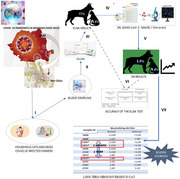 Figure 1
| CAT breed | No. of samples | Sex | Age category | |||
|---|---|---|---|---|---|---|
| F | M | Junior | Adult | Senior | ||
| Birman | 2 | 1 | 1 | 2 | ||
| Mixed breed | 63 | 35 | 28 | 10 | 38 | 15 |
| Siamese | 11 | 9 | 2 | 5 | 6 | |
| Persian | 6 | 1 | 5 | 2 | 4 | |
| Scottish | 2 | 2 | 0 | 1 | 1 | |
| Totals |
| 48 | 36 | 11 | 46 | 27 |
| ID | Species | Sampling time | SARS Cov2 variants circulating in humans |
|---|---|---|---|
|
| dog | June 2020 | Wuhan |
| 1235 | dog | October 2020 | Wuhan |
| 1326 | cat | November 2020 | Wuhan |
| 1421 | cat | December 2020 | Wuhan |
| 1426 | cat | January 2021 | Wuhan |
| 1494 | dog | January 2021 | 90%Wuhan/10% Alpha |
| 1510 | cat | February 2021 | Wuhan / 30% Alpha |
| 1604 | dog | March 2021 | 80%Alpha/20%Omicron |
| 1609 | dog | March 2021 | Alpha/ Beta |
| 1613 | cat | March 2021 | 95 %Alpha/Beta |
| 1640 | dog | April 2021 | 80%Alpha/20%Omicron |
| 1680 | dog | April 2021 | 75%Alpha/20%Omicron/ |
|
| dog | June 2021 | Alpha 80% / 20%Delta |
| 2034 | dog | August 2021 | Delta |
| 2216 | dog | November 2021 | Delta |
| 2259 | cat | November 2021 | Delta |
| 2271 | cat | November 2021 | Delta |
| 2606 | dog | June 2022 | Omicron |
| 2703 | cat | August 2022 | Omicron |
| 2731 | cat | August 2022 | Omicron |
| 2776 | cat | September 2022 | Omicron |
|
| dog | November 2022 | Omicron |
| 2884 | cat | November 2022 | Omicron |
|
| cat | February 2023 | Omicron |
| Sample ID | Breed/age/sex | ELISA result | Neutralizing Ab titer | |
|---|---|---|---|---|
| Wuhan | Omicron | |||
| 947 | Bichon/12yo/M | N | <1:20 | <1:20 |
| 1235 | Pincher/7 yo/F |
| <1:20 | <1:20 |
| 1494 | Bichon/13 yo/F |
| <1:20 | <1:20 |
| 1604 | Shar‐pei/ 6 yo/M |
| <1:20 | <1:20 |
| 1609 | Bichon/17 yo/F |
| <1:20 | <1:20 |
| 1640 | Mixed breed/3 yo/F |
| <1:20 | <1:20 |
| 1680 |
|
|
| <1:20 |
| 1784 | Bichon/6 yo/F |
| <1:20 | <1:20 |
| 2034 |
|
| <1:20 |
|
| 2216 | Pekinez/12 yo/F |
| <1:20 | <1:20 |
| 2606 |
|
|
|
|
| 2882 | Pekinez/12 yo/M |
| <1:20 | <1:20 |
| 2776 | Mixed breed/6yo/F | D | <1:20 | <1:20 |
| 3081 | Mixed breed/ 7 yo/M | N | <1:20 | <1:20 |
|
|
|
|
| <1:20 |
|
|
|
|
| <1:20 |
| 1426 |
|
|
| <1:20 |
| 1510 |
|
|
| <1:20 |
| 1613 |
|
|
| <1:20 |
|
|
|
|
| <1:20 |
| 2271 |
|
|
| <1:20 |
| 2703 |
|
|
|
|
| 2731 |
|
|
|
|
| 2884 |
|
| <1:20 | <1:20 |
| No. of tested samples | SARSCoV‐2 Prevalence (%) | ||||
|---|---|---|---|---|---|
| Country | cats | dogs | cats | dogs | References |
| Brazil | 182 | 762 | 2.2 | 4.3 | Jarrah et al. |
| Swiss | 172 | 49 | 4.65 | 4.08 | Kuhlmeier et al. |
| Wuhan | 102 | — | 10.8 | — | Zhang et al. |
| USA | 956 | 1336 | 0.4 | 0 | Barua et al. |
| The Netherlands | 240 | — | 0.8 | — | van der Leij et al. |
| France | 143 | 165 | 8.4 | 5.4 | Bessière et al. |
| Italy | 191 | 451 | 5.8 | 3.3 | Patterson et al. |
| Spain | 114 | — | 3.51 | — | Villanueva et al. |
| Portugal | 69 | 148 | 21.74 | 4.73 | Barroso et al. |
Peer Reviews
No public reviews on file for this paper yet. If you reviewed it on a platform where reviews are public (OpenReview, ICLR, NeurIPS, ICML), you can paste yours below so the community can read it here.
Videos
No videos yet. Explain this paper in a talk, walkthrough, or lecture? Add one.
Taxonomy
TopicsSARS-CoV-2 and COVID-19 Research · Animal Virus Infections Studies · Virus-based gene therapy research
Introduction
1
The COVID‐19 pandemic brought into light the necessity to better understand the zoonotic aspects of different pathogens. SARS‐CoV‐2, responsible for the COVID‐19 pandemic in humans, has been reported to transmit from humans to dogs and cats in several instances. There have been cases of pets testing positive for the virus after close contact with infected individuals (Alberto‐Orlando et al. 2022). Most of the studies reported the detection of specific antibodies in sera or SARS‐CoV‐2 RNA in faecal or respiratory swabs collected from pets from epidemic areas (Abdel‐Moneim and Abdelwhab 2020). The SARS‐CoV‐2 variants identified in cats and dogs are genetically similar to the ones that were circulating in humans at the same time, thus suggesting that zooanthroponotic transmission is a common and ongoing occurrence (Galhardo et al. 2023). By now, it is known that cats have a higher susceptibility to natural infection in comparison with dogs (Halfmann et al. 2020; Gaudreault et al. 2020; Sila et al. 2022), and virus transmission to other cats both by direct and indirect contact in laboratory conditions has been demonstrated (Bosco‐Lauth 2020). In addition, studies managed to demonstrate the transmission of the virus from cats to humans (Sila et al. 2022). The epidemiologic impact of pet‐to‐human transmissions is likely low, but this route represents nonetheless a risk for animal health workers such as veterinarians (Nielsen et al. 2023). Therefore, evaluating the SARS‐CoV‐2 serological status of household pets could help estimate the likelihood of zooanthroponotic transmission, which ultimately could mitigate the risk of SARS‐CoV‐2 zoonotic retransmission.
Despite continuous reports of SARS‐CoV‐2 infections in pets worldwide, there are still scattered data from Romania regarding this occurrence (Morosan et al. 2023; Crețu et al. 2022). The first pandemic wave started in Romania in March 2020, followed by successive waves until February 2022 with the most important infection peaks occurring in spring and autumn. Studying the seroconversion of household pets to circulating human SARS‐CoV‐2 strains can help evaluate the probability of the virus transmission to pets. This study aimed to add data from Romania to the international research effort analysing the presence of specific antibodies to SARS‐CoV‐2 in household cats and dogs during the COVID‐19 pandemic in humans.
Materials and Methods
2
Location of the Study and Animal Sampling
2.1
The survey was conducted prospectively during healthcare visits of animals at a veterinary clinic in Eastern Romania. The choice of the clinic was random and was based on the availability of the sample bank. For the purpose of the study, blood samples collected from March 2020 to December 2022 from cats and dogs in a small animal private practice in Iasi City (47° 10′ 0.012″ N and 27° 36′ 0 E) which is the third largest urban area in the country, were tested. Data from the Local Centre of Public Health Iași showed that the COVID‐19 morbidity rates in the human population were 2.8% in 2020, 4.4% in 2021, and 5.5% in 2022 situating the area among the most affected counties affected by COVID pandemics in Romania (from a total of 42). As of November 2022, Iasi reported 125,727 people who tested positive for COVID‐19 being placed the 6th in Romania (Statista Research Department 2023), with an overall prevalence of 12.68% in the county.
A total of 166 plasma samples from 84 cats and 82 dogs (corresponding to 166 different animals and households), that had direct contact with owners diagnosed previously with COVID‐19 were tested. Information on each sampled animal was registered by the veterinarian. It included the signalment of the animal (species, breed, age, and gender, Table 1). Blood samples were collected via cephalic and saphenous venipuncture. The plasma was extracted and stored at −20°C until further use after collection. The records did not include the exact date of the owner's infection with SARS‐CoV‐2 but only that they were COVID‐positive in the last 6 months prior to the animal consultation. Authorised medical staff from the clinic performed the sampling during the diagnostic procedure with the owners’ permission. Informed consent was obtained from every participating owner to use samples for diagnosis purposes (haematology, serology, biochemistry). All the handling of the animals was done in the frame of the 205/2004 Romanian Animal Welfare Law.
Serology
2.2
All plasma samples were tested for the presence of anti‐SARS‐CoV2 antibodies by ELISA test (ID Screen SARS‐CoV‐2 Double Antigen Multi‐species) and were performed according to the manufacturer's instructions. Briefly, the double antigen ELISA targets antibodies against the nucleocapsid of the SARS‐CoV‐2 virus. Sample dilutions of 1:50 were used. Positive and negative controls were provided by the manufacturer. A purified N protein recombinant antigen horseradish peroxidase (HRP) conjugate was used. After washing, the TMB Substrate Solution was added. Using a microplate spectrophotometer (Epoch 2; Agilent BioTek), the absorbance values were recorded at 450 nm wavelength. The results were expressed as the percentage of inhibition (IP). Samples with a S/P ratio equal to or higher than 60% were considered positive, while if the IP was ≤ 50%, they were considered negative. Cat‐positive samples were tested twice by ELISA to verify the accuracy of the results. In addition, a cat was sampled and tested three times.
Both cat and dog‐positive samples by ELISA were tested by seroneutralisation (SN) assay. The SARS‐CoV‐2 MAD6 viral strain (genome sequence identical to the Wuhan‐Hu isolate, GenBank MN908947) and Omicron strain were used, which were the predominant circulating lineages in humans (2020/2022) in Romania. The variants circulating in Romania at the time of collection were assessed based on the results provided by the National Centre for Communicable Diseases Surveillance and Control Romania (Table 2), (Centrul Național de Supraveghere Şi Control al Bolilor Transmisibile—Analiză Cazuri Confirmate COVID19, n.d.). Serial dilutions of heat‐inactivated cat or dog sera (starting at 1:10) were incubated with 100 PFU of SARS‐CoV‐2 MAD6 or Omicron for 1 h at 37°C in 96‐well plates. Vero E6 cells of 2 × 10^4^ were then seeded on the sera/virus mixture and incubated for 3 days at 37°C, 5% CO_2_. Culture media was removed and cells were fixed with 2% paraformaldehyde prior to staining with 2% crystal violet. Neutralising antibodies (Nab) titers were calculated as the serum dilution at which less than 50% cytopathic effect was observed in replicate wells.
Statistical Analyses
2.3
Results from the serology analyses, registered information per individual cat and dog, were entered into a Microsoft Excel spreadsheet. The seroprevalence was calculated at a 95% confidence interval, based on the binomial distribution, using the web‐based Free Statistics Calculators (Free Statistics Calculators, n.d.). The sensitivity and specificity of the ELISA against the SN test were calculated using the basic formulas as described by Trevethan R., (Trevethan 2017), where the golden standards were considered the SN test results.
Results
3
To investigate the prevalence of SARS‐CoV‐2 in domestic cats and dogs living in close contact with owners, plasma samples were collected from animals living in a district of Iasi City, Romania. SARS‐CoV‐2 ELISA showed a 9.5% seroprevalence in cats (8/84), [CI 95%: 3.25–15.8] and 11% seroprevalence in dogs (9/82), [CI 95%: 4.21–17.74] in plasma samples (Table 3).
To further confirm the presence of SARS‐CoV‐2 specific antibodies, the positive sera were tested by SN assay. Out of the eight positive samples detected by ELISA in cats, seven were also positive (9.4%) [CI 95%: 3.2–15.6] in SN assays (SN titers ranging from 1:20 to 1:320) whereas from the nine positive dog samples, Nab were detected in only two samples (2.4%) [CI 95%: ‐0.9–5.78] (SN titers ranging from 1:20 to 1:80). The negative samples in ELISA were also negative in SN assays (Table 3). The overall sensitivity of ELISA calculated against the SN test was 60% and the specificity was 45.71%.
Most NAb in cats blocked infection with the Wuhan MAD6 strain but not the Omicron strain, which suggests that pet infection did not generate cross‐reactive NAb. One dog S2606 possessed NAb to both Wuhan and Omicron strains (Table 3) suggesting a coinfection. In cats, there were two samples (S2703, S2731) in which NAb to both lineages were detected. Regarding clinical signs, the majority of the animals presented to the veterinarian for routine checks or surgical interventions. However, S2731 suffered from acute gastroenteritis (that was treated successfully in the clinic, and cat S2703 had a febrile syndrome and a regenerative anaemia.
Re‐testing of one cat that was in the evidence of the clinic with liver failure and was monitored after one year showed persistence of circulating antibodies with a 4‐fold reduction of the NAb titer from 1: 320 to 1:80 (samples no. 1326 and 2259), but with the same neutralisation level when tested at a month interval (sample no. 1326 and 1421). No data about the owner's COVID‐19 infection were gathered after the first sampling in December 2020.
Discussion
4
Our survey showed similar results to studies found in other countries in animals that were only housed indoors or had also street access (Table 4). Higher levels of neutralizing antibodies against SARS‐CoV‐2 were found in cats and low levels of antibodies and a lower seroprevalence in dogs (Gaudreault et al. 2020). Previous studies also showed that cats owned by COVID‐19 patients are more prone to develop higher neutralisation titers due to the close contact between cats and COVID‐19 patients (Zhang et al. 2020).
TABLE 4: Literature review regarding SARSCoV‐2 seroprevalence in pets (ELISA and SN * ).
Although, seroconversion in household cats and dogs was similar in our study using the ELISA test, the presence of Nab was markedly higher in cats, both in terms of percentage and antibody titers. SARS‐CoV‐2 replication is more efficient in cats than in dogs (Shi et al. 2020). This could lead to increased antigen exposure in cats, which would prompt potent adaptive immune responses characterised by Nab. In dogs, viral replication is poor, the infection is likely controlled mainly through innate immune mechanisms, resulting in lower activation of adaptive immune mechanisms such as the induction of Nab (Nielsen et al. 2023; Tomeo‐Martín et al. 2024). It should be noted that in the absence of the exact infection time of the pet owner with SARS‐CoV‐2, some of these differences could be attributed to sampling in dogs at later time points in which antibody titers have subsided, although this seems unlikely given the higher titer of Nab consistently detected in cats in our study. Nonetheless, it should be noted that one limitation of this study is the fact that the information about the occurrence of SARS‐CoV‐2 infection in owners was limited to the owners reporting it within six months prior to the sampling The seroprevalence we report herein could be lower than the real infection burden in pets, due to antibody titers that could have declined below the detection threshold of our techniques within the testing timeframe that we had. Our data also show that little cross‐reaction exists between MAD6‐specific Nab and Omicron antibodies in cats. This is in line with studies in humans that have found that infection with the Wuhan strain conferred little to no cross‐reactive Nab to omicron strains. Conversely, infection with omicron also provided a limited generation of Nab to Wuhan strains in unvaccinated individuals (Richardson et al. 2022). Thus, it is possible that in the cases of the dog and cats that presented antibodies to both Wuhan and Omicron SARS‐CoV‐2 lineages, repeated infection of these animals has occurred, first with Wuhan‐related strains and then with an Omicron‐related virus. In the absence of longitudinal samples, it is however impossible to confirm this, since it could also be the result of the generation of cross‐reactive Nab in these animals.
The reported prevalences differ from one study to another and may be related to the heterogeneity of the data taken into account (e.g. different animal populations, different test characteristics, and the characteristics of the pandemics at the time of sampling). The slightly higher seroprevalence in cats in our study compared to studies in other countries (Table 4), can be explained by the origin of the pets that were living inside the house in close contact with the owners. Studies reporting a lower seroprevalence took into consideration samples from stray or hospitalised cats (Brazil 2023), or only from stray cats (Spain 2021). Other studies targeting households’ animals reported seroprevalence varied from 0.2% in Dutch dogs without known contact with COVID‐19‐positive persons (Zhao et al. 2021) to 53% in dogs living in COVID‐19‐positive households in France (Fritz et al. 2021). In Italy, 3.3% of dogs and 5.8% of cats presented specific antibody responses (Patterson et al. 2020).
The findings about the persistence of specific seroneutralising antibodies in the present work are different from a previous study in which persistence was limited to 110 days (Zhang et al. 2020) since we still detected an NAb titer of 1:80 after one year in one cat. This is in accordance with more recent studies that showed a longer persistence of neutralising antibodies in pets (Decaro et al. 2022).
The use of ELISA against the nucleocapsid protein of SARS‐CoV‐2 that was commercially available at the time of starting our study was one of the study limitations. The overall sensitivity of ELISA calculated against the SN test was 60% and the specificity was 45.71%. Most Nab target the spike protein, thus our ELISA based on detecting antibodies to the nucleocapsid is unlikely to be a good predictor of neutralizing antibodies. Indeed, a comprehensive study comparing the use of different serological methods showed that spike protein‐based ELISAs are the most accurate tests for serodiagnosis of SARS‐CoV‐2 infections in cats and dogs (Diezma‐Díaz et al. 2023). Our data regarding the seroconversion are also in line with those results based on the comparison between anti‐nucleocapsid ELISA and SN test in dogs. It is likely that this difference is less notable in cats because viral replication is more efficient in this species (Shi et al. 2020). Increased replication would result in more antigen availability in cats, which in turn would induce higher antibody titers, both to the nucleocapsid and the spike protein, thus increasing the likelihood of neutralising antibody generation. However, serological testing using ELISA is the preferred choice in screening and preliminary seroconversion studies due to its high throughput, cost‐efficiency, safety, automation, and rapid turnaround time. For monitoring and surveillance of pathogens with a zoonotic potential such as SARS‐CoV‐2, the use of accurate ELISA kits for preliminary studies is highly recommended.
Conclusion
5
This is the first study that provides reliable serological evidence of SARS‐CoV‐2 exposure in household pets during the pandemic in Romania and describes the persistence of antibodies in one cat proving a long term seroconversion. The cats that were living in households in one area of the city were prone to be infected with SARS‐CoV‐2 from their owners and, high levels of seroconversion were detected. The ELISA commercially available at the time of testing and used in the study showed a low sensitivity in comparison with the SN assay. Based on our results, we recommend the use of a test with a higher sensitivity for serological screening as suggested also by other studies. The results of the seroconversion study from Romania, are in concordance with previous serological studies made in households with SARS‐CoV‐2 infected individuals that were cohabitating with their pets during the COVID‐19 epidemics. We are confirming that dogs and cats are susceptible to the infection, with cats being more susceptible in comparison to dogs.
Author Contributions
Luanda Elena Oslobanu: Conceptualisation, data curation, formal analysis, investigation, methodology, resources, writing – original draft. Luciana Alexandra Crivei: Formal analysis, investigation. Gheorghe Savuta: Formal analysis, project administration, supervision, visualisation. Laro Gómez‐Marcos: Data curation, formal analysis, investigation, methodology, writing – original draft. Pablo Nogales‐Altozano: Investigation, methodology, validation. José M. Rojas: Conceptualisation, data curation, resources, validation, writing – original draft, writing – review and editing. Noemí Sevilla: Conceptualisation, formal analysis, funding acquisition, investigation, methodology, visualisation, writing – review and editing.
Ethics Statement
The authors confirm that the ethical policies of the journal, as noted on the journal's author guidelines page, have been adhered to. No ethical approval was required as this is a serological investigation using samples from a sample data base. Authorised medical staff performed the sampling during the diagnostic procedure with the owners’ permission. Informed consent was obtained from every participating owner to use samples for diagnosis purposes (haematology, serology, biochemistry). All the handling of the animals was done in the frame of the 205/2004 Romanian Animal Welfare Law.
Conflicts of Interest
The authors declare no conflicts of interest.
Peer Review
The peer review history for this article is available at https://www.webofscience.com/api/gateway/wos/peer‐review/10.1002/vms3.70358.
The reference list from the paper itself. Each links out to its DOI / PubMed record.
- 1Abdel‐Moneim, A. S. , and E. M. Abdelwhab . 2020. “Evidence for SARS‐Co V‐2 Infection of Animal Hosts.” Pathogens 9, no. 7: 529. 10.3390/pathogens 9070529.32629960 PMC 7400078 · doi ↗ · pubmed ↗
- 2Alberto‐Orlando, S. , J. L. Calderon , A. Leon‐Sosa , et al. 2022. “SARS‐Co V‐2 Transmission From Infected Owner to Household Dogs and Cats is Associated With Food Sharing.” International Journal of Infectious Diseases 122: 295–299. 10.1016/j.ijid.2022.05.049.35643308 PMC 9132679 · doi ↗ · pubmed ↗
- 3Barroso, R. , A. Vieira‐Pires , A. Antunes , and I. Fidalgo‐Carvalho . 2022. “Susceptibility of Pets to SARS‐Co V‐2 Infection: Lessons From a Seroepidemiologic Survey of Cats and Dogs in Portugal.” Microorganisms 10, no. 2: 345. 10.3390/microorganisms 10020345.35208799 PMC 8879010 · doi ↗ · pubmed ↗
- 4Barua, S. , M. Hoque , F. Adekanmbi , et al. 2021. “Antibodies to SARS‐Co V‐2 in dogs and cats, USA.” Emerging Microbes & Infections 10, no. 1: 1669–1674. 10.1080/22221751.2021.1967101.34374631 PMC 8381919 · doi ↗ · pubmed ↗
- 5Bessière, P. , T. Vergne , M. Battini , et al. 2022. “SARS‐Co V‐2 Infection in Companion Animals: Prospective Serological Survey and Risk Factor Analysis in France.” Viruses 14, no. 6: 1178. 10.3390/v 14061178.35746652 PMC 9229200 · doi ↗ · pubmed ↗
- 6Bosco‐Lauth, A. M. 2020. “Experimental Infection of Domestic Dogs and Cats With SARS‐Co V‐2: Pathogenesis, Transmission, and Response to Reexposure in Cats.” Proceedings of the National Academy of Sciences of the United States of America 117, no. 42: 26382–26388. 10.1073/pnas.2013102117.32994343 PMC 7585007 · doi ↗ · pubmed ↗
- 7“Centrul Național de Supraveghere şi Control al Bolilor Transmisibile—Analiză cazuri confirmate COVID 19.” (n.d.). Retrieved 8 February 2024. https://www.cnscbt.ro/index.php/analiza‐cazuri‐confirmate‐covid 19.
- 8Crețu, D. M. , M. R. Gurău , M. Turcitu , and S. Bărăităreanu . 2022. “SARS‐Co V‐2 Detection In Three Cats (Felis catus) by Real‐Time Reverse‐Transcriptase Polymerase‐Chain‐Reaction In Bucharest, Romania.” Scientific Works. Series C. Veterinary Medicine LXVIII: 45–50.