Kinematic and neuromuscular responses to different visual focus conditions in stand-up paddleboarding
João Freitas, Ana Conceição, Jan Stastny, Jorge E. Morais, Diogo L. Marques, Hugo Louro, Daniel A. Marinnho, Henrique P. Neiva

TL;DR
This study shows that allowing paddleboarders to freely choose their visual focus improves their speed and muscle activation during stand-up paddleboarding.
Contribution
The study introduces a novel analysis of how different visual focus strategies affect kinematics and neuromuscular activity in stand-up paddleboarding.
Findings
Free visual focus increased speed, stroke frequency, and stroke index significantly compared to other conditions.
Free choice led to higher triceps brachii activation during recovery and greater biceps brachii activity during the pull phase.
Looking at the board nose reduced muscle activity in the triceps brachii and tibialis anterior compared to free choice.
Abstract
This study analyzed the kinematics and muscle activity during the stand-up paddleboarding (SUP) under different visual focus points in three conditions: i) eyes on the board nose, ii) looking at the turn buoy, and iii) free choice. Fourteen male paddleboarders (24.2 ± 7.1 years) performed three trials covering 65 m, and the electromyographic (EMG) activation patterns and kinematic parameters in four cycle strokes for the left and right sides were analyzed. Surface EMG of the upper trapezius, biceps brachii, triceps brachii, tibialis anterior, and gastrocnemius medialis were recorded. The data were processed according to the percentage of maximum voluntary contraction (%MVC). Speed, stroke frequency (SF), stroke length, and stroke index (SI) were analyzed. The speed, SF, and SI (p < 0.01, η2 ≥ 0.42) showed significant variance between conditions, with the free condition achieving the…
Genes, proteins, chemicals, diseases, species, mutations and cell lines named across the full text — each resolved to its canonical identifier and authoritative record.
Click any figure to enlarge with its caption.
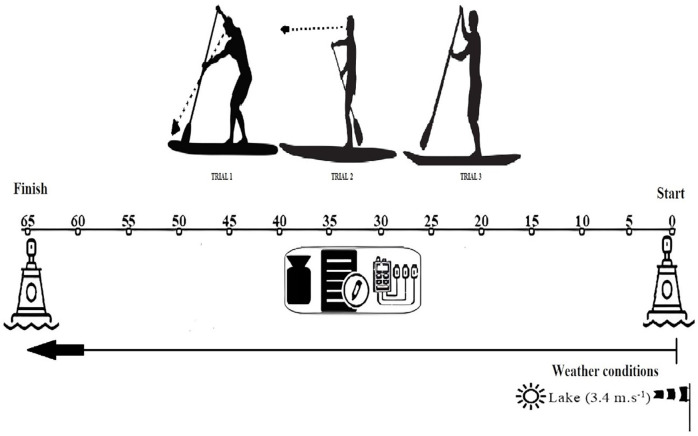 Figure 1
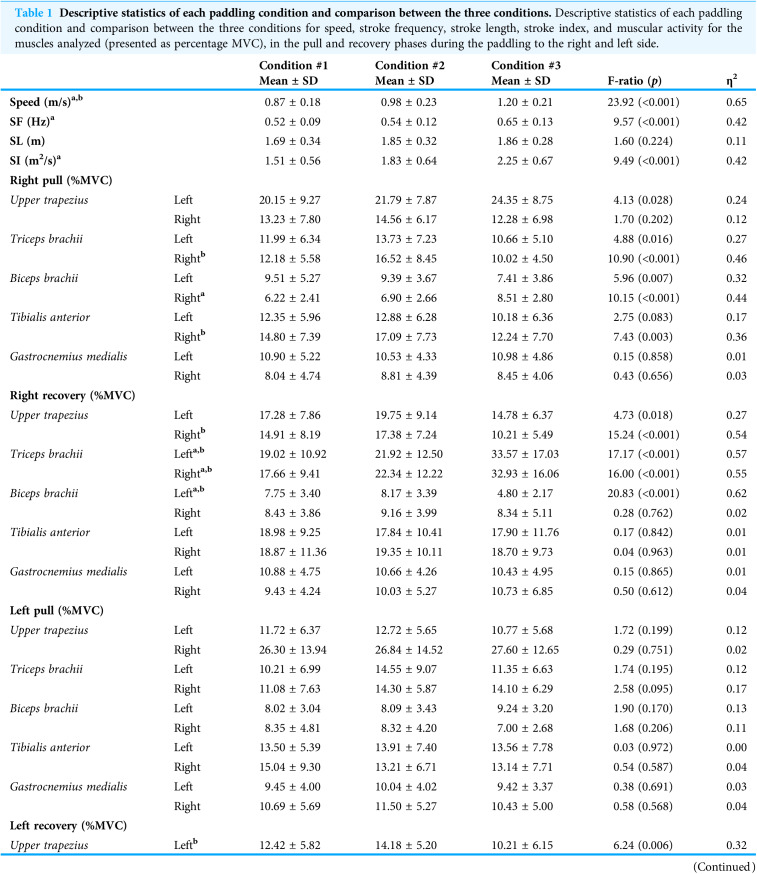 Figure 2
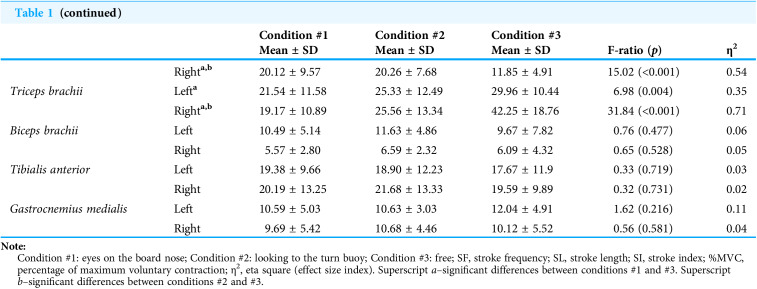 Figure 3
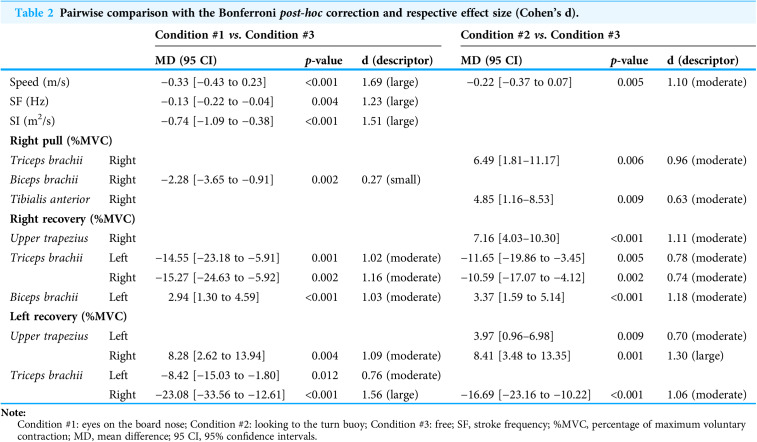 Figure 4
Peer Reviews
No public reviews on file for this paper yet. If you reviewed it on a platform where reviews are public (OpenReview, ICLR, NeurIPS, ICML), you can paste yours below so the community can read it here.
Videos
No videos yet. Explain this paper in a talk, walkthrough, or lecture? Add one.
Taxonomy
TopicsChildren's Physical and Motor Development · Sports Performance and Training · Motor Control and Adaptation