The alpha tubulin acetyltransferase atat-2 genetically interacts with klp-4 in C. elegans
Claire E. Reist, Michael D. Webb, Cortlen M. Mathews, Jay N. Pieczynski

TL;DR
This study explores how microtubule acetylation and kinesin function interact in C. elegans using genetic and pharmacological methods.
Contribution
The paper identifies a genetic interaction between atat-2 and klp-4 in C. elegans, linking microtubule acetylation to kinesin activity in vivo.
Findings
A genetic interaction was found between atat-2 and klp-4 in C. elegans.
Microtubule acetylation status affects kinesin function in a living organism.
Pharmacological and genetic approaches were combined to study tubulin code interactions.
Abstract
Microtubules dynamics are in part regulated by post-translational modification, including acetylation. Little is known about the relationship between microtubule acetylation status and how this affects kinesin function, especially in vivo . Using a series of aldicarb sensitivity assays in C. elegans where we combined pharmacological manipulation of microtubule dynamics with genetic approaches, we demonstrate a specific genetic interaction between the alpha tubulin acetyltransferase atat-2 and the kinesin motor klp-4 . Our work highlights interactions between kinesin activity and the tubulin code in vivo and lays the foundation of future work on these two parallel, yet related processes in cells.
Genes, proteins, chemicals, diseases, species, mutations and cell lines named across the full text — each resolved to its canonical identifier and authoritative record.
Click any figure to enlarge with its caption.
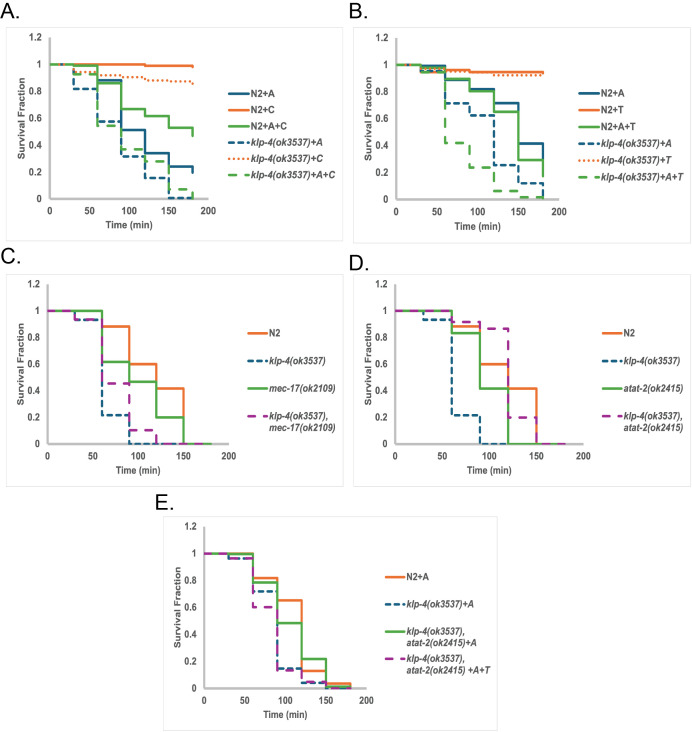 Figure 1
Peer Reviews
No public reviews on file for this paper yet. If you reviewed it on a platform where reviews are public (OpenReview, ICLR, NeurIPS, ICML), you can paste yours below so the community can read it here.
Videos
No videos yet. Explain this paper in a talk, walkthrough, or lecture? Add one.
Taxonomy
TopicsMicrotubule and mitosis dynamics · Ubiquitin and proteasome pathways · Cancer-related Molecular Pathways