On Flipping Edge Sets in Unique Sink Orientations
Michaela Borzechowski, Simon Weber

TL;DR
This paper improves the efficiency of computing phases in unique sink orientations and explores their structural and computational properties.
Contribution
An improved algorithm for computing phases in USOs and new insights into their computational complexity and structure.
Findings
An algorithm to compute phases in USOs in O(n·3^n) time, improving on the previous O(n·4^n) method.
Flipping a phase can be done in polynomial space relative to the USO storage.
Determining if two edges are in the same phase is PSPACE-complete for succinctly encoded USOs.
Abstract
A unique sink orientation (USO) is an orientation of the n-dimensional hypercube graph such that every non-empty face contains a unique sink. We consider the only known connected flip graph on USOs. This flip graph is based on the following theorem due to Schurr: given any n-dimensional USO and any one dimension \documentclass[12pt]{minimal} \usepackage{amsmath} \usepackage{wasysym} \usepackage{amsfonts} \usepackage{amssymb} \usepackage{amsbsy} \usepackage{mathrsfs} \usepackage{upgreek} \setlength{\oddsidemargin}{-69pt} \begin{document}\end{document}i∈[n], the set \documentclass[12pt]{minimal} \usepackage{amsmath} \usepackage{wasysym} \usepackage{amsfonts} \usepackage{amssymb} \usepackage{amsbsy} \usepackage{mathrsfs} \usepackage{upgreek} \setlength{\oddsidemargin}{-69pt}…
Genes, proteins, chemicals, diseases, species, mutations and cell lines named across the full text — each resolved to its canonical identifier and authoritative record.
Click any figure to enlarge with its caption.
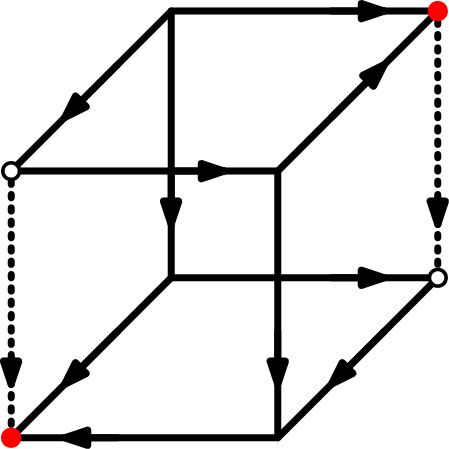 Figure 1
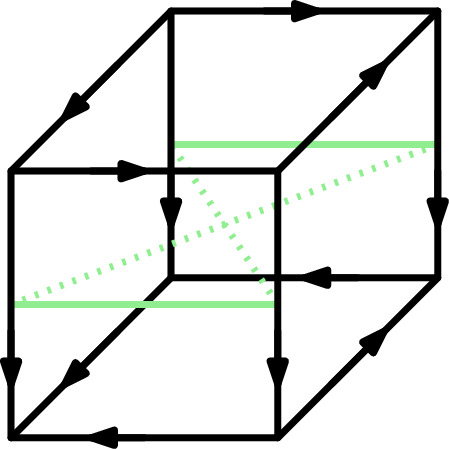 Figure 2
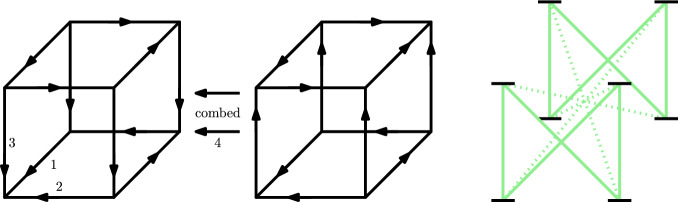 Figure 3
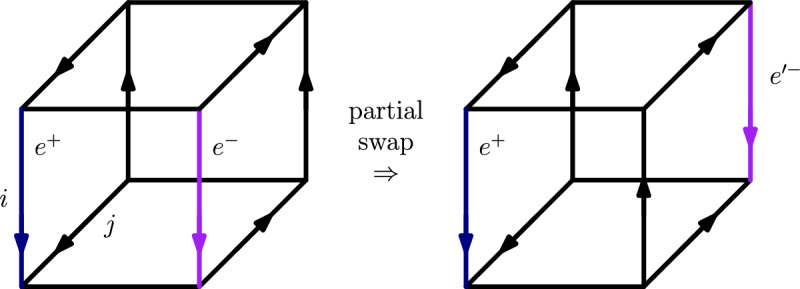 Figure 4
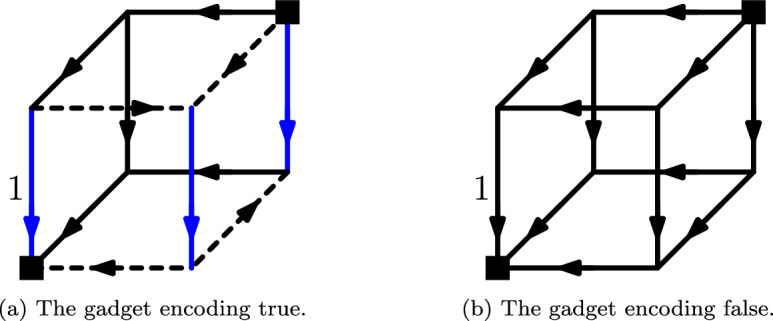 Figure 5
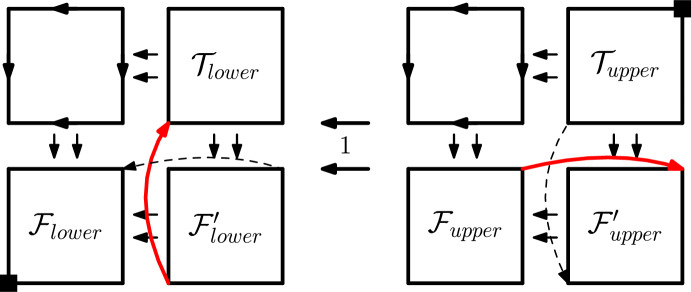 Figure 6
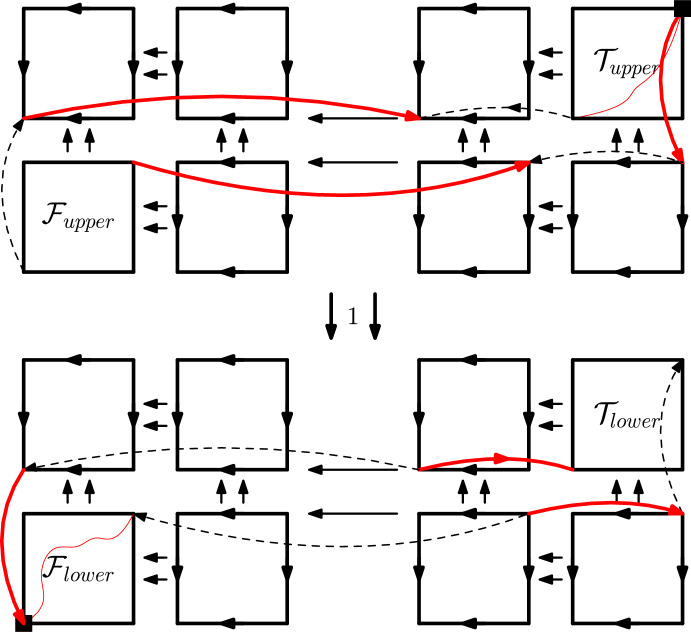 Figure 7
Peer Reviews
No public reviews on file for this paper yet. If you reviewed it on a platform where reviews are public (OpenReview, ICLR, NeurIPS, ICML), you can paste yours below so the community can read it here.
Videos
No videos yet. Explain this paper in a talk, walkthrough, or lecture? Add one.
Taxonomy
TopicsAdvanced Graph Theory Research · Interconnection Networks and Systems · graph theory and CDMA systems