Characterizing Social Communication Difficulties in Young Children within a Longitudinal Ecological Systems Framework
Samantha C. Perlstein, Wanjikũ F. M. Njoroge, Lauren K. White, Julia Parish-Morris, Alasia I. Williams, Kayla S. Malone, Yuheiry Rodriguez, Sydney Sun, Kate Wisniewski, Ayomide Popoola, Michaela Flum, Sara L. Kornfield, Jakob Seidlitz, Barbara H. Chaiyachati, Ran Barzilay

TL;DR
This study explores how factors like neighborhood resources and maternal bonding affect social communication difficulties in young children, using a longitudinal ecological approach.
Contribution
The study introduces a longitudinal ecological systems framework to identify risk factors for early social communication difficulties in children.
Findings
Fewer neighborhood resources were linked to more social communication difficulties at age 1 in dyads with impaired maternal bonding.
Lower gestational age, income, and maternal bonding were associated with more difficulties at age 2.
Neighborhood resources had a stronger effect at age 2 among families with low income.
Abstract
Social communication difficulties are a transdiagnostic risk factor for psychopathology. However, few studies have examined prospective risk for social communication difficulties in young children within an ecological systems framework. Our sample was 251 parent–child dyads assessed during pregnancy, postpartum, and toddlerhood (child ages 1 and 2). We leveraged observer ratings of child behavior, parent-reported questionnaires, and geocoded data. We examined prospective risk factors for social communication difficulties at ages 1 and 2, including at the level of the child (gestational age), family (household income, maternal mental health, maternal-child bonding), and neighborhood (neighborhood resources). Fewer neighborhood resources were associated with more social communication difficulties at age 1, but only among dyads with impaired maternal bonding. Lower gestational age, lower…
Genes, proteins, chemicals, diseases, species, mutations and cell lines named across the full text — each resolved to its canonical identifier and authoritative record.
Click any figure to enlarge with its caption.
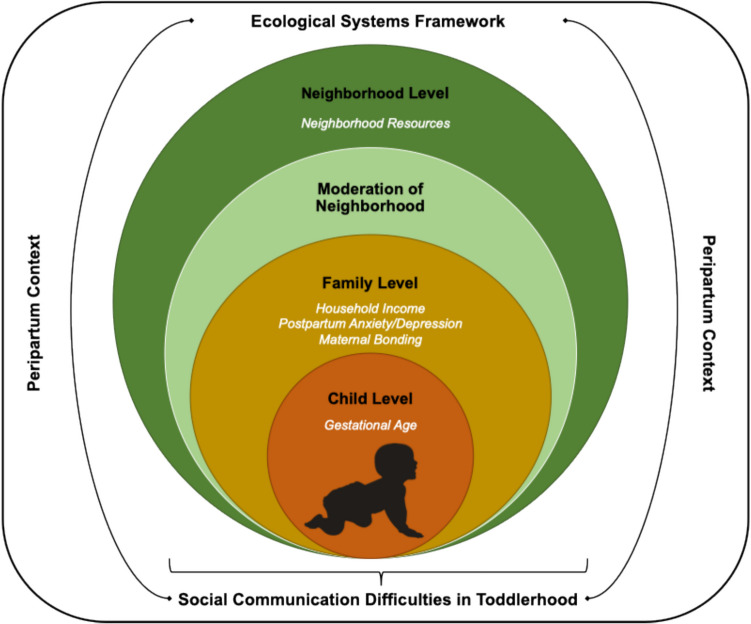 Figure 1
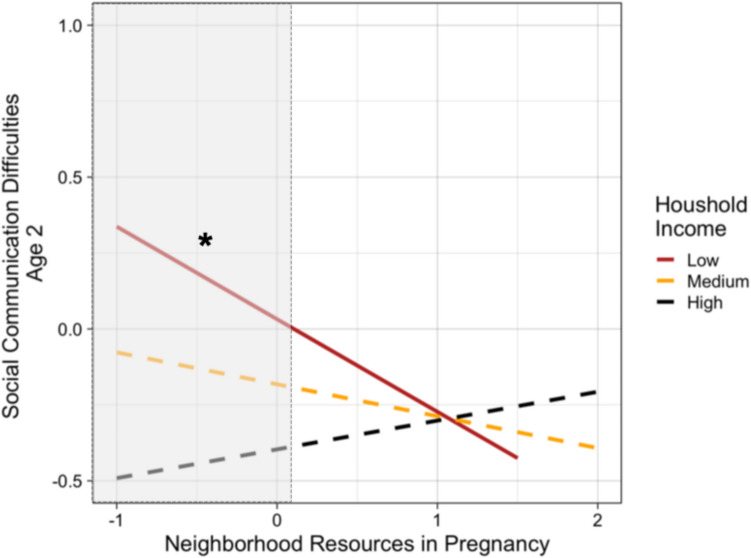 Figure 2
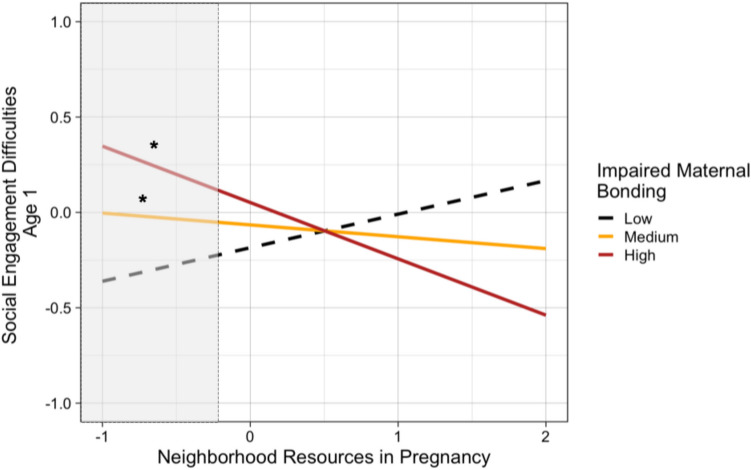 Figure 3
Peer Reviews
No public reviews on file for this paper yet. If you reviewed it on a platform where reviews are public (OpenReview, ICLR, NeurIPS, ICML), you can paste yours below so the community can read it here.
Videos
No videos yet. Explain this paper in a talk, walkthrough, or lecture? Add one.
Taxonomy
TopicsChild and Adolescent Psychosocial and Emotional Development · Maternal Mental Health During Pregnancy and Postpartum · Infant Health and Development