The mutational landscape and its longitudinal dynamics in relapsed and refractory classic Hodgkin lymphoma
Hanno Witte, Axel Künstner, Thomas Hahn, Veronica Bernard, Stephanie Stölting, Kathrin Kusch, Kumar Nagarathinam, Cyrus Khandanpour, Nikolas von Bubnoff, Arthur Bauer, Michael Grunert, Svenja Hartung, Annette Arndt, Konrad Steinestel, Hartmut Merz, Hauke Busch, Alfred C. Feller

TL;DR
This study explores the genetic differences in Hodgkin lymphoma patients who do not respond to treatment or relapse, identifying specific mutations that could lead to new therapies.
Contribution
The study identifies novel mutational signatures and longitudinal dynamics in relapsed and refractory classic Hodgkin lymphoma using ultra-deep sequencing.
Findings
Mutations in genes like PMS2, PDGFRB, KAT6A, EPHB1, and HGF are more frequent in refractory/relapsed cHL.
NOTCH pathway mutations are selected in relapsed/refractory cHL, while hippo-pathway mutations are negatively selected.
Distinct mutational profiles between responders and non-responders were identified, suggesting therapeutic vulnerabilities.
Abstract
In classic Hodgkin-lymphoma (cHL), only a few cases recur, and only a limited fraction of patients is primary-refractory to standard-polychemotherapy. Underlying genomic features of unfavorable clinical courses remain sparsely characterized. Here, we investigated the genomic characteristics of primary-refractory/relapsed cHL in contrast with responders. Therefore, ultra-deep next-generation panel-sequencing was performed on a total of 59 FFPE-samples (20 responders, 26 relapsed (rHL: 11 initial-diagnosis, 15 relapse) and 13 primary-refractory (prHL: 8 initial-diagnosis, 5 progression) from 44 cHL-patients applying a hybrid-capture approach. We compared samples associated with distinct disease courses concerning their oncogenic drivers, mutational signatures, and perturbed pathways. Compared to responders, mutations in genes such as PMS2, PDGFRB, KAT6A, EPHB1, and HGF were detected more…
Genes, proteins, chemicals, diseases, species, mutations and cell lines named across the full text — each resolved to its canonical identifier and authoritative record.
Click any figure to enlarge with its caption.
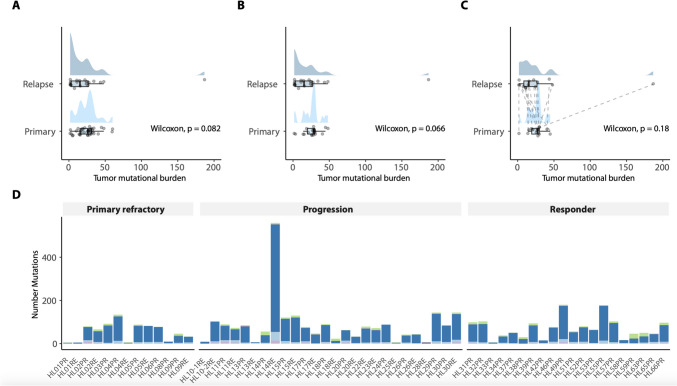 Figure 1
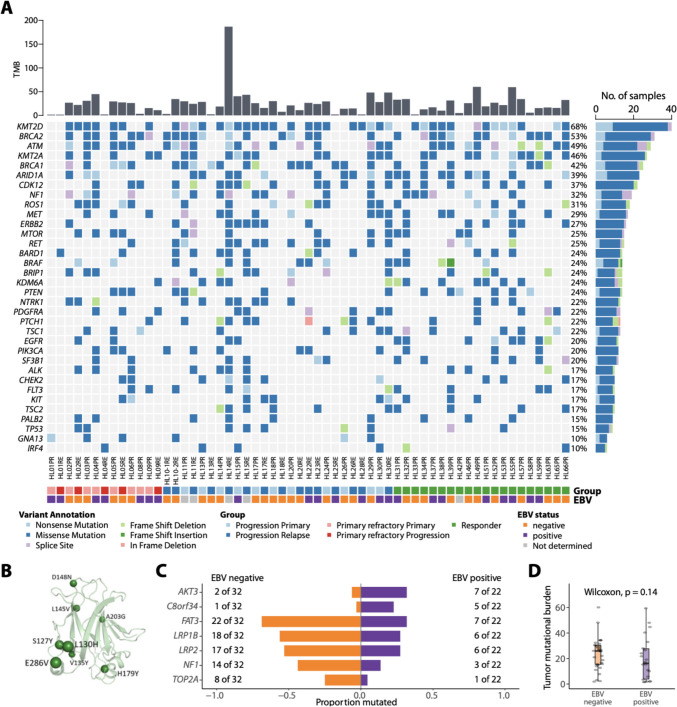 Figure 2
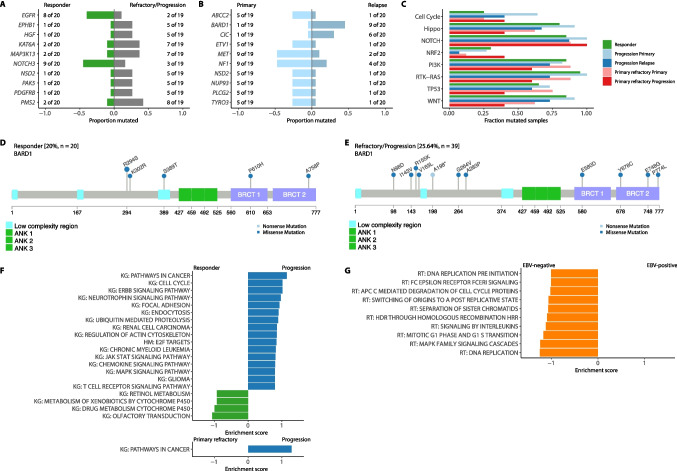 Figure 3
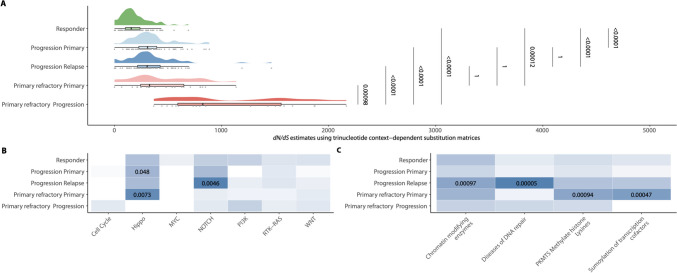 Figure 4
Peer Reviews
No public reviews on file for this paper yet. If you reviewed it on a platform where reviews are public (OpenReview, ICLR, NeurIPS, ICML), you can paste yours below so the community can read it here.
Videos
No videos yet. Explain this paper in a talk, walkthrough, or lecture? Add one.
Taxonomy
TopicsLymphoma Diagnosis and Treatment · Cancer Genomics and Diagnostics · Genetic factors in colorectal cancer