3D Spheroid Cultures for Salivary Gland Tissue Engineering: Effects of Fibroblast on Epithelial Cell Function
Lan Thi Phuong Nguyen, Joo Hyun Kim, Jiwon Son, Sung Sik Hur, Minyong Lee, Hyung Kwon Byeon, Jin-Young Kim, Myung Jin Ban, Joo Hyun Kim, Man Ryul Lee, Jae Hong Park, Yongsung Hwang

TL;DR
This study explores how combining epithelial cells and fibroblasts in 3D spheroids can help create salivary gland-like tissues, with a specific cell ratio showing the best results.
Contribution
The study identifies an optimal 2:1 epithelial to fibroblast ratio for maintaining salivary gland epithelial cell function in 3D spheroids.
Findings
A 2:1 ratio of epithelial cells to fibroblasts preserved epithelial cell phenotypes and structural integrity.
The optimal ratio reduced apoptosis and senescence markers while increasing progenitor marker expression.
These spheroids may serve as a model for salivary gland tissue engineering.
Abstract
Three-dimensional (3D) spheroid cultures are crucial for modeling salivary gland (SG) morphogenesis and advancing regenerative medicine. This study evaluated the effects of varying ratios of mouse SG-derived epithelial cells co-cultured with human dermal fibroblasts (hDFs), identifying a 2:1 ratio (spheroids containing 67% EpCAMpos cells with 33% hDFs) as optimal for preserving native SG-derived epithelial cell phenotypes. At this ratio, 67% EpCAMpos spheroids maintained structural integrity and demonstrated a significant reduction in apoptosis and senescence markers, specifically, cleaved caspase-3 (Cc3) and Serpine1, alongside an enhanced expression of the progenitor marker Keratin 5 (KRT5). This highlights the pivotal role of fibroblasts in supporting epithelial cell function in 3D cultures. These spheroids provide a useful model for developing SG tissues that closely mimic…
Genes, proteins, chemicals, diseases, species, mutations and cell lines named across the full text — each resolved to its canonical identifier and authoritative record.
Click any figure to enlarge with its caption.
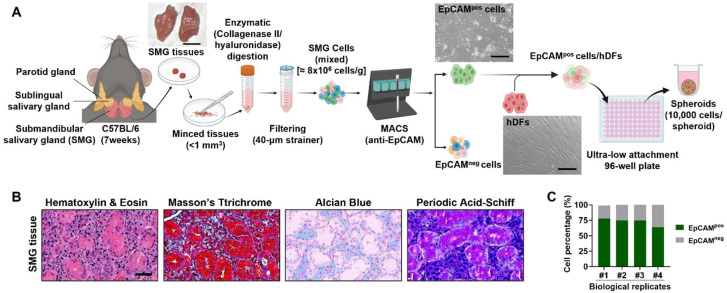 Figure 1
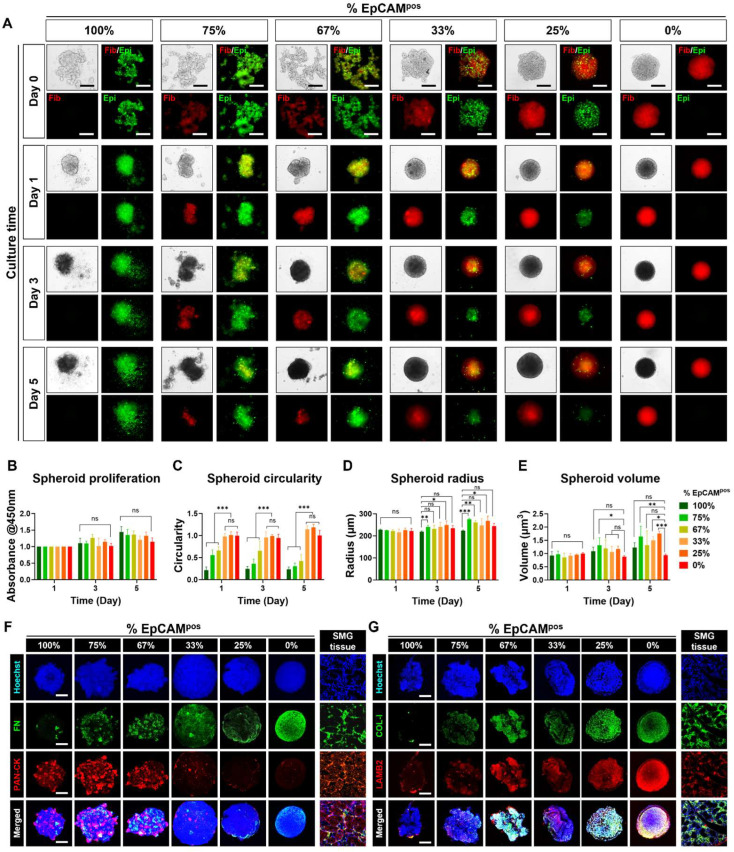 Figure 2
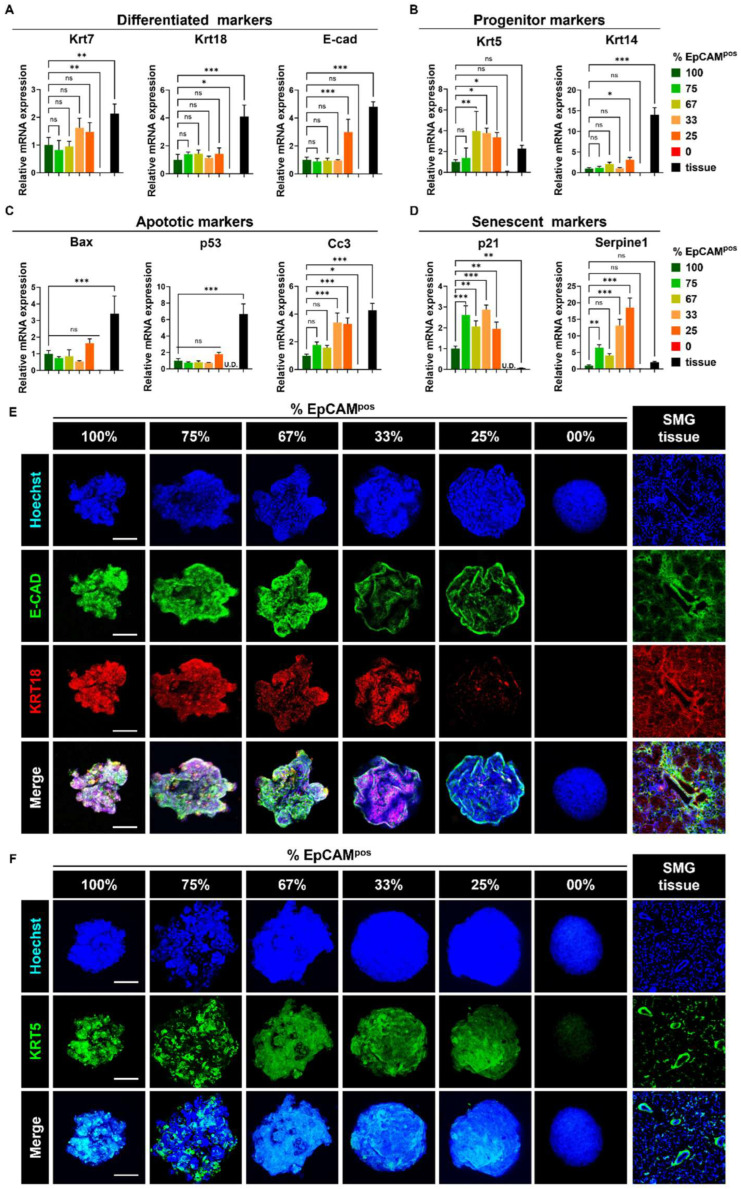 Figure 3
Peer Reviews
No public reviews on file for this paper yet. If you reviewed it on a platform where reviews are public (OpenReview, ICLR, NeurIPS, ICML), you can paste yours below so the community can read it here.
Videos
No videos yet. Explain this paper in a talk, walkthrough, or lecture? Add one.
Taxonomy
TopicsSalivary Gland Disorders and Functions · Mesenchymal stem cell research · 3D Printing in Biomedical Research