Targeted Suppression of CEACAM6 via pHLIP-Delivered RNAs in Pancreatic Ductal Adenocarcinoma
Hongsik Kim, Chang-Gok Woo, Seung-Myoung Son, Yong-Pyo Lee, Hee-Kyung Kim, Yaewon Yang, Jihyun Kwon, Ki-Hyeong Lee, Ho-Chang Lee, Ok-Jun Lee, Hye-Sook Han

TL;DR
This study shows that using pHLIP technology to deliver RNA molecules targeting CEACAM6 can effectively suppress pancreatic cancer growth in mice.
Contribution
The novel use of pHLIP to deliver siRNA and miRNA targeting CEACAM6 in pancreatic cancer treatment is demonstrated.
Findings
pHLIP-siCEACAM6 and pHLIP-miR-29a suppressed CEACAM6 expression and reduced cell viability under acidic conditions.
In mice, pHLIP-siCEACAM6 and pHLIP-miR-29a reduced tumor growth by 25.1% and 21.2%, respectively.
pHLIP technology shows promise for delivering RNA to pancreatic cancer cells by targeting the acidic tumor environment.
Abstract
Background and Objectives: Carcinoembryonic antigen-related cell adhesion molecule 6 (CEACAM6) is involved in pancreatic cancer progression and is an attractive therapeutic target for pancreatic cancer. In this study, we evaluated the therapeutic efficacy of small-interfering RNA (siRNA) targeting CEACAM6 (siCEACAM6) and the CEACAM6-suppressive microRNA-29a (miR-29a) in a pancreatic ductal adenocarcinoma xenograft mouse model using pH-low insertion peptide (pHLIP) technology, which targets the acidic tumor microenvironment. Materials and Methods: The delivery vectors for siRNA and miRNA were constructed by conjugating the peptide nucleic acid forms of siCEACAM6 and miR-29a to a peptide with a pHLIP, enabling the transport of siRNA and miRNA across the plasma membrane. The tumor-suppressive effects of pHLIP-siCEACAM6 and pHLIP-miR-29a were assessed in vivo using a BALB/c xenograft mouse…
Genes, proteins, chemicals, diseases, species, mutations and cell lines named across the full text — each resolved to its canonical identifier and authoritative record.
Click any figure to enlarge with its caption.
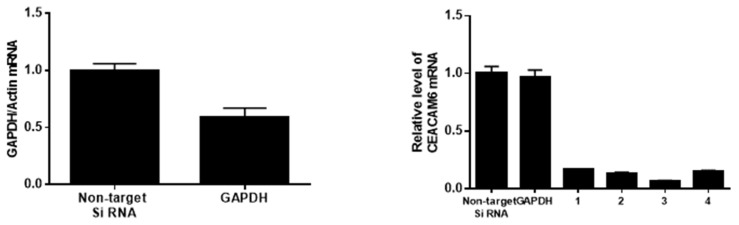 Figure 1
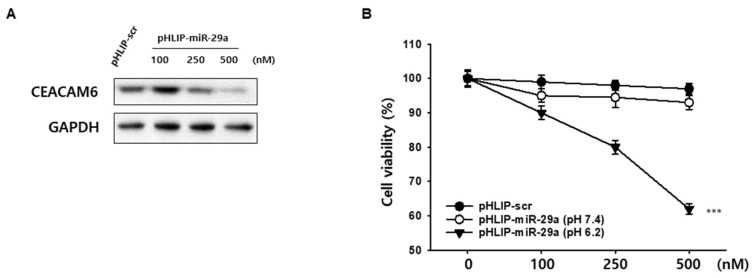 Figure 2
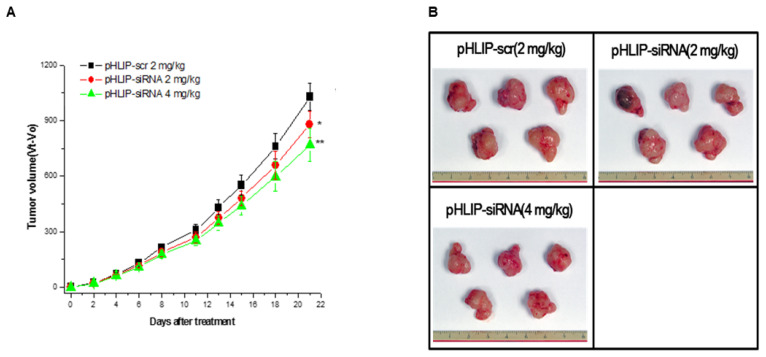 Figure 3
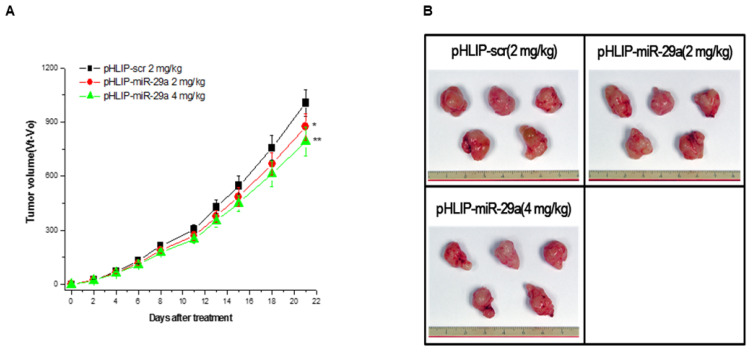 Figure 4
Peer Reviews
No public reviews on file for this paper yet. If you reviewed it on a platform where reviews are public (OpenReview, ICLR, NeurIPS, ICML), you can paste yours below so the community can read it here.
Videos
No videos yet. Explain this paper in a talk, walkthrough, or lecture? Add one.
Taxonomy
TopicsRadiopharmaceutical Chemistry and Applications · Peptidase Inhibition and Analysis · Chemical Synthesis and Analysis