Assessment of Intraspecific Variability in the Forest Dormouse (Dryomys nitedula) and Woolly Dormouse (Dryomys laniger) from Türkiye and Adjacent Regions Based on Mitochondrial DNA
Ercüment Çolak, Georgi Markov, Engin Selvi, Teoman Kankılıç, Perinçek Seçkinozan Şeker, Maria A. Kocheva, Milena K. Gospodinova, Reyhan Çolak, Hristo Dimitrov, Nuri Yiğit

TL;DR
This study explores genetic diversity in two dormouse species in Türkiye and nearby regions using mitochondrial DNA to understand their evolutionary history and geographic distribution.
Contribution
The study identifies new genetic lineages and proposes a potential new subspecies of Dryomys nitedula based on mitochondrial DNA analysis.
Findings
Three major clades of Dryomys nitedula diverged in the Late Miocene, with Turkish haplotypes divided into five distinct lineages.
The N2 lineage in the Eastern Black Sea region shows high genetic differentiation and may represent a new subspecies.
Dryomys laniger diverged into two lineages during the Late Pliocene, suggesting a need for further taxonomic assessment.
Abstract
This study aimed to reveal intraspecific variations in two Dryomys species distributed in Türkiye, based on mitochondrial DNA cytochrome b gene sequences, and to discuss the factors driving these variations in the context of phylogeography and genetic species concepts. As a result of Maximum Likelihood, Bayesian Inference, and Network analyses, which included haplogroups or lineages from Italy, Russia, the Caucasus, and Iran identified in previous studies, along with Turkish haplotypes, three major clades (MC1, MC2, and MC3) were identified within Dryomys nitedula. These clades began to diverge evolutionarily in the middle of the Late Miocene (8.82 million years ago) and exhibit significant genetic differences from one another. The Turkish haplotypes were divided into five distinct lineages (N1–N5), each within five subclades (SC1–SC5), which were nested within these MCs. These…
Genes, proteins, chemicals, diseases, species, mutations and cell lines named across the full text — each resolved to its canonical identifier and authoritative record.
Click any figure to enlarge with its caption.
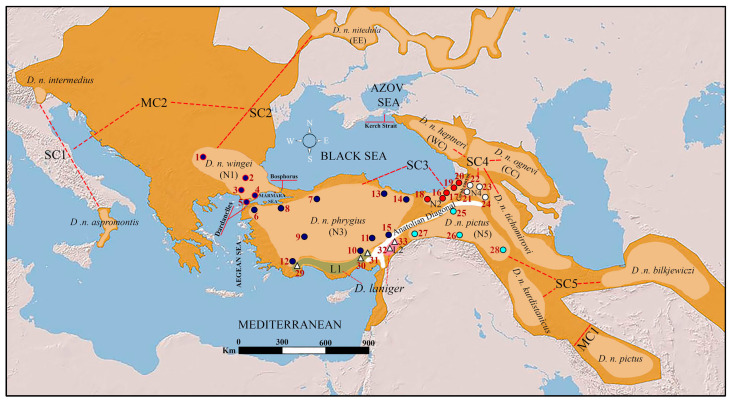 Figure 1
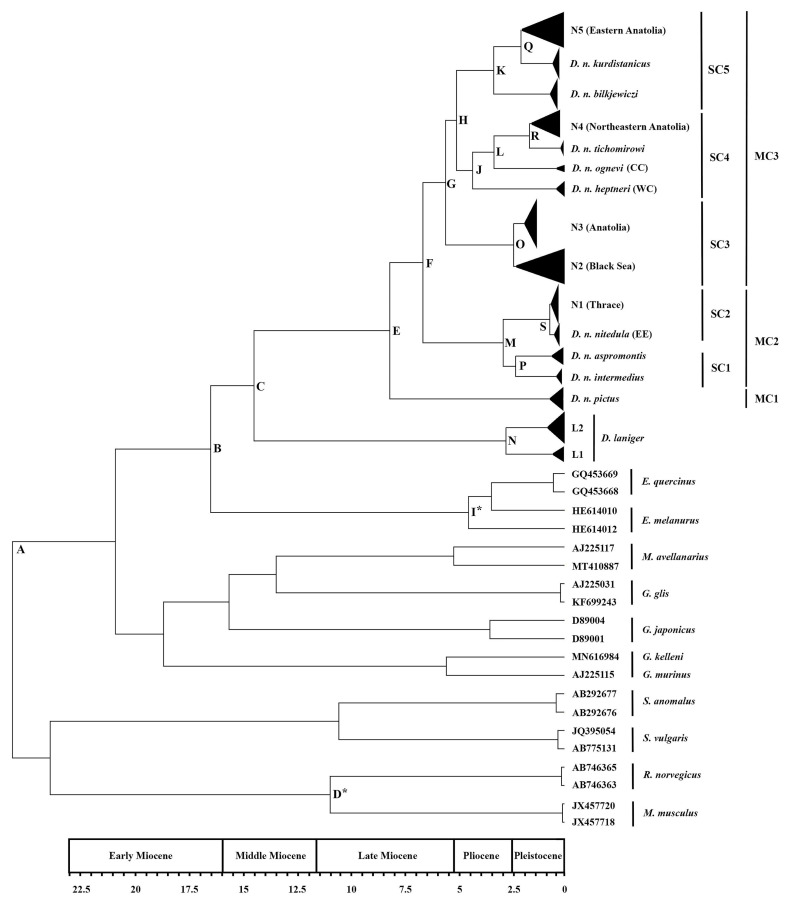 Figure 2
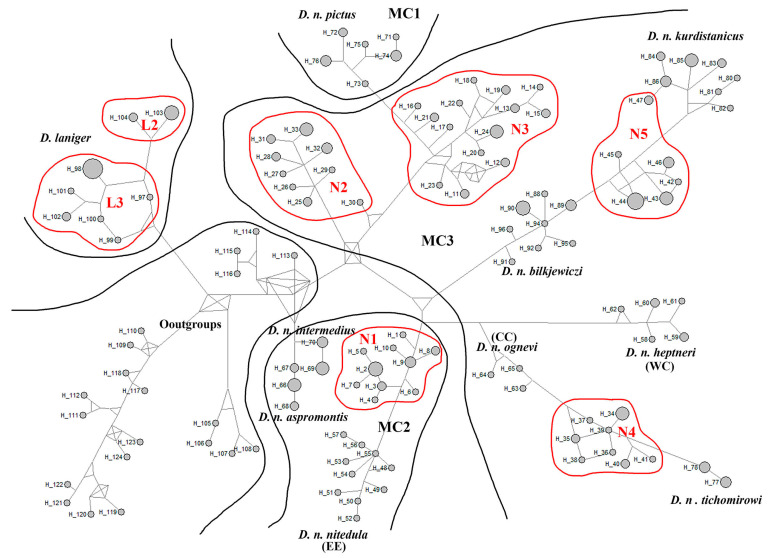 Figure 3
 Figure 4
Peer Reviews
No public reviews on file for this paper yet. If you reviewed it on a platform where reviews are public (OpenReview, ICLR, NeurIPS, ICML), you can paste yours below so the community can read it here.
Videos
No videos yet. Explain this paper in a talk, walkthrough, or lecture? Add one.
Taxonomy
TopicsAnimal Ecology and Behavior Studies · Genetic diversity and population structure · Yersinia bacterium, plague, ectoparasites research