Catheter Ablation of Septal Accessory Pathways in Children: A 12-Year Experience at a Tertiary Care Center
Ozlem Turan, Celal Akdeniz, Volkan Tuzcu

TL;DR
This study shares a 12-year experience of catheter ablation for septal accessory pathways in children, showing similar success rates for cryoablation and radiofrequency ablation, with cryoablation being safer.
Contribution
The study provides a long-term pediatric experience of septal accessory pathway ablation with limited fluoroscopy and compares cryoablation and radiofrequency ablation outcomes.
Findings
Cryoablation and radiofrequency ablation showed similar acute and long-term success rates for septal accessory pathways in children.
Higher recurrence rates were observed at the right-posteroseptal location, suggesting the need for repeat procedures in some cases.
No complications were observed, and repeat procedures achieved a 99% long-term success rate.
Abstract
Background: Septal accessory pathways (APs) are challenging ablation targets. This study aims to contribute to the pediatric literature by presenting our long-term experience of septal AP ablations with limited fluoroscopy. Methods: This is a retrospective study of all patients who underwent septal AP ablations from July 2012 to July 2023 at a single center. Results: We identified 298 septal AP connections in 291 (11.8 ± 4.9 years) patients. Seventy-nine (27%) cases were diagnosed with supraventricular tachycardia, and 212 (73%) cases were diagnosed with Wolff–Parkinson–White (WPW). The AP locations were posteroseptal (n = 159; 54%), anteroseptal (n = 86; 30%), and midseptal (n = 46; 16%). Of those diagnosed with WPW, 61 (28%) had high-risk AP, and 90 (40%) were adenosine-responsive. Cryoablation was used in 190 (66%), radiofrequency ablation (RFA) was used in 36 (12.5%), and both were…
Genes, proteins, chemicals, diseases, species, mutations and cell lines named across the full text — each resolved to its canonical identifier and authoritative record.
Click any figure to enlarge with its caption.
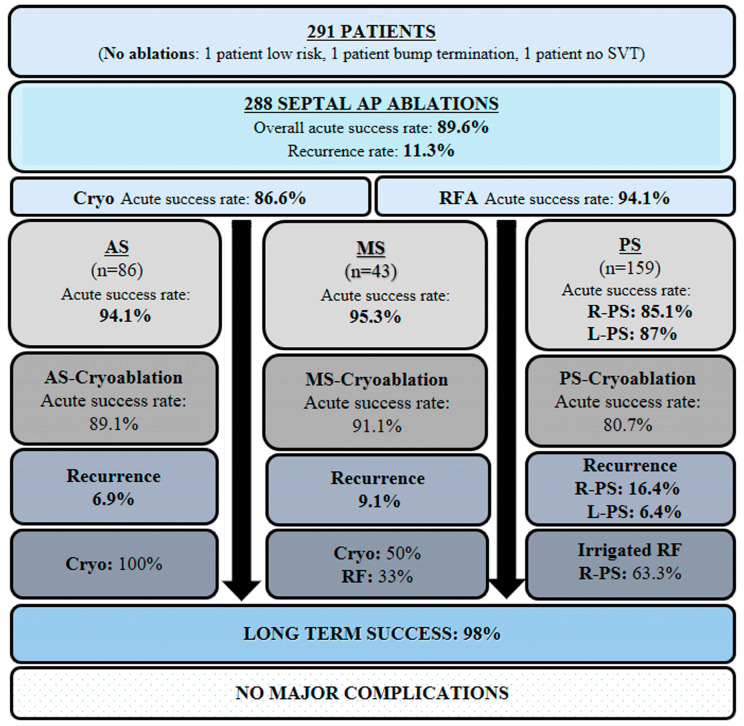 Figure 1
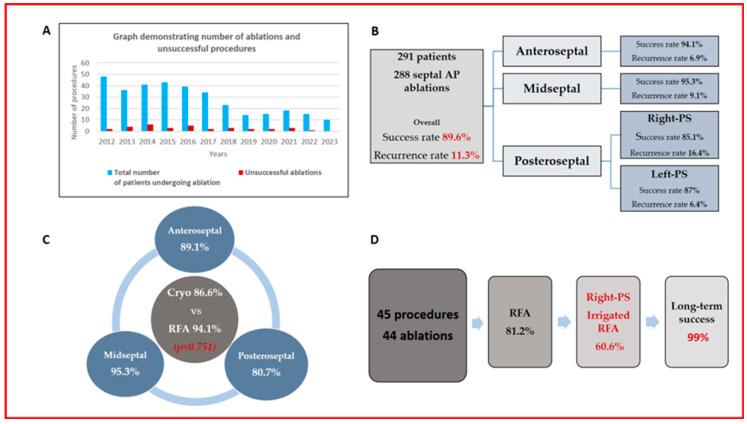 Figure 2
Peer Reviews
No public reviews on file for this paper yet. If you reviewed it on a platform where reviews are public (OpenReview, ICLR, NeurIPS, ICML), you can paste yours below so the community can read it here.
Videos
No videos yet. Explain this paper in a talk, walkthrough, or lecture? Add one.
Taxonomy
TopicsCardiac Arrhythmias and Treatments · Cardiac pacing and defibrillation studies · Atrial Fibrillation Management and Outcomes