Cognitive Rehabilitation as a Possible Therapeutic Approach in Patients with Blepharospasm
Francesco Marchet, Daniele Belvisi, Giorgio Leodori, Flavia Aiello, Matteo Costanzo, Federica Satriano, Antonella Di Vita, Antonella Conte, Giovanni Fabbrini, Gina Ferrazzano

TL;DR
This study explores how cognitive training, like reading and writing, can help reduce blinking and spasms in blepharospasm patients when used with botulinum toxin.
Contribution
The study introduces cognitive training as a novel complementary therapy to botulinum toxin for blepharospasm.
Findings
Cognitive training significantly improved blink rate reduction compared to botulinum toxin alone.
Reading and writing tasks were most effective in reducing dystonic spasms.
No correlation was found between clinical outcomes and demographic features.
Abstract
Background/Objectives: Blepharospasm (BSP) is a focal dystonia characterized by involuntary, bilateral spasms of the orbicularis oculi muscle. While botulinum toxin (BoNT) is the standard treatment, cognitive tasks such as reading and writing may exert transient modulatory effects on spontaneous blinking and dystonic spasms. This study investigates the potential of cognitive training, including reading and writing tasks, as a complementary therapeutic approach to BoNT in BSP patients. Methods: A total of 16 BSP patients were randomly assigned to two groups: Group A (n = 6) received cognitive training alongside BoNT, while Group B (n = 10) received only BoNT. Cognitive training included structured reading and writing exercises over three months. Blink rate (BR) and dystonic spasms were assessed at baseline (T0), one month (T1), and three months (T2) post-treatment. Results: Both groups…
Genes, proteins, chemicals, diseases, species, mutations and cell lines named across the full text — each resolved to its canonical identifier and authoritative record.
Click any figure to enlarge with its caption.
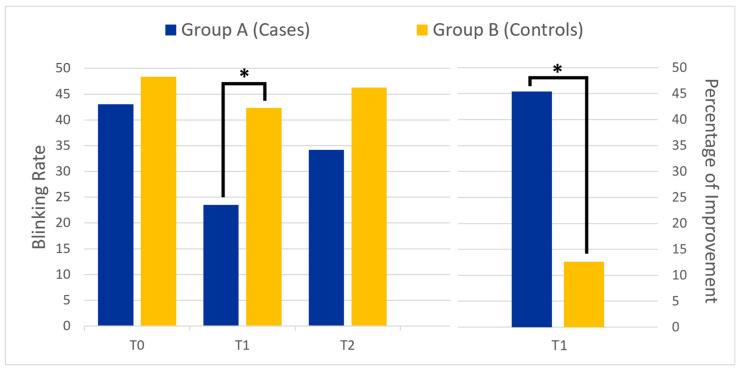 Figure 1
Peer Reviews
No public reviews on file for this paper yet. If you reviewed it on a platform where reviews are public (OpenReview, ICLR, NeurIPS, ICML), you can paste yours below so the community can read it here.
Videos
No videos yet. Explain this paper in a talk, walkthrough, or lecture? Add one.
Taxonomy
TopicsBotulinum Toxin and Related Neurological Disorders · Neurological disorders and treatments · Parkinson's Disease Mechanisms and Treatments