The MHC (Major Histocmpatibility Complex) Exceptional Molecules of Birds and Their Relationship to Diseases
Antonio Arnaiz-Villena, Fabio Suarez-Trujillo, Valentin Ruiz-del-Valle, Ignacio Juarez, Christian Vaquero-Yuste, José Manuel Martin-Villa, Tomás Lledo

TL;DR
This paper explores unique MHC molecules in passerine birds and their potential links to diseases, highlighting structural differences and gaps in understanding.
Contribution
The paper identifies unique amino acid residues in passerine MHC class I molecules and discusses their possible implications for disease and immune function.
Findings
Passerine birds have MHC class I molecules with non-canonic amino acid residues at positions 10 and 96.
MHC class I molecules in passerines may affect interactions with beta-2-microglobulin and immune responses.
Common bird diseases like malaria and Marek’s disease are potentially linked to MHC, though mechanisms remain unclear.
Abstract
There are about 5000 species of Passeriformes birds, which are half of the extant ones. Their class I MHC molecules are found to be different from all other studied vertebrates, including other bird species; i.e., amino acid residues 10 and 96 are not the seven canonic residues extant in all other vertebrate molecules. Thus, the canonic residues in MHC class I vertebrate molecules are reduced to five. These differences have physical effects in MHC (Major Histocompatibility Complex) class I alpha chain interaction with beta-2-microglobulin but have yet unknown functional effects. Also, introns show specific Passeriformes distinction both in size and invariance. The studies reviewed in this paper on MHC structure have been done in wild birds that cover most of the world’s passerine habitats. In this context, we are going to expose the most commonly occurring bird diseases with the caveat…
Genes, proteins, chemicals, diseases, species, mutations and cell lines named across the full text — each resolved to its canonical identifier and authoritative record.
Click any figure to enlarge with its caption.
 Figure 1
 Figure 2
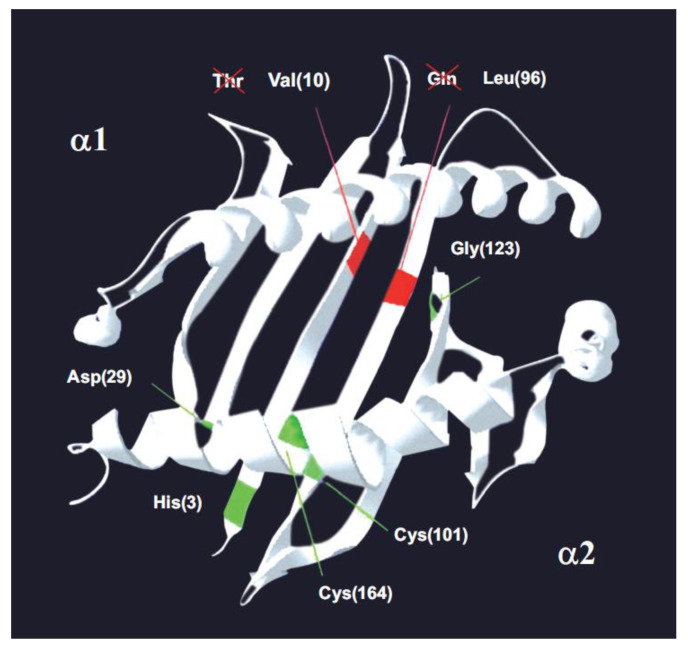 Figure 3
 Figure 4
Peer Reviews
No public reviews on file for this paper yet. If you reviewed it on a platform where reviews are public (OpenReview, ICLR, NeurIPS, ICML), you can paste yours below so the community can read it here.
Videos
No videos yet. Explain this paper in a talk, walkthrough, or lecture? Add one.
Taxonomy
TopicsT-cell and B-cell Immunology · Immune Cell Function and Interaction · Immune Response and Inflammation