Intravenous Immunoglobulin (IVIG) for Patients with Severe Neurotoxicity Associated with Chimeric Antigen Receptor T-Cell (CAR-T) Therapy
Sepideh Mokhtari, Justin M. Asquith, Syeda Saba Kareem, Christina A. Bachmeier, Yolanda Pina, Rawan G. Faramand, Youngchul Kim, Edwin N. Peguero, Solmaz Sahebjam, Mohammad H. Jaffer, David P. Iacono, Michael D. Jain, Michael A. Vogelbaum, Marco L. Davila, Peter A. Forsyth

TL;DR
This study explores the use of IVIG as a treatment for severe neurotoxicity in patients undergoing CAR-T therapy for lymphoma.
Contribution
The study provides insights into the safety and potential efficacy of IVIG in managing severe ICANS in CAR-T-treated patients.
Findings
IVIG was found to be tolerable and safe in patients with severe ICANS.
Patients receiving IVIG had more severe ICANS grades at baseline.
There was no significant difference in time to resolution of ICANS between IVIG and glucocorticoids-only groups.
Abstract
Severe immune effector cell-associated neurotoxicity syndrome (ICANS) occurs in about 30% of all patients with large B-cell lymphoma (LBCL) who are treated with axicabtagene ciloleucel (axi-cel). There are currently limited treatment strategies other than the standard corticosteroids, and it is essential to find additional therapies to manage severe ICANS. We conducted a retrospective study of neurologic outcomes among patients who received axi-cel for LBCL from May 2015 to February 2019. We identified patients who developed severe ICANS and were treated with glucocorticoids followed by intravenous immunoglobulin (IVIG) (n = 9) or glucocorticoids alone (n = 10). There was no statistically significant difference in the time to resolution (TTR) of severe ICANS between groups; however, patients in the IVIG had more severe grades of ICANS with a lower performance status at baseline. The…
Genes, proteins, chemicals, diseases, species, mutations and cell lines named across the full text — each resolved to its canonical identifier and authoritative record.
Click any figure to enlarge with its caption.
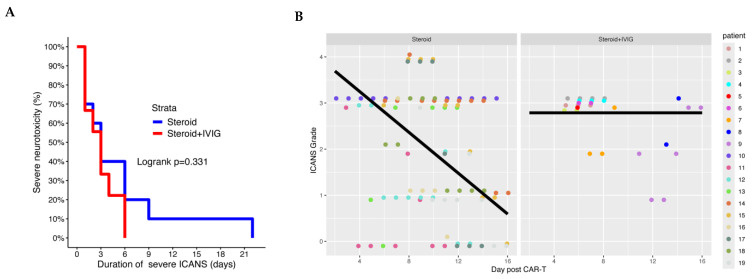 Figure 1
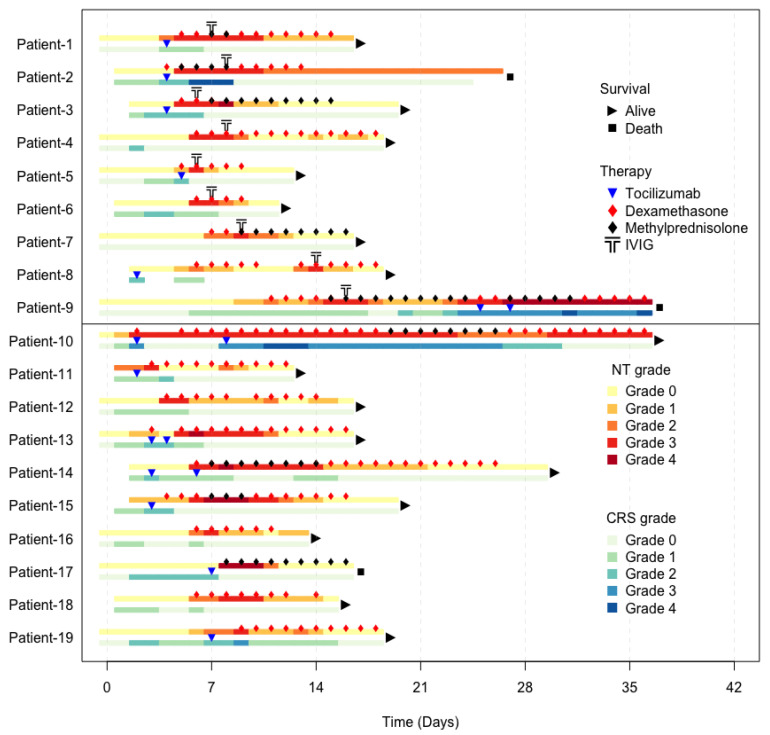 Figure 2
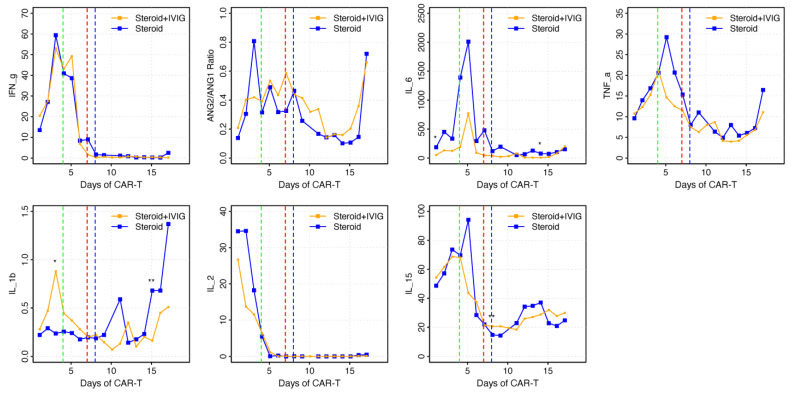 Figure 3
Peer Reviews
No public reviews on file for this paper yet. If you reviewed it on a platform where reviews are public (OpenReview, ICLR, NeurIPS, ICML), you can paste yours below so the community can read it here.
Videos
No videos yet. Explain this paper in a talk, walkthrough, or lecture? Add one.
Taxonomy
TopicsCAR-T cell therapy research · Nanowire Synthesis and Applications · Advancements in Semiconductor Devices and Circuit Design