The Dangers of Growing Old: Adult Moths Face Higher Predation Pressures than Caterpillars in Hyles lineata
Braulio A. Sanchez, Oceane Da Cunha, Jackson W. Savage, L. Miles Horne, Sol Saenz-Arreola, Kajaya Pollard, Oliver Neria, Spencer Duffendack, Simon Terrazas, Javier M. Diaz, John Deitsch, Brett M. Seymoure

TL;DR
Adult white-lined sphinx moths face higher predation than caterpillars, with most attacks happening during the day, likely due to their larger and more visible size.
Contribution
This study provides empirical evidence that adult moths are more vulnerable to predation than caterpillars in a natural setting.
Findings
Adult moth replicas were attacked twice as often as caterpillar replicas.
Predation was six times more likely to occur during the day than at night.
Birds were responsible for the majority of attacks on both adult and caterpillar replicas.
Abstract
Predation on insects can depend upon numerous factors, including morphology, size, age, environment, time, and many others. Most insects undergo complete metamorphosis, in which they begin as eggs, then become larvae, then pupae, and then reproductive adults. Complete metamorphosis has been hypothesized to be advantageous for numerous reasons, including reduced predation between the different stages. Here, we tested the attack rates on a common moth, the white-lined sphinx, in both caterpillar and adult moth stages, using clay replicas. We paired caterpillar and moth replicas in a natural desert environment and monitored attack rates at dawn and dusk for 72 h. By checking attack rates at dawn and dusk, we were able to quantify if the replicas had been attacked during the day or night. We found that most attacks occurred during the day and that the chance of adult moths being attacked…
Genes, proteins, chemicals, diseases, species, mutations and cell lines named across the full text — each resolved to its canonical identifier and authoritative record.
Click any figure to enlarge with its caption.
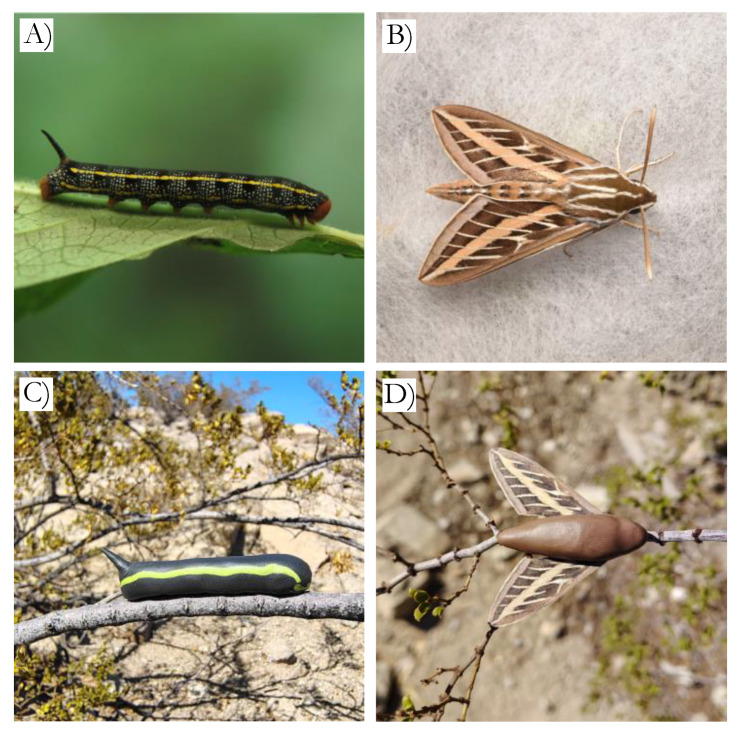 Figure 1
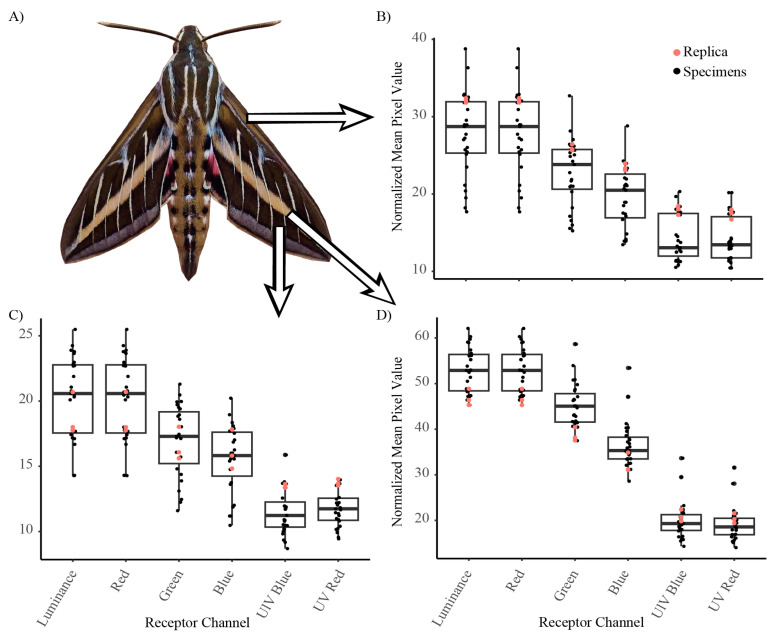 Figure 2
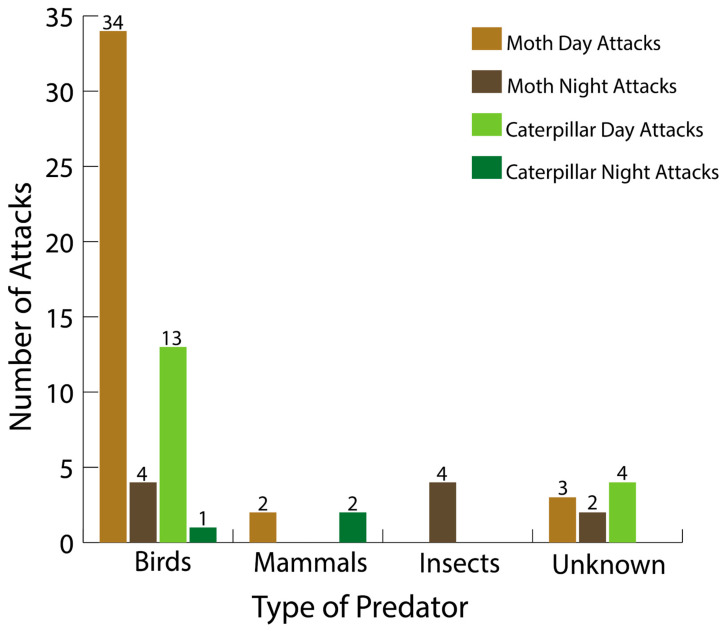 Figure 3
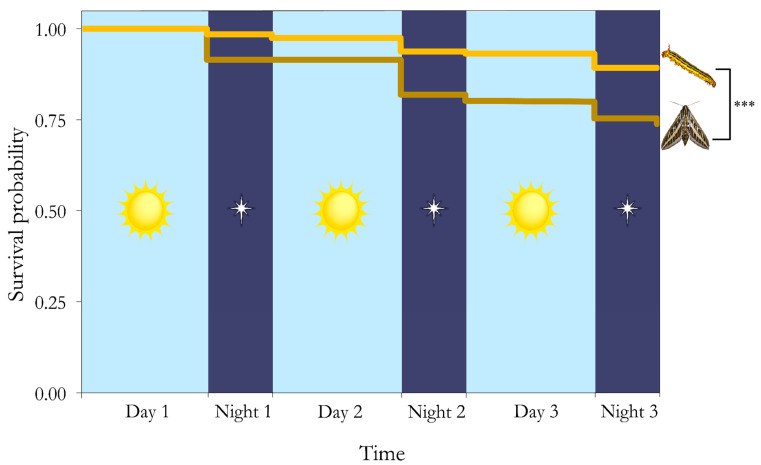 Figure 4
Peer Reviews
No public reviews on file for this paper yet. If you reviewed it on a platform where reviews are public (OpenReview, ICLR, NeurIPS, ICML), you can paste yours below so the community can read it here.
Videos
No videos yet. Explain this paper in a talk, walkthrough, or lecture? Add one.
Taxonomy
TopicsInsect-Plant Interactions and Control · Plant and animal studies · Insect and Arachnid Ecology and Behavior