Non-Invasive Measurement of Hemodynamic Parameters via Whole-Body Impedance Cardiography Among Hospitalized Heart Failure Patients: An Effective Alternative to Invasive Right Heart Catheterization?
Felix Ausbuettel, Sabah Khwamurad, Murad Haj Abdo, Sebastian Kerber, Karin Nentwich, Martina Hautmann, Sebastian Barth

TL;DR
This study compares non-invasive whole-body impedance cardiography to invasive catheterization for measuring heart function in hospitalized heart failure patients.
Contribution
The study evaluates the accuracy of whole-body ICG as a non-invasive alternative to RHC in measuring hemodynamic parameters in heart failure patients.
Findings
Non-invasive CO and CI measurements showed no significant bias compared to RHC measurements.
Non-invasive TPR and PVR measurements showed significant bias compared to RHC measurements.
Whole-body ICG may be a reliable alternative for CO and CI but not for TPR and PVR.
Abstract
(1) Background: The measurement of hemodynamic parameters has proven to be crucial in the treatment of hospitalized heart failure patients, necessitating invasive measurement by right heart catheterization (RHC). The reliability of whole-body impedance cardiography (ICG) among this cohort has not been investigated to date; (2) Methods: The RHC and whole-body ICG examinations measured cardiac output (CO), the cardiac index (CI), total peripheral resistance (TPR), and pulmonary vascular resistance (PVR). To assess the accuracy of the whole-body ICG measurement, bias and precision were calculated as the mean difference and the twofold standard deviation between the average values of measurements; (3) Results: A total of 203 patients were analyzed. No significant bias was observed between the non-invasive CO and CI measurements when compared with the RHC measurements (−0.14 ± 2.56 L/min, p…
Genes, proteins, chemicals, diseases, species, mutations and cell lines named across the full text — each resolved to its canonical identifier and authoritative record.
Click any figure to enlarge with its caption.
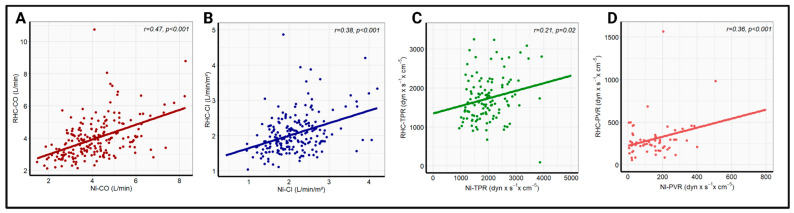 Figure 1
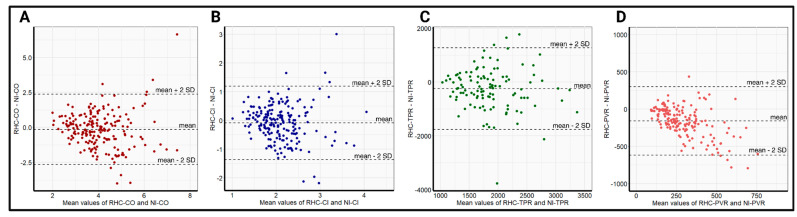 Figure 2
Peer Reviews
No public reviews on file for this paper yet. If you reviewed it on a platform where reviews are public (OpenReview, ICLR, NeurIPS, ICML), you can paste yours below so the community can read it here.
Videos
No videos yet. Explain this paper in a talk, walkthrough, or lecture? Add one.
Taxonomy
TopicsHemodynamic Monitoring and Therapy · Blood Pressure and Hypertension Studies · Heart Failure Treatment and Management