Development of a BiAD Sensor for Locus-Specific Detection of Cellular Histone Acetylation Dynamics by Fluorescence Microscopy
Anja R. Köhler, Nicole Gutekunst, Annika Harsch, Pavel Bashtrykov, Albert Jeltsch

TL;DR
Researchers developed a new sensor called BiAD to detect changes in histone acetylation in living cells using fluorescence microscopy.
Contribution
The novel BiAD sensor uses a tandem bromodomain to detect locus-specific histone acetylation dynamics in living cells.
Findings
The TTC34 gene body was identified as a suitable target for the BiAD sensor due to its dense histone acetylation and repeated sequences.
A dual-domain bromodomain reader was necessary for effective detection, showing the importance of avidity effects.
The sensor successfully detected increased histone acetylation after treatment with Trichostatin A.
Abstract
Background: Dynamic changes in histone acetylation play crucial roles during cellular differentiation and disease development, but their detection in living cells is still a challenging task. Objectives: Here, we developed a Bimolecular Anchor Detector (BiAD) sensor for the detection of locus-specific changes in histone acetylation in living cells by fluorescence microscopy. Methods: We used the BRD9 bromodomain cloned as tandem double domain (2xBRD9-BD) as a reader of histone acetylation. It was integrated into a dual-color BiAD chassis that was previously described by us. Results: We identified the gene body of TTC34 as a potential target for our sensor, because it contains dense histone acetylation and 392 local sequence repeats. Using a binding-deficient mutant of 2xBRD9-BD as a negative control, we established a successful readout of histone acetylation at the TTC34 locus. A…
Genes, proteins, chemicals, diseases, species, mutations and cell lines named across the full text — each resolved to its canonical identifier and authoritative record.
Click any figure to enlarge with its caption.
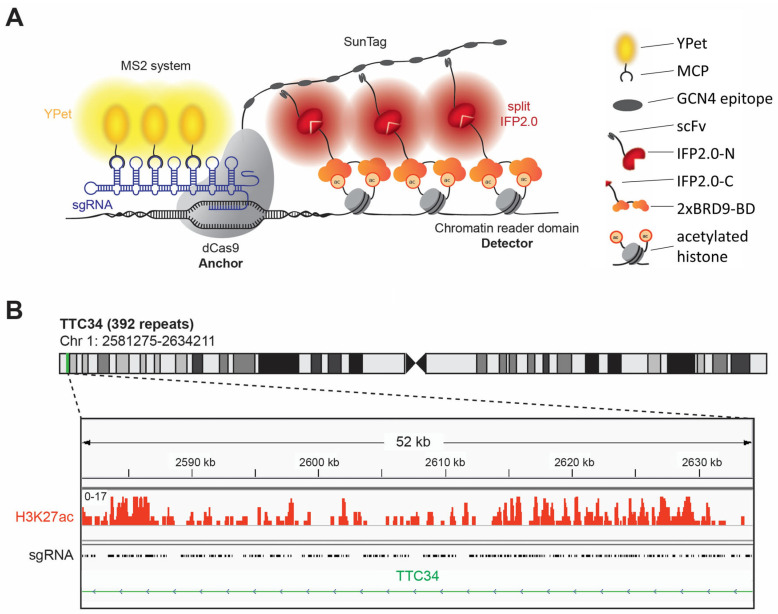 Figure 1
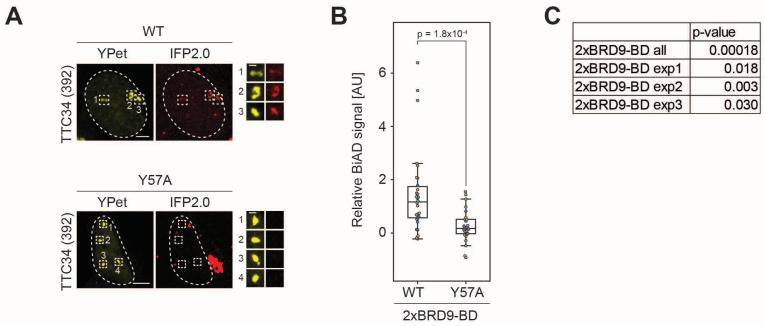 Figure 2
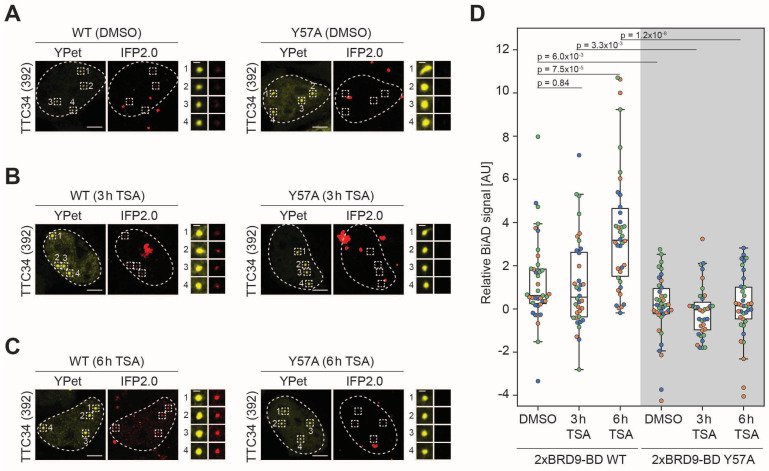 Figure 3
Peer Reviews
No public reviews on file for this paper yet. If you reviewed it on a platform where reviews are public (OpenReview, ICLR, NeurIPS, ICML), you can paste yours below so the community can read it here.
Videos
No videos yet. Explain this paper in a talk, walkthrough, or lecture? Add one.
Taxonomy
TopicsProtein Degradation and Inhibitors · Genomics and Chromatin Dynamics · Ubiquitin and proteasome pathways