The Role of Paramedics in Diagnosing Sandifer’s Syndrome
Michał Wójcik, Damian Krysiak, Piotr Babik, Łukasz Suchanek, Michał Ćwiertnia, Joanna Trojak-Piętka, Marek Kawecki, Wioletta Pollok-Waksmańska, Monika Mikulska, Tomasz Ilczak

TL;DR
This paper discusses how paramedics can help correctly diagnose Sandifer’s syndrome, a rare condition often mistaken for epilepsy, by identifying key symptoms during emergency care.
Contribution
The paper introduces a framework for paramedics to recognize and differentiate Sandifer’s syndrome from epilepsy in pre-hospital settings.
Findings
A thorough patient examination by paramedics helped rule out epilepsy and identify Sandifer’s syndrome in a 7-week-old child.
A rare symptom of apnoea was observed during the case study.
Correct diagnosis of Sandifer’s syndrome can prevent unnecessary anti-epilepsy medication and reduce side effects.
Abstract
Background: Sandifer’s syndrome is an uncharacteristic symptom of gastroesophageal reflux disease (GERD). It is often misdiagnosed as epilepsy. Paramedics can play a crucial role in recognising the differences between Sandifer’s syndrome and epilepsy. Therefore, education is important to reduce the likelihood of misdiagnosis and the mistreatment of patients. This purpose of this study is to provides information and guidelines for collecting patients’ medical history and identifying the most common symptoms, which support pre-hospital suspicion of Sandifer’s syndrome. Methods: The study consisted of a clinical case study, concerning the management of the emergency team, in a 7-week-old child with symptoms indicative of an epileptic seizure. Results: The clinical case analysis showed that a thorough examination of the patient helped to rule out epilepsy in the child and observed the…
Genes, proteins, chemicals, diseases, species, mutations and cell lines named across the full text — each resolved to its canonical identifier and authoritative record.
Click any figure to enlarge with its caption.
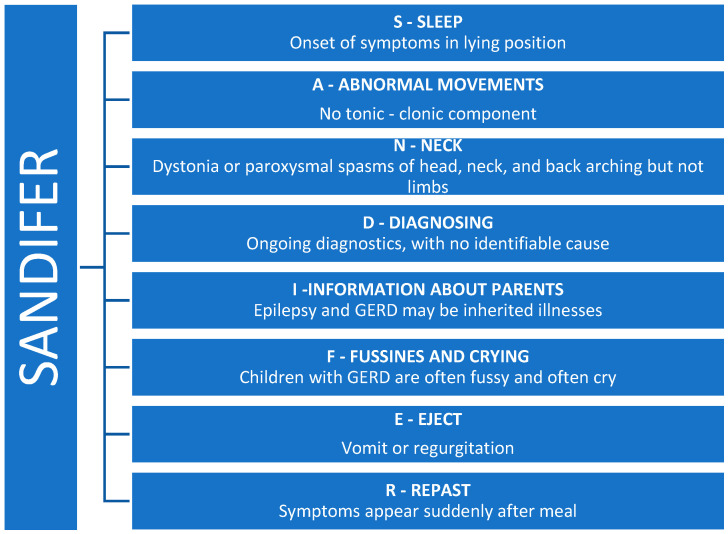 Figure 1
Peer Reviews
No public reviews on file for this paper yet. If you reviewed it on a platform where reviews are public (OpenReview, ICLR, NeurIPS, ICML), you can paste yours below so the community can read it here.
Videos
No videos yet. Explain this paper in a talk, walkthrough, or lecture? Add one.
Taxonomy
TopicsGastroesophageal reflux and treatments · Helicobacter pylori-related gastroenterology studies · Respiratory and Cough-Related Research