Evaluating language policy implementation in South African higher education - three decades of progress and challenges: A scoping review protocol
Silingene Joyce Ngcobo, Tracy Zhandire, Zamasomi Meyiwa Luvuno, Wilbroda Hlolisile Chiya, Celenkosini Thembelenkosini Nxumalo, Gugulethu Brightness Mazibuko, Busisiwe Purity Ncama, Sinegugu Evidence Duma, Deshini Naidoo, Muhammad Shahzad Aslam, Muhammad Shahzad Aslam

TL;DR
This paper outlines a scoping review protocol to assess the implementation of multilingual language policies in South African higher education over the past three decades.
Contribution
The study introduces a systematic protocol to evaluate progress and challenges in integrating indigenous African languages into higher education in post-apartheid South Africa.
Findings
The review will map the integration of multilingual policies into teaching, research, and administrative practices.
It will identify barriers and successful strategies for promoting multilingualism in academic settings.
The findings will inform policy refinement and guide future research on inclusive language practices.
Abstract
South Africa’s higher education institutions (HEIs) continue to face challenges in implementing inclusive language policies that integrate indigenous African languages into academic settings, even three decades after apartheid. Higher Education Institutions (HEIs) face significant challenges in integrating indigenous African languages into academic settings. Despite progressive reforms, higher education institutions face significant challenges in integrating indigenous African languages into academic settings. This scoping review aims to evaluate the current state of language policy implementation in South African public HEis. Specifically, it seeks to: (1) map the integration of multilingual policies into teaching, research, and administrative practices; (2) identify persistent barriers to effective policy implementation; (3) explore successful strategies for promoting multilingualism…
Genes, proteins, chemicals, diseases, species, mutations and cell lines named across the full text — each resolved to its canonical identifier and authoritative record.
Click any figure to enlarge with its caption.
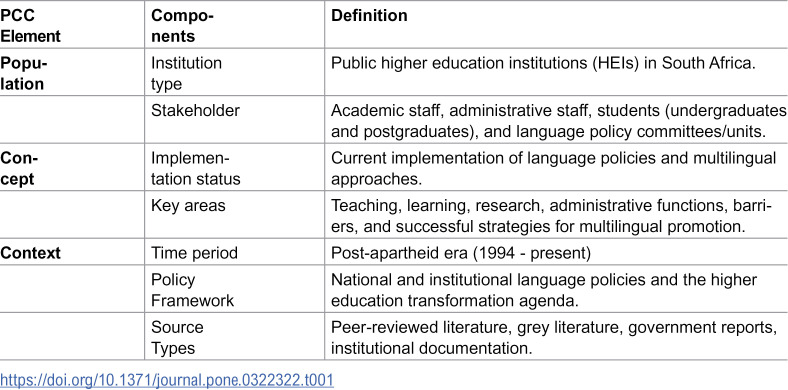 Figure 1
 Figure 2
 Figure 3
 Figure 4
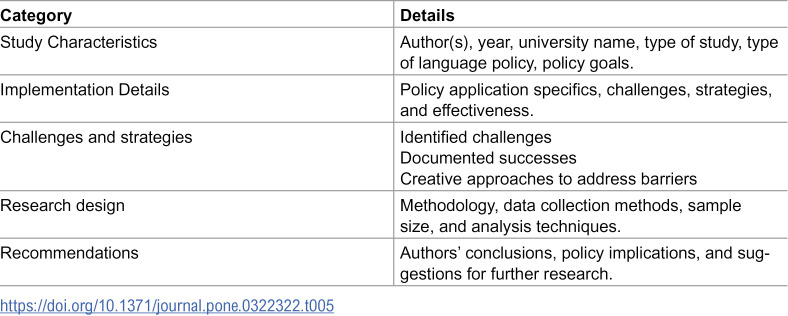 Figure 5
Peer Reviews
No public reviews on file for this paper yet. If you reviewed it on a platform where reviews are public (OpenReview, ICLR, NeurIPS, ICML), you can paste yours below so the community can read it here.
Videos
No videos yet. Explain this paper in a talk, walkthrough, or lecture? Add one.
Taxonomy
TopicsSecond Language Learning and Teaching · Multilingual Education and Policy · EFL/ESL Teaching and Learning