A divide-and-conquer approach based on deep learning for long RNA secondary structure prediction: Focus on pseudoknots identification
Loïc Omnes, Eric Angel, Pierre Bartet, François Radvanyi, Fariza Tahi, Emanuele Paci, Emanuele Paci, Emanuele Paci, Emanuele Paci

TL;DR
This paper introduces DivideFold, a deep learning method that improves the prediction of RNA secondary structures, especially pseudoknots, in long RNA sequences.
Contribution
DivideFold uses a divide-and-conquer strategy to enhance pseudoknot prediction accuracy and scalability for long RNA sequences.
Findings
DivideFold outperforms existing methods in predicting pseudoknots in long RNA sequences.
The method scales effectively by breaking down RNA sequences into manageable fragments.
It maintains high accuracy while handling the computational complexity of long RNA structures.
Abstract
The accurate prediction of RNA secondary structure, and pseudoknots in particular, is of great importance in understanding the functions of RNAs since they give insights into their folding in three-dimensional space. However, existing approaches often face computational challenges or lack precision when dealing with long RNA sequences and/or pseudoknots. To address this, we propose a divide-and-conquer method based on deep learning, called DivideFold, for predicting the secondary structures including pseudoknots of long RNAs. Our approach is able to scale to long RNAs by recursively partitioning sequences into smaller fragments until they can be managed by an existing model able to predict RNA secondary structure including pseudoknots. We show that our approach exhibits superior performance compared to state-of-the-art methods for pseudoknot prediction and secondary structure prediction…
Genes, proteins, chemicals, diseases, species, mutations and cell lines named across the full text — each resolved to its canonical identifier and authoritative record.
Click any figure to enlarge with its caption.
 Figure 1
 Figure 2
 Figure 3
 Figure 4
 Figure 5
 Figure 6
 Figure 7
 Figure 8
 Figure 9
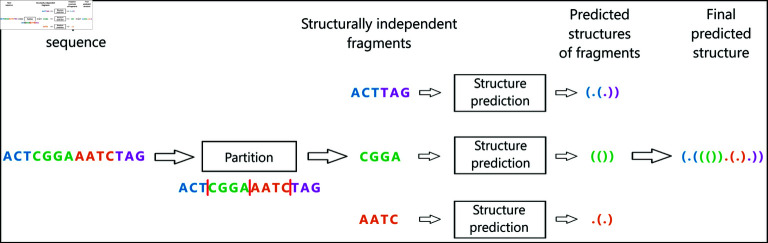 Figure 10
 Figure 11
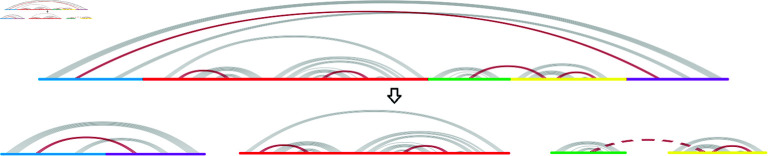 Figure 12
 Figure 13
 Figure 14
 Figure 15
 Figure 16
 Figure 17
 Figure 18
 Figure 19
 Figure 20
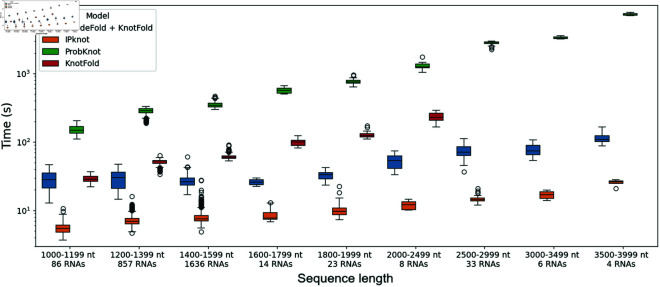 Figure 21
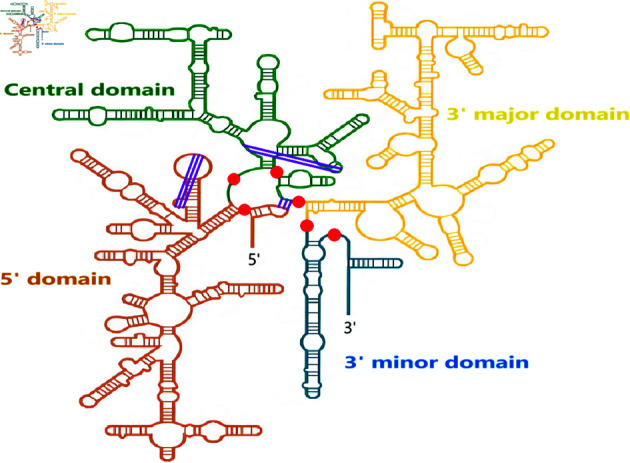 Figure 22
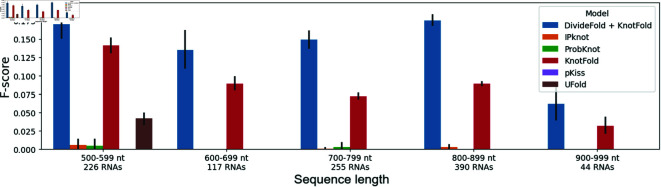 Figure 23
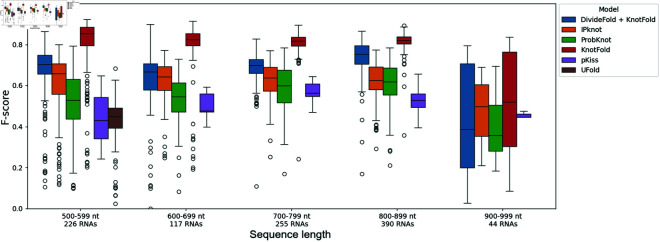 Figure 24
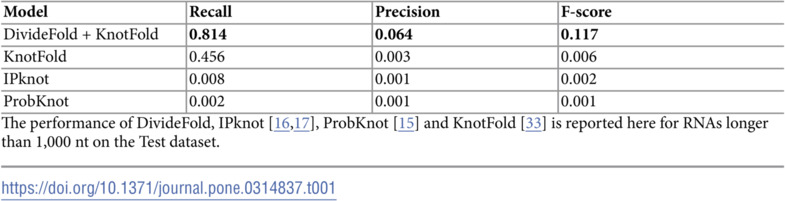 Figure 25
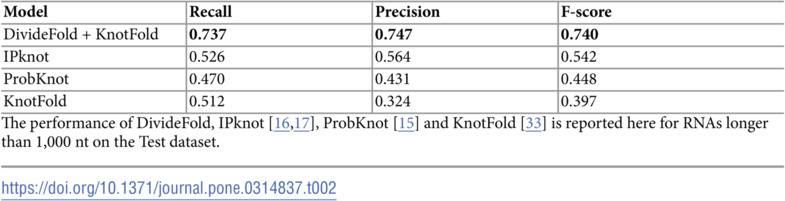 Figure 26
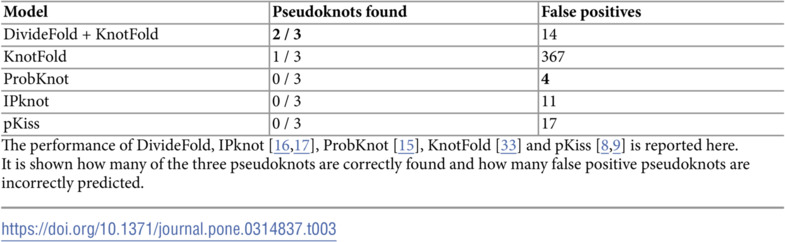 Figure 27
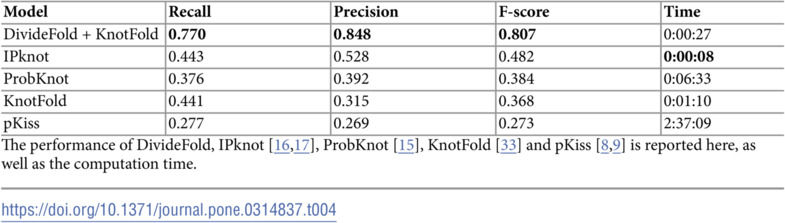 Figure 28
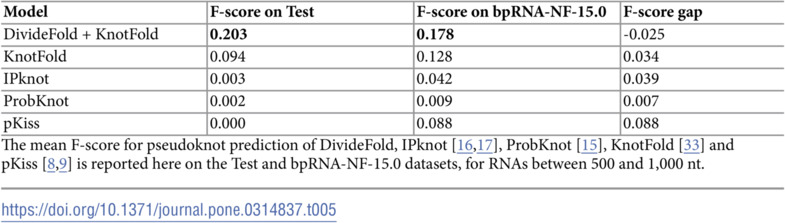 Figure 29
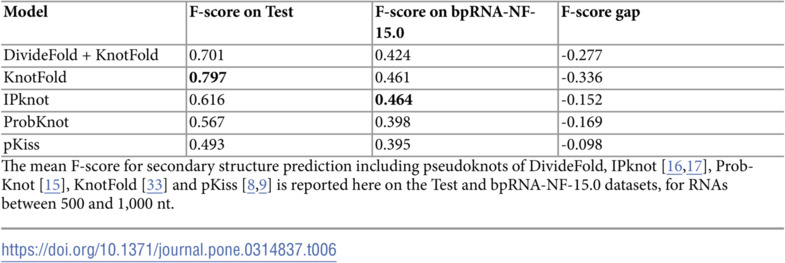 Figure 30
Peer Reviews
No public reviews on file for this paper yet. If you reviewed it on a platform where reviews are public (OpenReview, ICLR, NeurIPS, ICML), you can paste yours below so the community can read it here.
Videos
No videos yet. Explain this paper in a talk, walkthrough, or lecture? Add one.
Taxonomy
TopicsRNA and protein synthesis mechanisms · RNA modifications and cancer · RNA Research and Splicing