Tribe Paniceae Cereals with Different Ploidy Levels: Setaria italica, Panicum miliaceum, and Echinochloa esculenta
Kazuhiro Satomura

TL;DR
This paper explores how different ploidy levels in three millet species affect their genome evolution and diversity.
Contribution
The study provides insights into the molecular evolution of genome duplication in millet species through comparative genomic analysis.
Findings
Setaria italica, Panicum miliaceum, and Echinochloa esculenta have different ploidy levels and chromosome sets.
The timing of ploidy and gene family expansion varies among the millet species.
Wild species within each genus show complex subgenomic evolution.
Abstract
Plants have repeatedly undergone whole-genome duplication during their evolutionary history. Even in modern plants, there is diversity in ploidy within and between species, providing a snapshot of the evolutionary turnover of ploidy. Here, I will review the diversity of ploidy and the evolution of the genome constitution, focusing on the millet species Setaria italica, Panicum miliaceum, and Echinochloa esculenta. These are all historically important cereal crops that have been domesticated in East Asia. They all display a basic chromosome set of nine, but they are diploid, tetraploid, and hexaploid, respectively. The timing of ploidy is different among the millet species, as is the extent of gene family expansion and gene loss. There also exists complex subgenomic evolution in the wild species within each genus. These three millet species and their related wild species are suitable…
Genes, proteins, chemicals, diseases, species, mutations and cell lines named across the full text — each resolved to its canonical identifier and authoritative record.
Click any figure to enlarge with its caption.
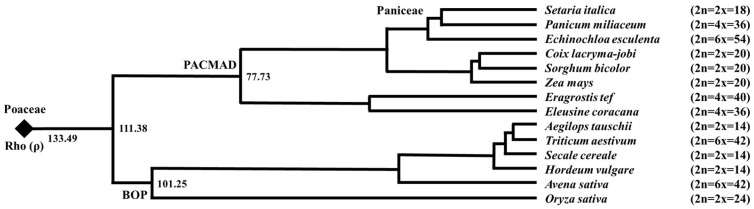 Figure 1
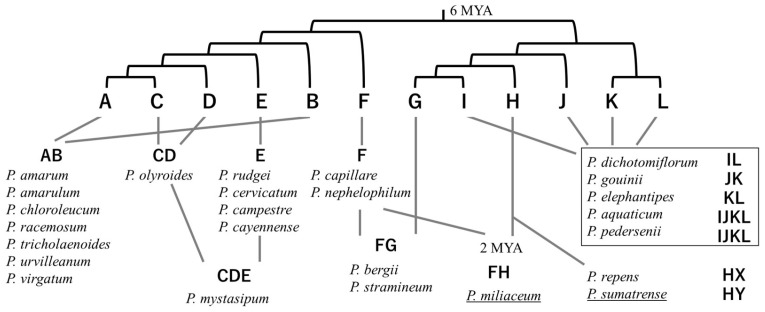 Figure 2
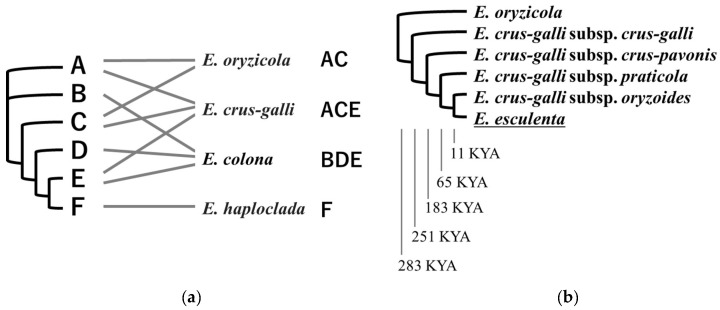 Figure 3
Peer Reviews
No public reviews on file for this paper yet. If you reviewed it on a platform where reviews are public (OpenReview, ICLR, NeurIPS, ICML), you can paste yours below so the community can read it here.
Videos
No videos yet. Explain this paper in a talk, walkthrough, or lecture? Add one.
Taxonomy
TopicsChromosomal and Genetic Variations · Plant Disease Resistance and Genetics · Plant Taxonomy and Phylogenetics