Aberrant Short Tandem Repeats: Pathogenicity, Mechanisms, Detection, and Roles in Neuropsychiatric Disorders
Yuzhong Liu, Kun Xia

TL;DR
This paper explores how abnormal short tandem repeats in DNA contribute to neuropsychiatric disorders like autism and schizophrenia, and how they can be detected and studied.
Contribution
The paper provides a comprehensive overview of the pathogenic mechanisms and detection methods of STR expansions in neuropsychiatric disorders.
Findings
STR expansions disrupt gene function through mechanisms like gene silencing and RNA/protein toxicity.
Advances in sequencing technologies have improved detection of STR variations linked to neuropsychiatric disorders.
STR expansions are associated with autism spectrum disorders and schizophrenia via effects on neurodevelopment and signaling genes.
Abstract
Short tandem repeat (STR) sequences are highly variable DNA segments that significantly contribute to human neurodegenerative disorders, highlighting their crucial role in neuropsychiatric conditions. This article examines the pathogenicity of abnormal STRs and classifies tandem repeat expansion disorders(TREDs), emphasizing their genetic characteristics, mechanisms of action, detection methods, and associated animal models. STR expansions exhibit complex genetic patterns that affect the age of onset and symptom severity. These expansions disrupt gene function through mechanisms such as gene silencing, toxic gain-of-function mutations leading to RNA and protein toxicity, and the generation of toxic peptides via repeat-associated non-AUG (RAN) translation. Advances in sequencing technologies—from traditional PCR and Southern blotting to next-generation and long-read sequencing—have…
Genes, proteins, chemicals, diseases, species, mutations and cell lines named across the full text — each resolved to its canonical identifier and authoritative record.
Click any figure to enlarge with its caption.
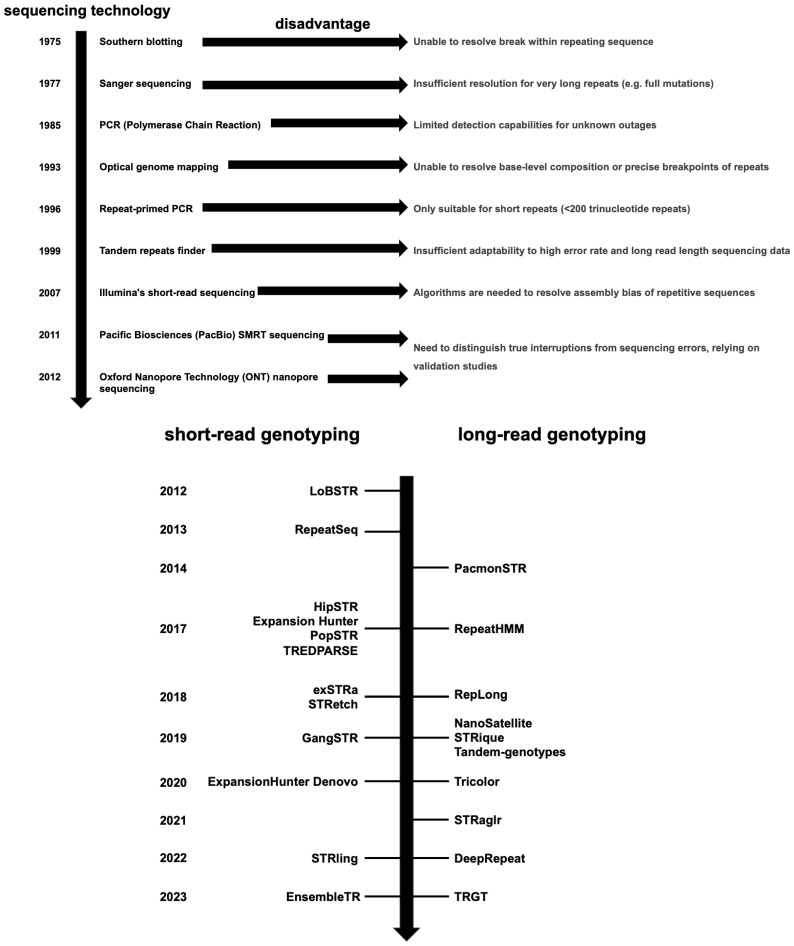 Figure 1
Peer Reviews
No public reviews on file for this paper yet. If you reviewed it on a platform where reviews are public (OpenReview, ICLR, NeurIPS, ICML), you can paste yours below so the community can read it here.
Videos
No videos yet. Explain this paper in a talk, walkthrough, or lecture? Add one.
Taxonomy
TopicsGenetic Neurodegenerative Diseases · Mitochondrial Function and Pathology · RNA Research and Splicing