Single-State Multi-Party Quantum Key Agreement with Single-Particle Measurement
Hao Yang, Dunbo Cai, Ling Qian, Runqing Zhang, Songfeng Lu, Chengfu Sun

TL;DR
This paper introduces a new quantum key agreement protocol that uses single-particle measurements and is more efficient than previous methods.
Contribution
The novel contribution is a single-state multi-party quantum key agreement protocol that improves efficiency and eliminates complex operations.
Findings
The protocol uses a single multi-particle entangled state as a quantum resource.
It achieves higher qubit efficiency and requires fewer qubits for transmission.
The protocol is secure against internal and external attacks.
Abstract
In this study, we propose a single-state multi-party quantum key agreement (MQKA) protocol with single-particle measurement. Firstly, a single-state three-party quantum key agreement protocol with single-particle measurement is introduced, followed by a security analysis that validated its capability to resist potential internal and external attacks. Furthermore, we utilize multi-particle entangled states to present a multi-party version of the single-state multi-party quantum key agreement with single-particle measurement. In comparison to previous MQKA protocols, our approach presents the following advantages: it employs one kind of multi-particle entangled state as the quantum resource; eliminates the need for entanglement swapping techniques, unitary operations, or pre-shared keys between participants; uses only the X measurement basis and Z measurement basis; transmits fewer…
Genes, proteins, chemicals, diseases, species, mutations and cell lines named across the full text — each resolved to its canonical identifier and authoritative record.
Click any figure to enlarge with its caption.
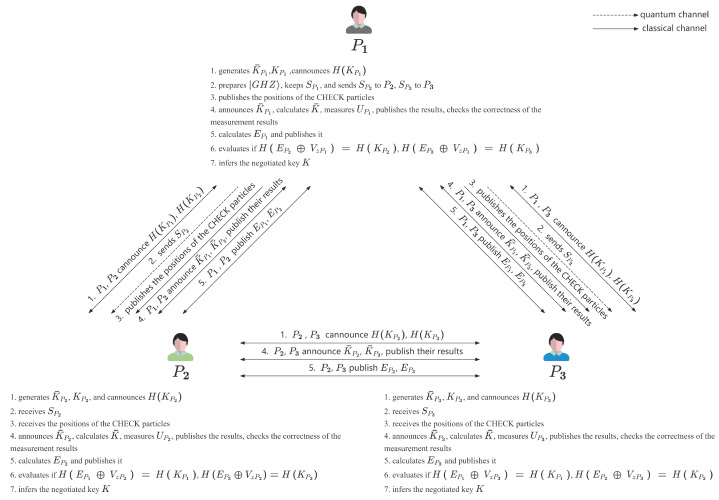 Figure 1
Peer Reviews
No public reviews on file for this paper yet. If you reviewed it on a platform where reviews are public (OpenReview, ICLR, NeurIPS, ICML), you can paste yours below so the community can read it here.
Videos
No videos yet. Explain this paper in a talk, walkthrough, or lecture? Add one.
Taxonomy
TopicsQuantum Information and Cryptography · Quantum Mechanics and Applications · Quantum Computing Algorithms and Architecture