Beyond the Surface: The Peculiar World of Benthic Biodiversity, from Microbes to Multicellular Life and Their Ecosystem Roles
Mayya Gogina, Judith Piontek

Abstract
Genes, proteins, chemicals, diseases, species, mutations and cell lines named across the full text — each resolved to its canonical identifier and authoritative record.
Click any figure to enlarge with its caption.
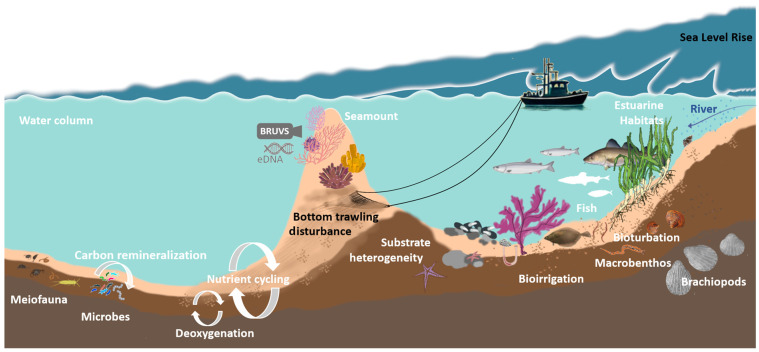 Figure 1
Peer Reviews
No public reviews on file for this paper yet. If you reviewed it on a platform where reviews are public (OpenReview, ICLR, NeurIPS, ICML), you can paste yours below so the community can read it here.
Videos
No videos yet. Explain this paper in a talk, walkthrough, or lecture? Add one.
Taxonomy
TopicsMicrobial Community Ecology and Physiology · Marine Biology and Ecology Research · Coral and Marine Ecosystems Studies
Below the water column depths, marine sediments harbor a vibrant tapestry of life that underpins a variety of ecological balances. From the tiniest microbes to complex multicellular organisms, benthic communities play pivotal roles in nutrient cycling, energy flow, and habitat formation. Understanding these intricate ecosystems is paramount, especially as they face intensive evolutionary fluctuation and natural succession. Changing climate conditions and the increasing influence of other threats from human activities are putting pressure on communities in benthic marine ecosystems and require adaptations within short periods of time.
In this Special Issue, we wanted to delve into the multifaceted world of benthic biodiversity, exploring the dynamic interactions among its diverse communities and their impacts on marine ecosystem functioning. We were lucky to collect 13 articles, totaling 252 pages, that have been co-authored by 65 researchers from 8 countries.
The contributions span a broad spectrum of topics, beginning with microbial communities that form the foundation of benthic ecosystems. Advanced metabarcoding techniques have unveiled the astonishing diversity and versatility of benthic protists, shedding light on their roles in biogeochemical processes and food webs and addressing their resilience to environmental perturbations. Transitioning to meiofauna and macrofauna, several studies investigate species distribution patterns in response to natural gradients and anthropogenic pressures like bottom trawling, sea level rise, or organic and pollutant influences from the river plume, suggesting species that suffer most from these perturbations and spotting those that are tolerant. These findings underscore the sensitivity of benthic organisms to habitat alterations, emphasizing the need for comprehensive monitoring and conservation strategies.
Interdisciplinary approaches featured in this issue highlight the functional interplays between different benthic compartments, but also the need for more integrated assessments. For instance, research on bioturbation and bioirrigation demonstrates how macrofaunal activities enhance microbial processes, facilitating nutrient exchange across the sediment–water interface. Such interactions are crucial for maintaining ecosystem health and productivity. However, establishing robust quantitative relationships to improve predictive capacity remains a challenge.
The contributions in this issue primarily focus on observational and modeling approaches to understand benthic biodiversity distribution and ecosystem functioning (Table 1). Purely experimental studies were unfortunately lacking. We therefore advocate for more of them in the future, as they can reveal not only species-specific responses but also potential cascading effects on community structure and ecosystem services. Such insights remain missing for many organism groups but are vital for predicting future changes and formulating adaptive management plans.
To serve as a quick reference for readers to navigate the diverse topics covered in this Special Issue and to synthesize the wealth of information presented, Table 1 categorizes the 13 published studies based on their focal organism groups (microbes, meiofauna, macrofauna, fish) and methodological approaches (observational, experimental, modeling) and outlines key findings related to ecosystem functions. In conclusion, this compilation of research offers a snapshot of some current advancements in benthic biodiversity studies. It underscores the importance of integrative approaches to unravel the complexities of marine ecosystems and informs strategies for their understanding and preservation amidst a rapidly changing world.
Additionally, Figure 1 illustrates schematically the expected interconnections between different benthic biodiversity components, depicting how microbial, meiofaunal, and macrofaunal interactions might drive or alter essential processes like nutrient cycling, carbon remineralization, deoxygenation, and overall energy transfer.
The reference list from the paper itself. Each links out to its DOI / PubMed record.
- 1Gogina M. Renz J.R. Forster S. Zettler M.L. Benthic Macrofauna Community Bioirrigation Potential (BI Pc): Regional Map and Utility Validation for the South-Western Baltic Sea Biology 202211108510.3390/biology 1107108536101463 PMC 9312502 · doi ↗ · pubmed ↗
- 2Tsikopoulou I. Smith C.J. Papadopoulou K.N. Austen M.C. Linking Species Functional Traits to Specific Biogeochemical Processes under Trawling Pressure Biology 202211137810.3390/biology 1110137836290284 PMC 9598213 · doi ↗ · pubmed ↗
- 3Dixon O. Gammal J. Clark D. Ellis J.I. Pilditch C.A. Estimating Effects of Sea Level Rise on Benthic Biodiversity and Ecosystem Functioning in a Large Meso-Tidal Coastal Lagoon Biology 20231210510.3390/biology 1201010536671797 PMC 9855350 · doi ↗ · pubmed ↗
- 4Miernik N.A. Janas U. Kendzierska H. Role of Macrofaunal Communities in the Vistula River Plume, the Baltic Sea—Bioturbation and Bioirrigation Potential Biology 20231214710.3390/biology 1202014736829426 PMC 9952380 · doi ↗ · pubmed ↗
- 5Zheng S. Zhang T. Tu K. Li L. Liu Z. Wu B. Zhou L. Sun X. Population Genetics of Manila Clam (Ruditapes philippinarum) in China Inferred from Microsatellite Markers Biology 20231255710.3390/biology 1204055737106757 PMC 10135866 · doi ↗ · pubmed ↗
- 6Wu H. Zhang Y. Chen A. Stubbs T.L. A Highly Diverse Olenekian Brachiopod Fauna from the Nanpanjiang Basin, South China, and Its Implications for the Early Triassic Biotic Recovery Biology 20231262210.3390/biology 1204062237106822 PMC 10136273 · doi ↗ · pubmed ↗
- 7Romoth K. Darr A. Papenmeier S. Zettler M.L. Gogina M. Substrate Heterogeneity as a Trigger for Species Diversity in Marine Benthic Assemblages Biology 20231282510.3390/biology 1206082537372109 PMC 10295182 · doi ↗ · pubmed ↗
- 8Istomina A.A. Zhukovskaya A.F. Mazeika A.N. Barsova E.A. Chelomin V.P. Mazur M.A. Elovskaya O.A. Mazur A.A. Dovzhenko N.V. Fedorets Y.V. The Relationship between Lifespan of Marine Bivalves and Their Fatty Acids of Mitochondria Lipids Biology 20231283710.3390/biology 1206083737372122 PMC 10294809 · doi ↗ · pubmed ↗