Evaluating potential impact of monoamine oxidase A missense L32S on the function of the enzyme monoamine oxidase A using in silico prediction tools and molecular modeling
Jared Laughlin, Cynthia L Stenger, Hanna J Jefcoat

TL;DR
This study examines how a specific genetic change in the MAOA enzyme might contribute to ADHD by using computational tools and modeling.
Contribution
The study provides new evidence for the pathogenicity of the L32S missense variant in monoamine oxidase A.
Findings
In silico tools suggest the L32S variant is pathogenic.
Molecular dynamics modeling supports functional impact of the L32S mutation.
The variant affects the FAD-binding domain of monoamine oxidase A.
Abstract
Attention-deficit hyperactivity disorder (ADHD) is a neurodevelopmental disorder that affects 6-7% of people worldwide (Wilcutt, 2012). MAOA is a gene that encodes monoamine oxidase A, an enzyme responsible for the regulation and metabolism of monoamines thought to be associated with ADHD. This study investigates a leucine to serine swap at amino acid position 32 in FAD-binding domain of the enzyme monoamine oxidase A. Results from in silico prediction tools and molecular dynamics modeling provide evidence to support pathogenicity of the L32S missense variant of monoamine oxidase A.
Genes, proteins, chemicals, diseases, species, mutations and cell lines named across the full text — each resolved to its canonical identifier and authoritative record.
Click any figure to enlarge with its caption.
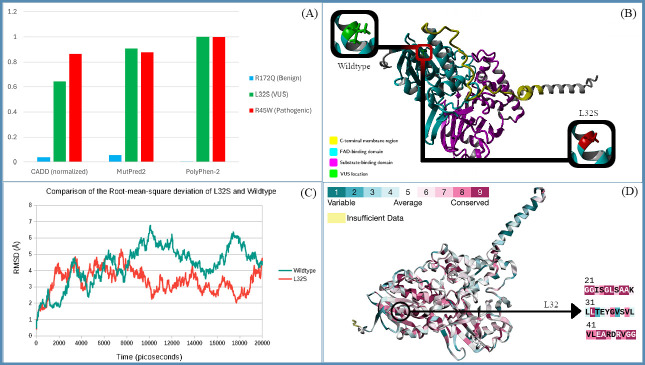 Figure 1
Peer Reviews
No public reviews on file for this paper yet. If you reviewed it on a platform where reviews are public (OpenReview, ICLR, NeurIPS, ICML), you can paste yours below so the community can read it here.
Videos
No videos yet. Explain this paper in a talk, walkthrough, or lecture? Add one.
Taxonomy
TopicsBiotin and Related Studies
Description
Monoamine oxidase A catalyzes the oxidative deamination of monoamines. Monoamine oxidase A is expressed alongside monoamine oxidase B in most human tissues. It’s most abundant in the small intestine but is also expressed in the brain. Monoamine oxidase A is expressed in catecholaminergic neurons, where it metabolizes catecholamines such as norepinephrine and dopamine (Shih et al., 2004). Monoamine oxidase A catalyzes the first step in the processes of metabolism and excretion of catecholamines. Treatments for attention-deficit hyperactivity disorder (ADHD) target catecholamine systems in the brain, and ADHD is thought to be related to dysfunction in these catecholamine systems (Arnsten et al., 2011). Since monoamine oxidase A is expressed in these same neural circuits and impacts catecholamine concentrations in neurons, a variant in monoamine oxidase A could potentially contribute to the pathophysiology of ADHD.
One example of how monoamine oxidase A could contribute to the pathophysiology of ADHD is related to the high prevalence of substance use disorders (SUDs) in individuals with ADHD. Individuals with ADHD are much more likely to suffer from SUDs than non-ADHD individuals (Choi et al., 2022). SUDs are mediated by dopaminergic activity in the nucleus accumbens (Gardner, 2011). This is especially interesting as monoamine oxidase A is very highly expressed in the nucleus accumbens, where it degrades monoamines like dopamine (Kolla et al., 2020). Despite their reinforcing properties, catecholaminergic drugs used to treat ADHD reduce the risk of developing SUDs in individuals with ADHD and do not worsen existing SUDs (Hammerness et al., 2017; Levy et al., 2014; Wilens et al., 2003).
The leucine to serine swap at amino acid position 32 (L32S) has higher predicted pathogenicity scoring than both the selected benign and pathogenic variants for PolyPhen-2, and MutPred2, and L32S had a higher predicted pathogenicity score than the selected benign variant for CADD ( Figure 1A ) (Schubach et al., 2024; Adzhubei et al., 2010; Pejaver et al., 2020). The residue found in position 32 is very highly conserved according to the ConSurf server, with a conservation grade of 9/9 (Yariv et al., 2023; Landau et al., 2005). The residue is also located in the flavin adenine dinucleotide (FAD)-binding domain ( Figure 1B ). FAD is a redox active cofactor associated with monoamine oxidase A. The non-polar to polar swap from leucine to serine within the FAD-binding domain may alter the binding of this coenzyme to monoamine oxidase A, due to the abundance of polar bonds in the structure of FAD (National Center for Biotechnology Information, 2025). This variant also involves swapping a helix former, leucine, to a helix breaker, serine, on an alpha helix (Lewis, 1970). This can compromise the structural integrity of the protein and significantly alter the interaction between monoamine oxidase A and its environment. It is not currently known what structural effects this could have on the binding pocket of the enzyme. Although the swap occurred at position 32, the model shows consequential shifting throughout the sequence. The RMSD ( Figure 1C ) shows a stark divergence between the wildtype and the L32S variant.
Methods
MAOA is one of the few genes known to be associated with metabolism of catecholamines. Monoamine oxidase A was chosen for study because of the wide variety of pharmaceutical drugs known to interact with this enzyme, opening up the possibility of future medical applications of this research. A variant of unknown significance (VUS) from MAOA L32S was chosen by comparing normalized scores from various pathogenicity predictors ( Figure 1A ). Using the ConSurf server, L32 was found to be highly evolutionarily conserved when compared to its homologues ( Figure 1D ) (Yariv et al., 2023; Landau et al., 2005). Slow homology models of the wildtype and variant proteins were constructed from a FASTA (P21397) sequence retrieved from UniProt. Using these homology models, molecular dynamics simulations were run using YASARA protein modeling to assess how the variant affects protein functionality. Molecular dynamics simulations model the movement of a protein in an aqueous environment over a period of 20000 picoseconds.
The reference list from the paper itself. Each links out to its DOI / PubMed record.
- 1Adzhubei IA Schmidt S Peshkin L Ramensky VE Gerasimova A Bork P Kondrashov AS Sunyaev SR 201041 A method and server for predicting damaging missense mutations.Nat Methods 741548-709124824910.1038/nmeth 0410-24820354512 PMC 2855889 · doi ↗ · pubmed ↗
- 2Arnsten AF Pliszka SR 201122 Catecholamine influences on prefrontal cortical function: relevance to treatment of attention deficit/hyperactivity disorder and related disorders.Pharmacol Biochem Behav 9920091-305721121610.1016/j.pbb.2011.01.02021295057 PMC 3129015 · doi ↗ · pubmed ↗
- 3Choi WS Woo YS Wang SM Lim HK Bahk WM 2022114 The prevalence of psychiatric comorbidities in adult ADHD compared with non-ADHD populations: A systematic literature review.P Lo S One 1711 e 0277175 e 027717510.1371/journal.pone.027717536331985 PMC 9635752 · doi ↗ · pubmed ↗
- 4Gardner EL 2011419 Addiction and brain reward and antireward pathways.Adv Psychosom Med 300065-3268226010.1159/00032406521508625 PMC 4549070 · doi ↗ · pubmed ↗
- 5Gay Carter Watford Shelby Johnson Eric B 202494 Comparison of Variants of Uncertain Significance in Three Regions of the Human Glucokinase Protein Using In Vitro and In Silico Analyses Cureus 2168-818410.7759/cureus.68638 PMC 1145236139371753 · doi ↗ · pubmed ↗
- 6Hammerness P Petty C Faraone SV Biederman J 2016728 Do Stimulants Reduce the Risk for Alcohol and Substance Use in Youth With ADHD? A Secondary Analysis of a Prospective, 24-Month Open-Label Study of Osmotic-Release Methylphenidate.J Atten Disord 2111087-0547717710.1177/108705471246805123264367 · doi ↗ · pubmed ↗
- 7Kolla NJ Bortolato M 2020620 The role of monoamine oxidase A in the neurobiology of aggressive, antisocial, and violent behavior: A tale of mice and men.Prog Neurobiol 1940301-008210187510187510.1016/j.pneurobio.2020.10187532574581 PMC 7609507 · doi ↗ · pubmed ↗
- 8Landau M Mayrose I Rosenberg Y Glaser F Martz E Pupko T Ben-Tal N 200571 Con Surf 2005: the projection of evolutionary conservation scores of residues on protein structures.Nucleic Acids Res 33Web Server issue 0305-1048 W 299W 30210.1093/nar/gki 37015980475 PMC 1160131 · doi ↗ · pubmed ↗