Positive susceptibility‐based contrast imaging with dephased balanced steady‐state free precession
Jonas Frederik Faust, Peter Speier, Axel Joachim Krafft, Sunil Patil, Ravi Teja Seethamraju, Mark E. Ladd, Florian Maier

TL;DR
This paper introduces a new MRI technique called d-bSSFP that improves the visibility of metallic devices in scans.
Contribution
The novel contribution is a signal model for d-bSSFP that explains and enhances positive contrast artifacts for better device visualization.
Findings
The d-bSSFP model accurately predicts artifact size with less than 1 mm error.
d-bSSFP artifacts show higher signal magnitude and symmetry compared to d-FLASH and d-SSFP.
d-bSSFP is more robust against banding artifacts than d-SSFP.
Abstract
Dephasing gradients can be introduced within a variety of gradient‐echo pulse sequences to delineate local susceptibility changes (“White‐Marker” phenomenon), e.g., for the visualization of metallic interventional devices which are otherwise difficult to display. We investigated dephased balanced steady‐state free precession (d‐bSSFP) and compared it with similar contrast techniques: dephased RF‐spoiled fast low‐angle shot (d‐FLASH) and dephased steady‐state free precession (d‐SSFP). A signal model was formulated to describe the positive contrast in d‐bSSFP. For the example of an MR‐compatible aspiration needle, the positive contrast artifact appearance was theoretically derived, and the model was verified in a water phantom at B0 = 0.55 T. Model accuracy was evaluated by comparing the measured artifact size (for TEs between 3.4 ms and 50 ms) and the signal magnitude to the model…
Genes, proteins, chemicals, diseases, species, mutations and cell lines named across the full text — each resolved to its canonical identifier and authoritative record.
Click any figure to enlarge with its caption.
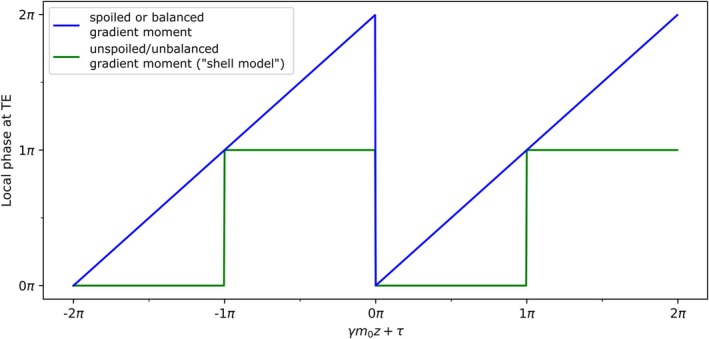 Figure 1
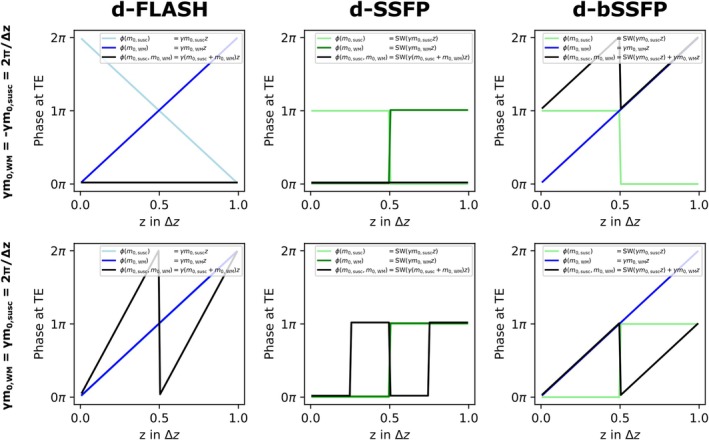 Figure 2
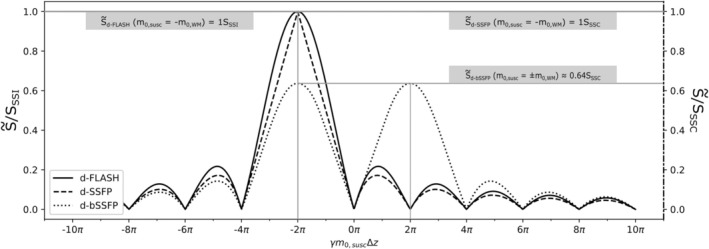 Figure 3
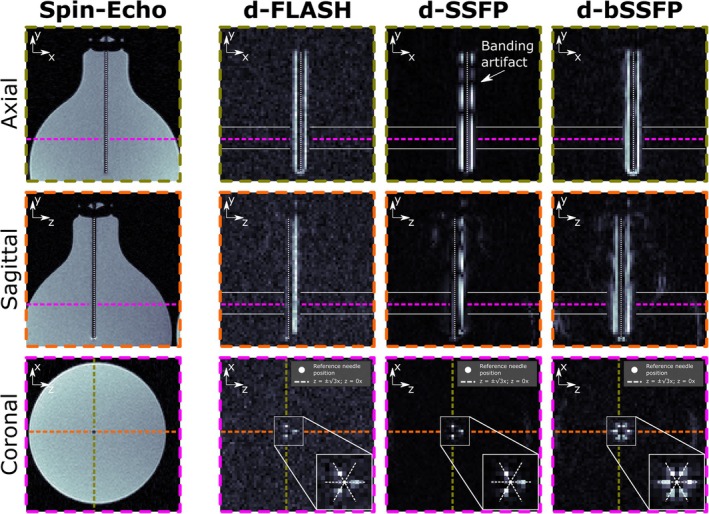 Figure 4
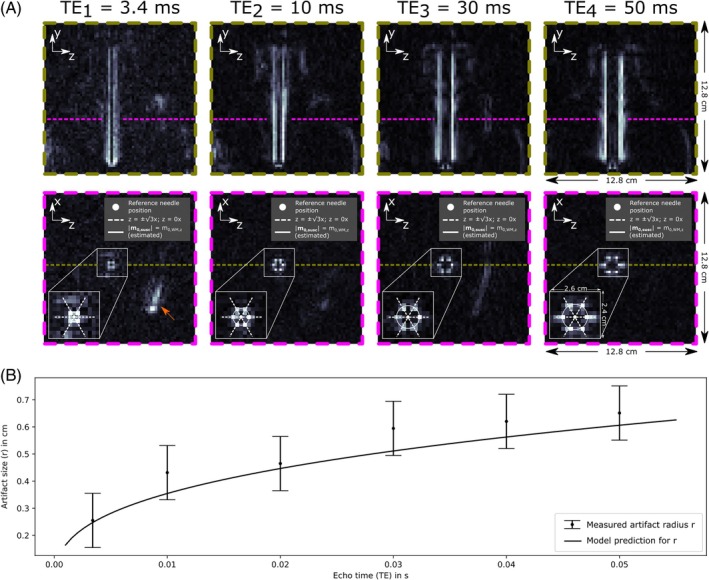 Figure 5
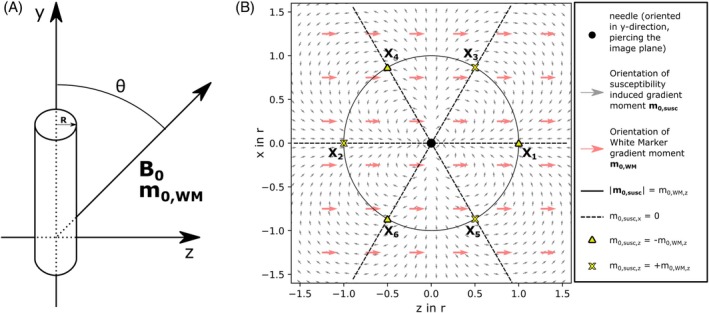 Figure 6
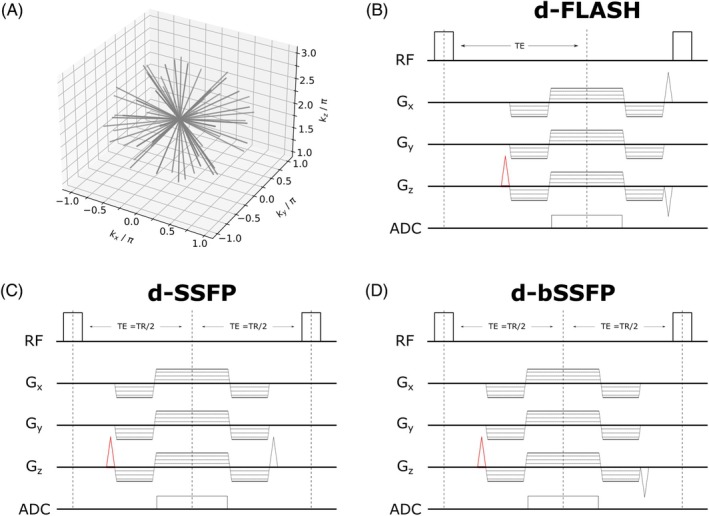 Figure 7
Peer Reviews
No public reviews on file for this paper yet. If you reviewed it on a platform where reviews are public (OpenReview, ICLR, NeurIPS, ICML), you can paste yours below so the community can read it here.
Videos
No videos yet. Explain this paper in a talk, walkthrough, or lecture? Add one.
Taxonomy
TopicsAdvanced MRI Techniques and Applications · Photoacoustic and Ultrasonic Imaging · Atomic and Subatomic Physics Research