Reconstruction of the On-Top Two-Electron Density from Natural Orbitals and Their Occupation Numbers
Jerzy Cioslowski, Krzysztof Strasburger

TL;DR
This paper shows how to reconstruct the on-top two-electron density using natural orbitals and their occupation numbers, offering a new way to validate electronic structure theories.
Contribution
A novel method to reconstruct the on-top two-electron density from natural orbitals and their occupation numbers is introduced.
Findings
Spatial derivatives of natural orbitals at nodal surfaces encode information about the on-top two-electron density.
The reconstruction becomes exact with an infinite number of nodal surfaces and a multiplicative constant derived from NOs and their occupation numbers.
This method provides a new consistency check for electronic structure formalisms using natural orbitals.
Abstract
Spatial derivatives of the natural orbitals (NOs) at their nodal surfaces are shown to encode information about the on-top two-electron density Φ2(r⃗) in an approximate manner. This encoding, which becomes exact at the limit of an infinite number of nodal surfaces, allows the reconstruction of Φ2(r⃗) up to a multiplicative constant that can be retrieved from an identity involving the NO in question and its occupation number. This reconstruction provides a new consistency check for electronic structure formalisms, such as the one-electron reduced density matrix theory, that employ NOs as primary quantities.
Genes, proteins, chemicals, diseases, species, mutations and cell lines named across the full text — each resolved to its canonical identifier and authoritative record.
Click any figure to enlarge with its caption.
 Figure 1
 Figure 2
 Figure 3
 Figure 4
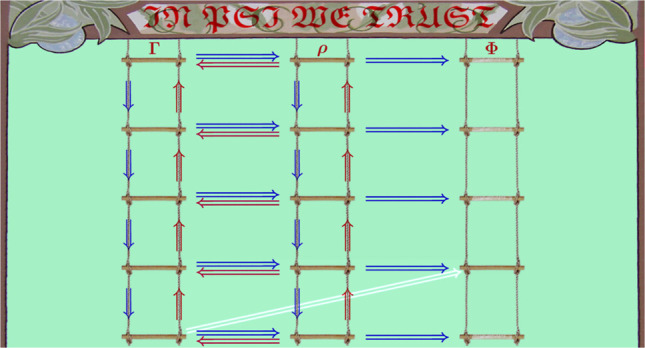 Figure 5
 Figure 6
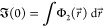 Figure 7
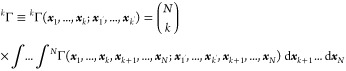 Figure 8
 Figure 9
 Figure 10
 Figure 11
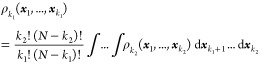 Figure 12
 Figure 13
 Figure 14
 Figure 15
 Figure 16
 Figure 17
 Figure 18
 Figure 19
 Figure 20
 Figure 21
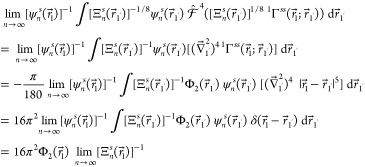 Figure 22
 Figure 23
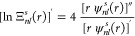 Figure 24
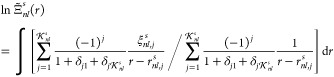 Figure 25
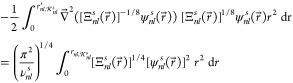 Figure 26
Peer Reviews
No public reviews on file for this paper yet. If you reviewed it on a platform where reviews are public (OpenReview, ICLR, NeurIPS, ICML), you can paste yours below so the community can read it here.
Videos
No videos yet. Explain this paper in a talk, walkthrough, or lecture? Add one.
Taxonomy
TopicsAdvanced Chemical Physics Studies · Electron and X-Ray Spectroscopy Techniques · Inorganic Fluorides and Related Compounds